Evolution … Changes

Evolution and Changes: Navigating Through Transformation

Overview:

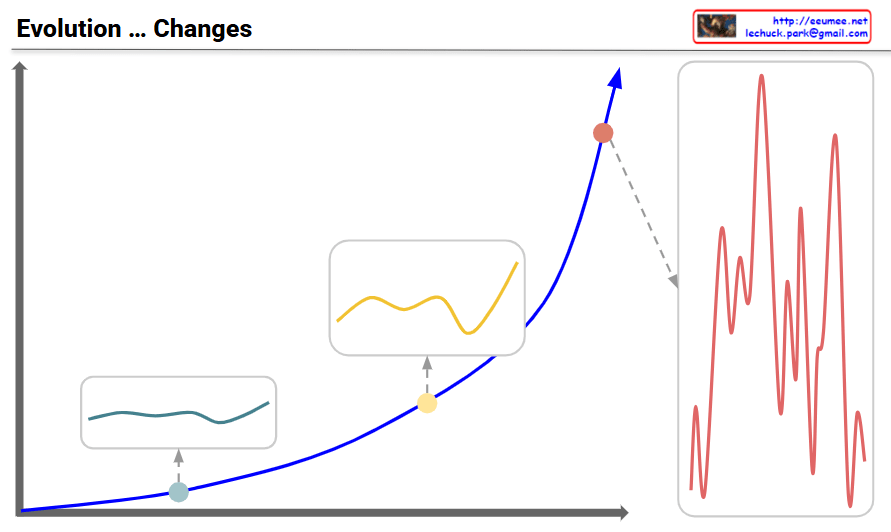
Main Graph (Blue Curve)

  • Shows the pattern of evolutionary change transitioning from gradual growth to exponential acceleration over time
  • Three key developmental stages are marked with distinct points

Three-Stage Development Process:

Stage 1: Initial Phase (Teal point and box – bottom left)

  • Very gradual and stable changes
  • Minimal volatility with a flat curve
  • Evolutionary changes are slow and predictable
  • Response Strategy: Focus on incremental improvements and stable maintenance

Stage 2: Intermediate Phase (Yellow point and box – middle)

  • Fluctuations begin to emerge
  • Volatility increases but remains limited
  • Transitional period showing early signs of change
  • Response Strategy: Detect change signals and strengthen preparedness

Stage 3: Turbulent Phase (Red point and box on right – top)

  • Critical turning point where exponential growth begins
  • Volatility maximizes with highly irregular and large-amplitude changes
  • The red graph on the right details the intense and frequent fluctuations during this period
  • Characterized by explosive and unpredictable evolutionary changes
  • Response Imperative: Rapid and flexible adaptation is essential for survival in the face of high volatility and dramatic shifts

Key Message:

Evolution progresses through stable initial phases → emerging changes in the intermediate period → explosive transformation in the turbulent phase. During the turbulent phase, volatility peaks, making the ability to anticipate and actively respond critical for survival and success. Traditional stable approaches become obsolete; rapid adaptation and innovative transformation become essential.


#Evolution #Change #Transformation #Adaptation #Innovation #DigitalTransformation

With Claude

From Stability to Turbulence: Why Smart Operations Matter Most

History always alternates between periods of stability and turbulence. In turbulent times, management and operations become critical, since small decisions can determine survival. This shift mirrors the move from static, stability-focused maintenance to agile, data-driven, and adaptive operations.

#PhilosophyShift #DataDriven #AdaptiveOps #AIDataCenter #ResilientManagement #StabilityToAgility

New Era of Digitals

This image presents a diagram titled “New Era of Digitals” that illustrates the evolution of computing paradigms.

Overall Structure:

The diagram shows a progression from left to right, transitioning from being “limited by Humans” to achieving “Everything by Digitals.”

Key Stages:

  1. Human Desire: The process begins with humans’ fundamental need to “wanna know it clearly,” representing our desire for understanding and knowledge.
  2. Rule-Based Era (1000s):
    • Deterministic approach
    • Using Logics and Rules
    • Automation with Specific Rules
    • Record with a human recognizable format
  3. Data-Driven Era:
    • Probabilistic approach (Not 100% But OK)
    • Massive Computing (Energy Resource)
    • Neural network-like structures represented by interconnected nodes

Core Message:

The diagram illustrates how computing has evolved from early systems that relied on human-defined explicit rules and logic to modern data-driven, probabilistic approaches. This represents the shift toward AI and machine learning, where we achieve “Not 100% But OK” results through massive computational resources rather than perfect deterministic rules.

The transition shows how we’ve moved from systems that required everything to be “human recognizable” to systems that can process and understand patterns beyond direct human comprehension, marking the current digital revolution where algorithms and data-driven approaches can handle complexity that exceeds traditional rule-based systems.

With Claude