New BIZ ?

From DALL-E with some prompting
This diagram explains the process of finding new business opportunities from the perspective of digital transformation. The first step, ‘Digitization,’ involves converting real-world information into digital data while ensuring data quality. The next step, ‘Digitalization,’ extends the use of digital data to enhance automated processes. By executing these two steps, new opportunities can be discovered, and through ‘Digital Transformation,’ these discoveries can be converted into actual innovations. Overall, this process presents a methodology for leveraging digital technology to innovate business models and create new value.
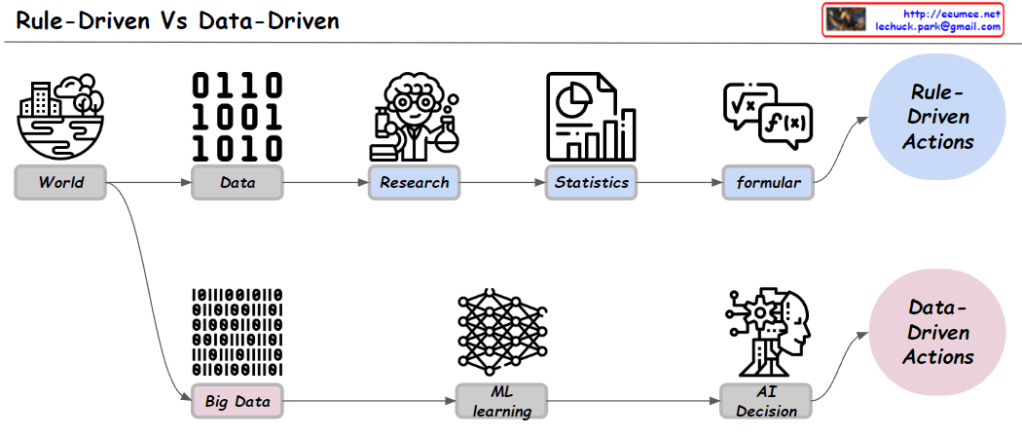
Rule-Driven Vs Data-Driven

From the Bard with some prompting

Rule-based and data-driven systems are two different approaches to artificial intelligence (AI).

Data-driven systems make decisions based on data. For example, a data-driven system could be used to recommend products to customers based on their purchase history.

Here is a summary of the key differences between rule-based and data-driven systems:

  • Decision-making process: Rule-based systems use if-then rules, while data-driven systems use data.
  • Examples: Rule-based systems can be used for simple tasks, such as turning on a fan. Data-driven systems can be used for more complex tasks, such as recommending products to customers.
  • Strengths: Rule-based systems are simple and easy to understand. Data-driven systems are accurate.
  • Weaknesses: Rule-based systems can be difficult to adapt to new situations. Data-driven systems can be inaccurate if data is insufficient.

In conclusion, rule-based systems are simple and easy to understand, but they can be difficult to adapt to new situations. Data-driven systems are accurate, but they can be inaccurate if data is insufficient.

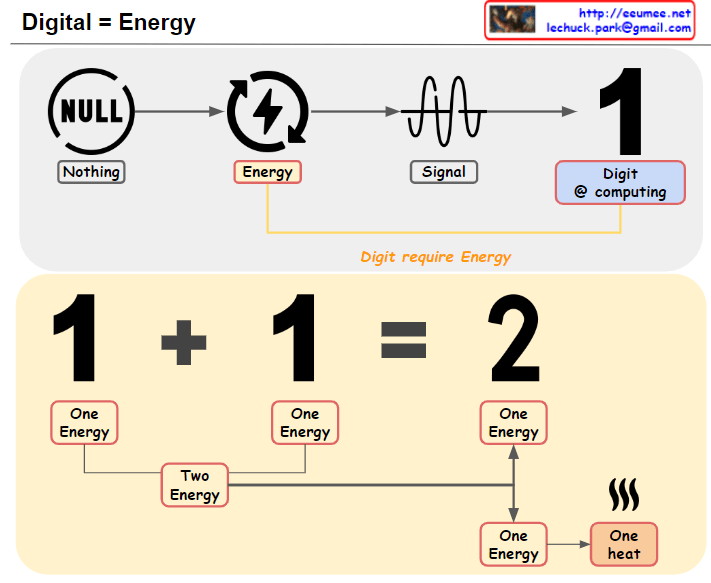
Digital = Energy

From DALL-E with some prompting
this image illustrates the concept that “Digital equals Energy.” The first row shows the transformation from ‘NULL’, which represents nothingness, into a signal through energy, and then into a digital ‘1’ for computing. The second row demonstrates that digital operations require energy by showing that adding ‘1’ and ‘1’ results in ‘2’, with each ‘1’ requiring a unit of energy and the process generating heat, indicating energy loss.

A probability world

From DALL-E with some prompting
The image explores how human decision-making has evolved from data analysis to probabilistic judgments. Initially, rules derived from data led to definitive decisions, but with the advent of AI, we have returned to probabilistic decision-making. The phrases at the top suggest that the real world may be inherently probabilistic and that humans still lack complete knowledge of the quantum realm.

Digital Service

From DALL-E with some prompting
The image outlines the workflow and components of digital data services. It begins with data collection from various sources, which is then subjected to a verification process to ensure its integrity. The verified data is stored in a database and undergoes the ETL process (Extract, Transform, Load) to be formatted appropriately for analysis. This data is visualized to facilitate insightful analysis, which then feeds into an AI learning process. The outcomes of this analysis are applied in the service stage where established processes are confirmed and automation tools are implemented to deliver the final service. The AI model, refined by learning from the data, plays a critical role in enhancing the precision and efficiency of the service provided.

Digitization

From DALL-E with some prompting
The image illustrates the concept of digitization. It shows an analog signal being converted into a digital format, represented by a sequence of binary numbers. The process emphasizes the importance of accuracy and precision in digitization, noting that even small errors in digitizing the signal can lead to significant computing errors. Therefore, maintaining high accuracy and precision is marked as important to ensure the integrity of the huge computing tasks that rely on the digitized data. 

IF/THEN with AI/DT

From DALL-E with some prompting
The image depicts the evolution of decision-making processes from manual to automated, facilitated by AI and Digital Transformation (DT). Initially, decisions were made by humans based on specific conditions (IF condition THEN action). This manual approach did not involve computing. With DT, the process becomes automated through computing, making it faster and more efficient. The transition to AI and Machine Learning (ML) marks a further evolution where decisions are not just automated but are also data-driven, increasing accuracy and the ability to adapt to complex situations. The visual suggests a shift from human-based decision-making to a more sophisticated, automated, and intelligent system of processing and action-taking, indicative of modern advancements in technology.