NTP

From DALL-E with some prompting
The image appears to be a visual explanation of the Network Time Protocol (NTP). At the top, there’s a title, “Network Time Protocol,” and below it, there are icons arranged along a line that seems to represent servers, energy symbols, a thermometer, a surveillance camera, and storage devices. These icons are connected by arrows, indicating the flow of synchronization signals for time.

Below these icons, there are two messages. The first message says, “Sync Time of data from all connected Machine,” suggesting the synchronization of time across data from all connected devices. The second message reads, “sequence of events and causal relationship,” referring to the order of events and their causality. Underneath this message, icons representing the universe, Earth, a forest, and a group of people are displayed, which likely denote the concept of “Universal Time.”

Overall, the image emphasizes the importance of using Network Time Protocol to synchronize time across various devices and systems, accurately recording the sequence and causality of events, and maintaining consistent universal time globally. There’s an email address displayed in the top right corner of the image, but personal identity information cannot be shared.

Requires for DL

From DALL-E with some prompting
The image outlines the importance of data in the era of deep learning (DL). It starts with “Data,” representing various sources and types, which feeds into “Deep Learning,” depicted by a neural network diagram. The process leads to “Result,” symbolized by charts and graphs indicating the output or findings. The central message, “Data determines the results,” stresses that the quality of data significantly impacts the outcome of deep learning processes. Below, “Data Verification” suggests the need for ensuring data accuracy, which ties into the cycle of “UPDATE” and “Analysis,” highlighting an iterative process to refine and improve deep learning applications. The phrase “What to deal with DL” hints at the challenges and considerations in managing and utilizing deep learning effectively.

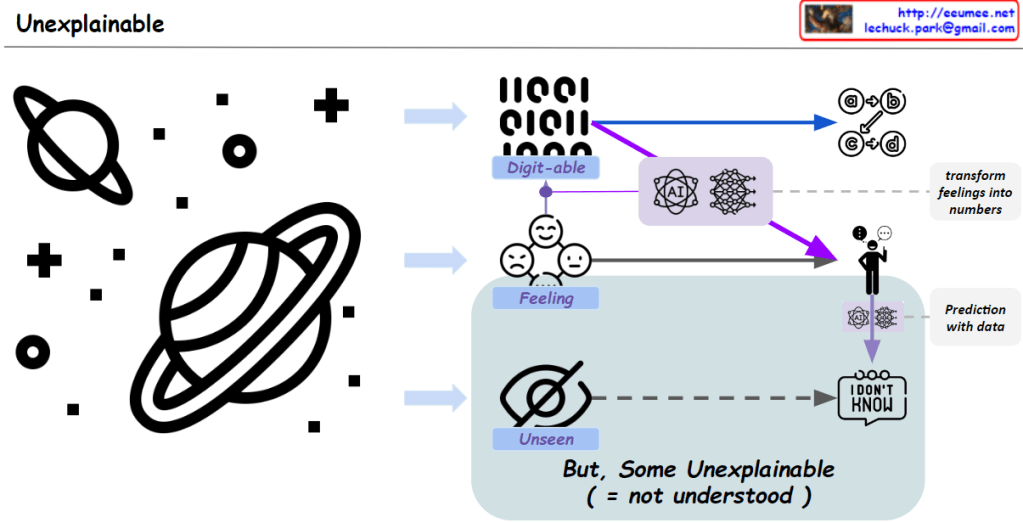
Unexplainable

From DALL-E with some prompting
The image intends to explain two critical perspectives of AI/ML. First, it illustrates that while traditionally digitalized data was defined by rules, AI/ML enables us to judge human ‘feelings’ as data based on a more extensive dataset. Second, AI/ML allows for the prediction of the future using data; however, some parts of these significant advancements remain unexplainable and difficult for humans to comprehend fully. This interpretation suggests that while AI aims to quantify and use non-visible elements like emotions for predictions through data standardization and optimized processing, there are aspects that cannot be fully articulated or understood.

Data Standardization

From DALL-E with some prompting
The image emphasizes the importance of data quality in the digital transformation of large-scale operations. By securing “Data Quality” through data standardization, optimized operations based on verified data enable reliable decision-making, monitoring, and optimization. AI-enhanced analysis and optimization accelerate business transformation, drive data-led innovation, and achieve sustainable operation and customer satisfaction.

  1. Data Standardization: Emphasizes the importance of “Data Quality,” indicating that high-quality, standardized data is foundational.
  2. Operation based on verified data/system: Shows the use of verified data to ensure reliable decision-making, monitoring, and optimization, leading to sustainable operations, business intelligence, and customer satisfaction.
  3. Accelerating (AI) digital business transformation: Describes how optimized and customized processing, along with an AI data analysis platform, can accelerate digital transformation. This leads to work automation, user customization, resource optimization, data-driven innovation, AI predictions and analytics, and expanding standardization.

The overall message suggests that standardizing data quality is crucial for building AI systems that can drive digital transformation and improve business operations and customer satisfaction.

DT for new biz

From DALL-E with some prompting
The image is a diagram that illustrates the process of digital transformation for discovering new business opportunities through the digitization of data center operations. The stages included are as follows:

  1. Digitization: The initial step of converting data into digital form.
  2. Digitalization: The process of enhancing operational know-how and creating new value through the experience and analysis with AI, as indicated by the phrases “Exp & Analysis with AI” and “Selling EXP and more!!”.
  3. Digital Transformation: The stage where insights and ideas gained from digitalization are actualized into new business changes.

At the bottom of the diagram, the phrase “All New for DC By Digital(data)” is accompanied by four boxes labeled Design, Deployment, Operating, and Customer. This indicates that all components of business operations are undergoing new changes based on digital data. The “NEW” marker emphasizes the new business opportunities that arise through digital transformation.

The diagram visually explains how transforming existing data into a digital format and using technologies like AI for analysis can improve operational knowledge and, as a result, generate and implement new business ideas. It specifically highlights that digital transformation in data center operations can provide opportunities for uncovering new business ventures.

Road to “the new”

From DALL-E with some prompting

The image visually explains the process of creating new ideas and innovations. Each stage is as follows:

Experience: The icon represents human experiences.
Digitization: The process of converting experiences into digital data.
Data: The digitized information.
AI/ML (Artificial Intelligence/Machine Learning): Technologies that analyze and learn from the data.
Accelerator: Represents the acceleration of the analysis and learning process through AI/ML.
Analysis: The process of analyzing data to extract useful insights.
Idea: The emergence of new ideas from data analysis. The phrase “Easy to Get” indicates that this process has become more accessible.
New: Two text icons depicting the implementation of new ideas into innovative products or services.


The image illustrates the flow of digitizing experiences into data, using AI/ML to analyze and accelerate this data, easily obtaining new ideas, and transforming them into new innovations.

Unknown conditions

From DALL-E with some prompting
The image conveys that the response to external conditions and the infinite number of conditions that humans cannot precisely analyze is becoming possible through Artificial Intelligence (AI), especially deep learning. The top part represents the traditional programming approach, where predefined actions are executed given known conditions, as indicated by the “if (conditions) then (actions)” code snippet and the “100% analyzed” phrase, highlighting the need for conditions to be fully analyzed. In contrast, the bottom part illustrates how AI, even with unknown conditions, can learn from data and autonomously determine appropriate actions. Data-driven AI actions suggest the capability to recognize complex patterns and make autonomous decisions, demonstrating the potential of deep learning technologies to go beyond human analysis in various contexts.