Processing UNIT

From DALL-E With some prompting

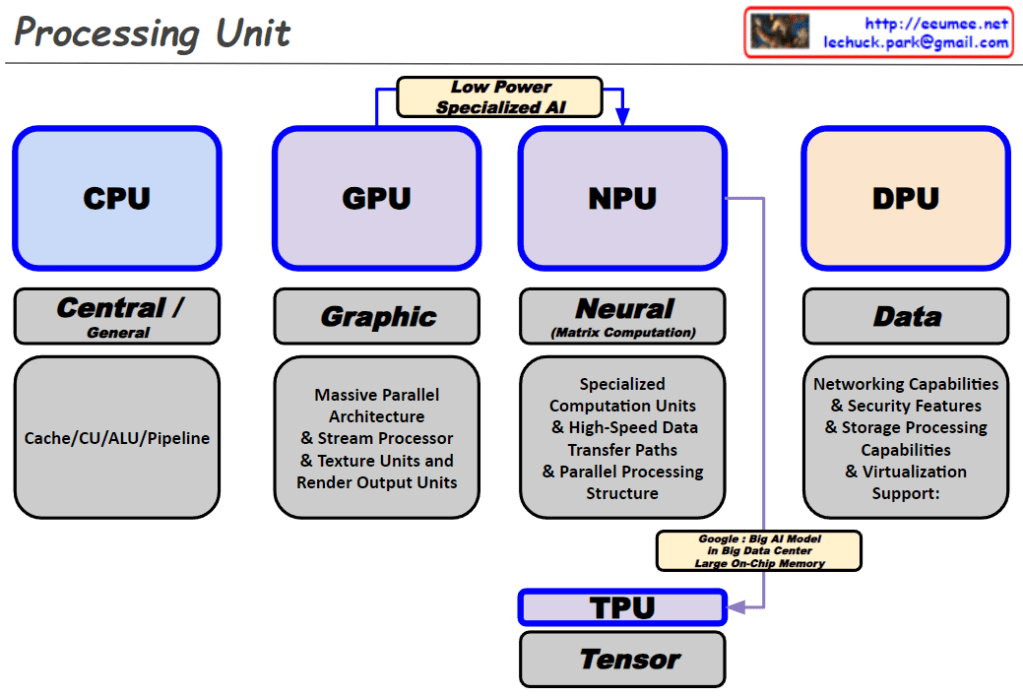
Processing Unit

  • CPU (Central Processing Unit): Central / General
    • Cache/Control Unit (CU)/Arithmetic Logic Unit (ALU)/Pipeline
  • GPU (Graphics Processing Unit): Graphic
    • Massive Parallel Architecture
    • Stream Processor & Texture Units and Render Output Units
  • NPU (Neural Processing Unit): Neural (Matrix Computation)
    • Specialized Computation Units
    • High-Speed Data Transfer Paths
    • Parallel Processing Structure
  • DPU (Data Processing Unit): Data
    • Networking Capabilities & Security Features
    • Storage Processing Capabilities
    • Virtualization Support
  • TPU (Tensor Processing Unit): Tensor
    • Tensor Cores
    • Large On-Chip Memory
    • Parallel Data Paths

Additional Information:

  • NPU and TPU are differentiated by their low power, specialized AI purpose.
  • TPU is developed by Google for large AI models in big data centers and features large on-chip memory.

The diagram emphasizes the specialized nature of NPU and TPU for AI tasks, highlighting their low power consumption and specialized computation capabilities, particularly for neural and tensor computations. It also contrasts these with the more general-purpose capabilities of CPUs and the graphic processing orientation of GPUs. DPU is presented as specialized for handling data-centric tasks involving networking, security, and storage in virtualized environments.
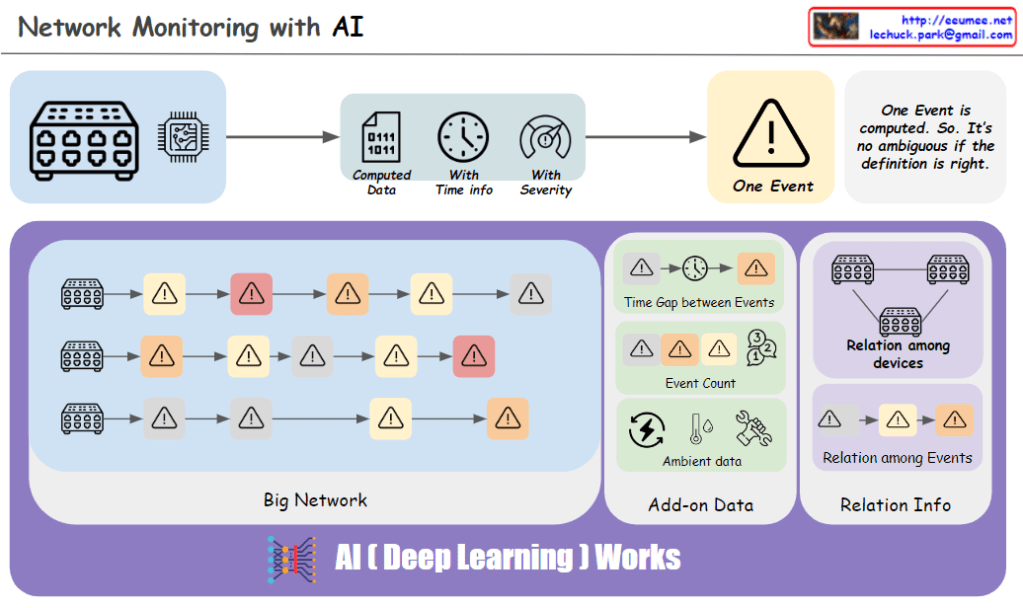
Network Monitoring with AI

from DALL-E with some prompting
The image portrays a network monitoring system enhanced by AI, specifically utilizing deep learning. It shows a flow from the network infrastructure to the identification of an event, characterized by computed data with time information and severity. The “One Event” is clearly defined to avoid ambiguity. The system identifies patterns such as the time gap between events, event count, and relationships among devices and events, which are crucial for a comprehensive network analysis. AI deep learning algorithms work to process additional data (add-on data) and ambient data to detect anomalies and support predictive maintenance within the network.

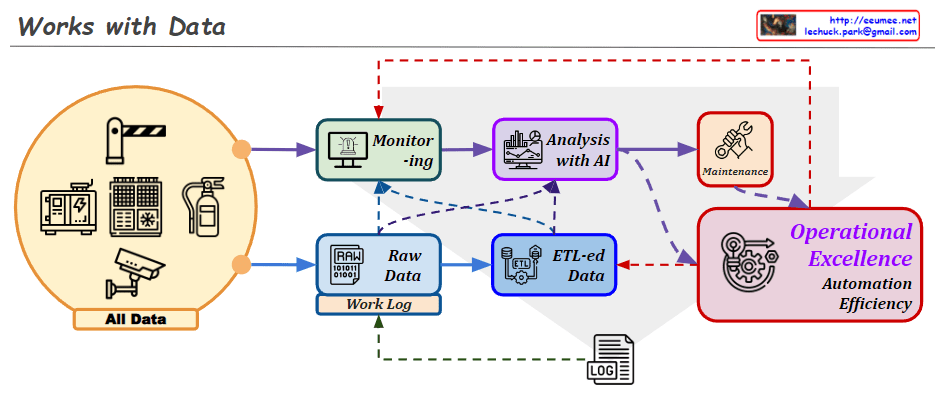
Works with data

From DALL-E with some prompting
The image describes a data workflow process that involves various stages of data handling and utilization for operational excellence. “All Data” from diverse sources feeds into a monitoring system, which then processes raw data, including work logs. This raw data undergoes ETL (Extract, Transform, Load) procedures to become structured “ETL-ed Data.” Following ETL, the data is analyzed with AI to extract insights and inform decisions, which can lead to actions such as maintenance. The ultimate goal of this process is to achieve operational excellence, automation, and efficiency.

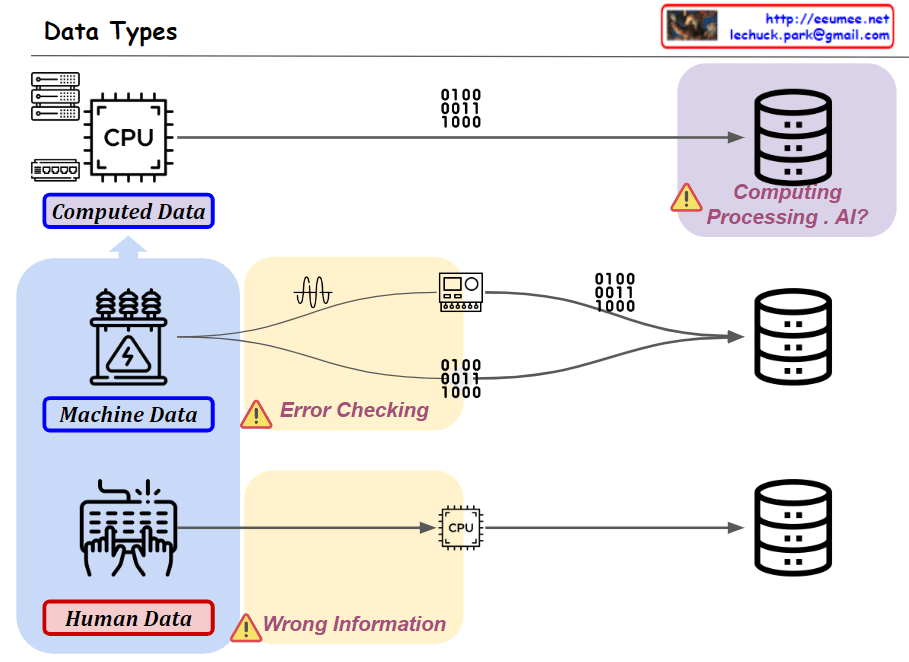
Data types

From DALL-E with some prompting
The image classifies data types and emphasizes the need for verification and response to potential errors for each type.

Computed Data: Processed by the CPU, with an implication of potential issues during computing or AI processing before storage.
Machine Data: Originating from machines or sensors, requiring error checking before storage, and awareness of possible errors.
Human Data: Entered by humans, needing verification due to the potential inclusion of wrong information, and awareness of errors.
This classification underlines the importance of ensuring accuracy in data processing and the need to be aware of and respond to potential errors.

Statistics ?

From DALL-E with some prompting
The image presents an exploration of perspectives in the context of big data and AI. “Subjective” reflects personal perception, while “Objective” shows a fact-based approach, though limited. “Statistics” introduces a big data-based AI perspective, offering a nearly complete yet unlimited framework for interpretation and judgment. This new perspective highlights the need for fresh terminology and concepts to navigate the advanced analytical landscape shaped by AI, suggesting an evolution from traditional subjective and objective paradigms to a more nuanced, data-centric approach.

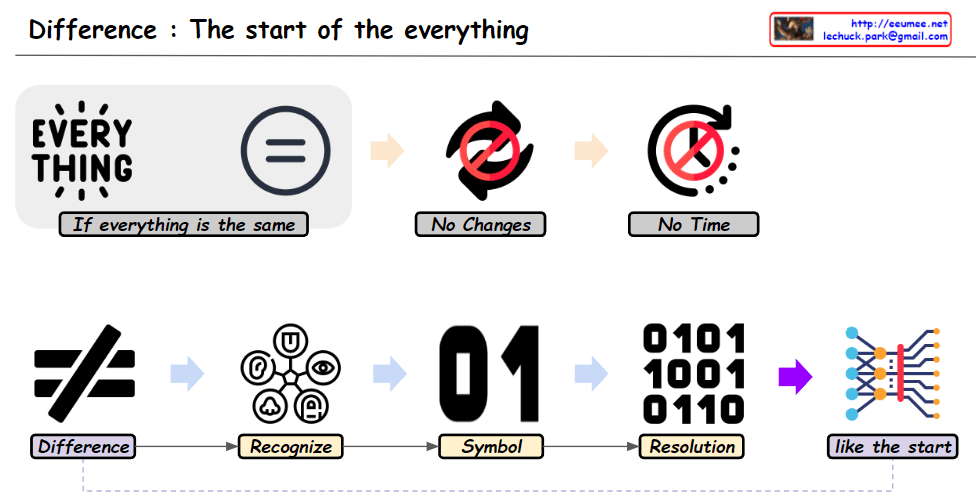
Difference

From DALL-E with some prompting
The image represents how AI approaches differences using infinite computing power, akin to recognizing the initial differences that sparked evolution. It shows that without variation (“EVERYTHING” icon), there is no concept of change or time, but differences lead to recognition (“Recognition”), which evolves into symbolization (“Symbol”) and understanding through resolution (“Resolution”). As complexities grow, so does our interpretative capacity, and now AI retraces the evolutionary journey back to the beginning. Through the human process of creating numbers and adding complex interpretations, AI now comprehends the initial differences that started it all.

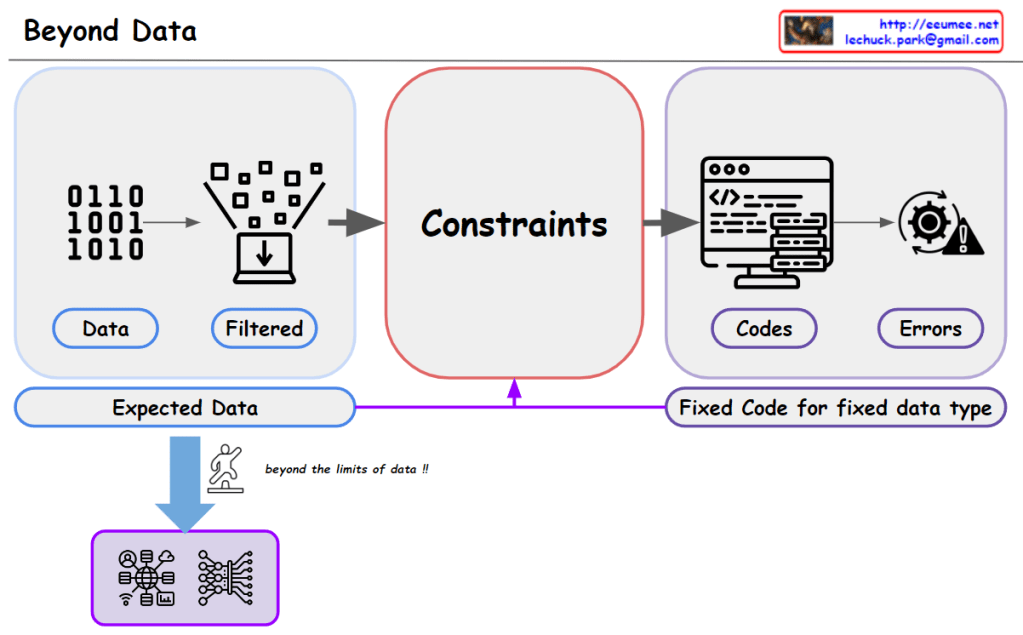
Beyond data

From DALL-E with some prompting
This image depicts the process of overcoming the constraints of traditional programming based on expected data through big data and deep learning. Starting on the left, binary digits labeled as “Data” are processed through a “Filtered” stage to become the necessary “Expected Data.” The box labeled “Constraints” in the center represents the limitations that can occur in programming. These constraints suggest barriers that can be overcome with big data processing and deep learning technologies. On the right, there’s a section transitioning from “Codes” to “Errors,” which signifies possible errors during the coding process. However, the text “Fixed Code for fixed data type” reflects that program code is pre-established for expected data types and does not transcend the boundaries of this data, thereby limiting its potential. The phrase “beyond the limits of data!!” at the bottom expresses the ambition of future programming to surpass the limitations of data processing by utilizing big data and deep learning.