Data Center Service Types

From the Bard with some prompting

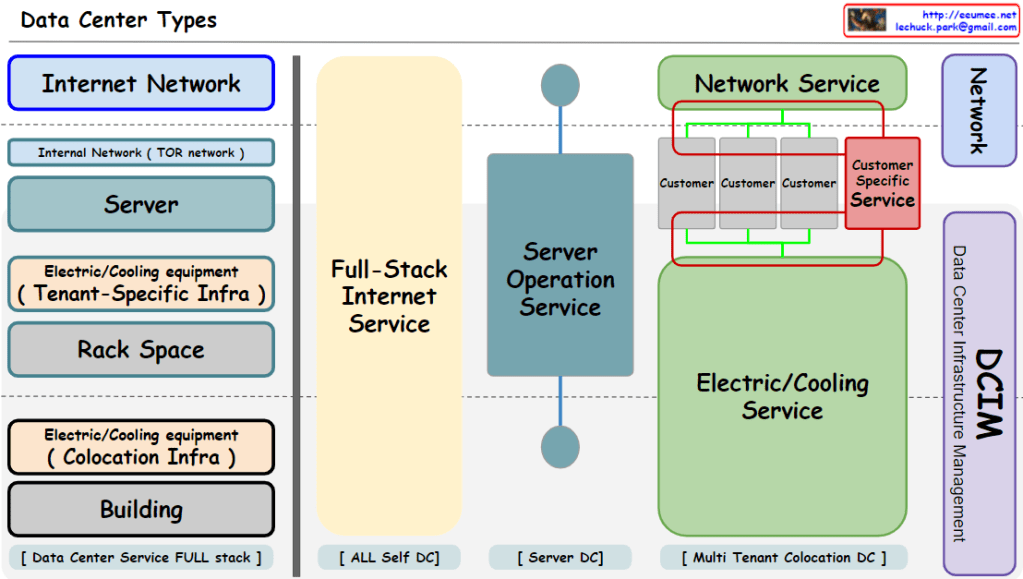
Data Center Types Diagram

This diagram shows four main types of data centers:

  • Full-stack data centers provide a comprehensive solution for all of a customer’s IT infrastructure. This includes servers, networks, storage, security, and operational services.
  • In-house data centers are owned and managed by the customer. This includes servers, networks, storage, security, and operational services.
  • Server data centers provide only servers. This includes servers, networks, and operational services.
  • Multi-tenant colocation data centers are shared by multiple customers. This includes servers, networks, and operational services.

This diagram shows the various factors that should be considered when selecting a data center. It is important to choose the type that is best suited to the customer’s needs and budget.

Digitalization of the data center

From DALL-E with some prompting
The image represents the digital transformation process in data center operations. The top section labeled ‘AI/DT Services’ showcases a variety of Artificial Intelligence and Digital Transformation services including predictive analytics, energy management, reliability, automation, and customer engagement. These services contribute to establishing service standards and ensure the services stay updated through continuous improvements.

The middle section, ‘Data Processing,’ covers the processes involved in data collection, transformation (ETL), and visualization. These processes are responsible for data control, verification through the network, and feeding into an analysis platform.

The bottom section, ‘DC Facility,’ illustrates the fundamental infrastructure of a data center, including power supply, cooling systems, security, CCTV, and fire detection, which are essential for the efficient operation of a data center.

All three sections are underpinned by a ‘Data-Driven Process’ and suggest a transition from legacy processes to modern, data-centric operations through ‘Digital Trans’ (presumably short for Digital Transformation).

AI DC Operation

from DALL-E with some prompting
The image represents a diagram that outlines the transformation of data center operations through the integration of Artificial Intelligence (AI). The flow from left to right demonstrates the transition from traditional data center operations to a new paradigm facilitated by AI. The diagram begins with legacy operations characterized by machines, alarm systems, and the processes managed by experts.

The section titled ‘DC Growing’ highlights the expansion of data centers and the new challenges that arise, including hyperscale, increased complexity, and shifts in customer demographics from retail to major Cloud Service Providers (CSP).

In the subsequent ‘DT’ and ‘AI’ sections, the diagram showcases how Digital Transformation (DT) and AI are integrated into data center operations, enhancing service reliability, automation, energy optimization, and customer service. The ‘AI Accelerator’ section illustrates the role of AI in speeding up the operations of a data center, setting new benchmarks for AI-driven operations.

This diagram visually summarizes how data centers evolve with technological advancements and how AI and digital transformation technologies are revolutionizing traditional operational practices.

AI driven Machine Operation Optimization 

From DALL-E with some prompting
The image illustrates an AI-driven approach to machine operation optimization, with a detailed operation plan that incorporates expert risk assessments. The process is structured as follows:

  1. AI Guide:
    • AI recommends strategies for optimizing operations, including metrics like the number of operations, operating ratio, and load balancing.
  2. Operation Plan:
    • This section emphasizes the creation of a comprehensive operation plan that includes expert assessments of risk and importance in case of failures, alongside safety and emergency response strategies. It also suggests a methodical plan for incrementally applying AI to operations.
  3. Operation Risk and Step-by-Step Operation Expansion:
    • It involves managing operational risks identified by domain experts and the systematic expansion of operations using AI guidance. The gradual application of AI is based on expert risk assessments, leading to a refined approach to risk management and the transformation of operations towards AI-driven processes.

In summary, the key to successfully optimizing operations through AI involves leveraging the expertise of domain professionals to assess risks and guide the step-by-step implementation of AI strategies, ensuring operations are both efficient and secure. 

Facility with AI

From DALL-E with some prompting
The image represents the integration of AI into facility operation optimization. The process begins with AI suggesting guidelines based on predictive models that take into account variables like weather temperature and cooling load. These models undergo evaluation and analysis to assess risks and efficiency before being validated.

Guidance for optimization is then provided, focusing on reducing power usage in cooling towers, chillers, and pumps. A domain operator analyzes the risks and efficiency gains from the proposed changes.

The final stage involves a gradual application of the AI recommendations to the actual operation, with continuous updates to the AI model ensuring real-time adaptability. The percentage indicates the extent to which the AI’s guidance is applied, suggesting that while the guide may be 100% complete, the actual application may vary.

This is followed by the application and analysis (monitoring) phase, which ensures that the optimizations are working as intended and provides feedback for further improvements. This iterative process emphasizes the importance of continuously refining AI-driven operations to maintain optimal performance with minimal risk.

Alarm with AI ( Development )

From DALL-E with some prompting
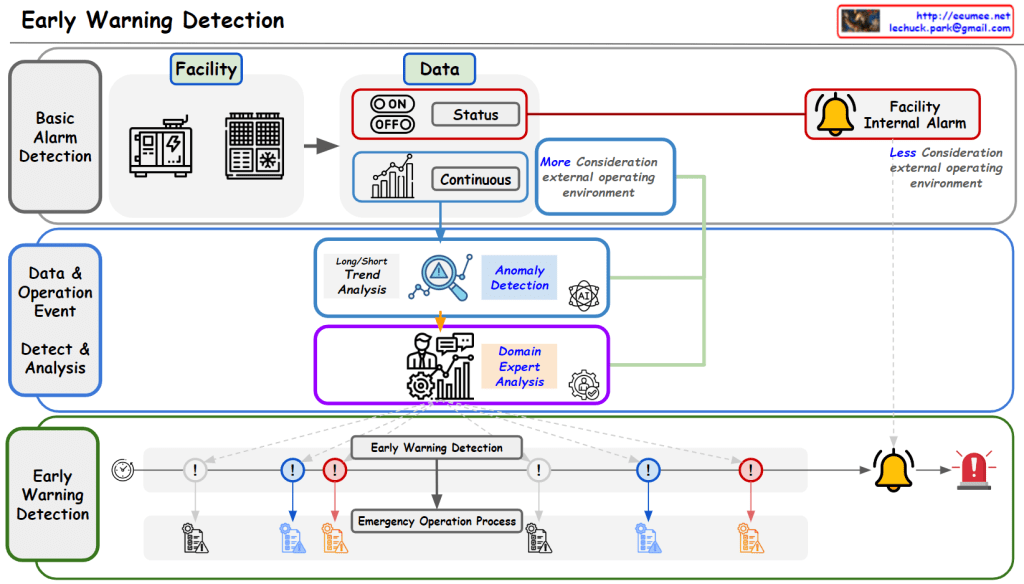
This image illustrates the implementation of an advanced alert system in facilities, extending beyond basic equipment alarms to incorporate data-driven anomaly detection, potentially utilizing AI technologies. The system engages domain experts to analyze data patterns, identifying deviations and planning for event-based responses. These events are systematized with defined levels such as alarms or warnings, and corresponding emergency operation processes are established. By considering the external operating environment, this comprehensive system enhances facility stability and operational efficiency.

Unchanging data

from DALL-E with some prompting
The image illustrates a process of monitoring typically unchanging data to detect system malfunctions. The ‘Traffic / User(s)’ data reflects the relative amount of traffic between two connected users, which generally remains constant. The heat generated by the CPU, as well as electrical elements like voltage and current, are also considered unchanging data in a stable state. A fault detection sensor sends an alert when anomalies are detected in these data points. The ‘Detect it!!’ sensor shows no changes under normal conditions but identifies deviations when an event occurs, enabling a response to potential issues.