Facility with AI

From DALL-E with some prompting
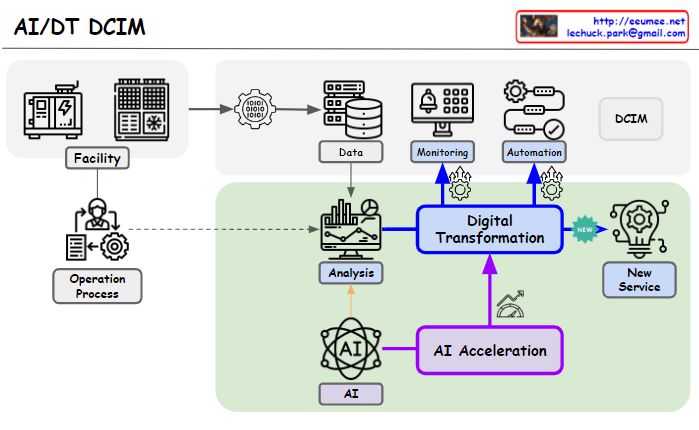
The image represents the integration of AI into facility operation optimization. The process begins with AI suggesting guidelines based on predictive models that take into account variables like weather temperature and cooling load. These models undergo evaluation and analysis to assess risks and efficiency before being validated.

Guidance for optimization is then provided, focusing on reducing power usage in cooling towers, chillers, and pumps. A domain operator analyzes the risks and efficiency gains from the proposed changes.

The final stage involves a gradual application of the AI recommendations to the actual operation, with continuous updates to the AI model ensuring real-time adaptability. The percentage indicates the extent to which the AI’s guidance is applied, suggesting that while the guide may be 100% complete, the actual application may vary.

This is followed by the application and analysis (monitoring) phase, which ensures that the optimizations are working as intended and provides feedback for further improvements. This iterative process emphasizes the importance of continuously refining AI-driven operations to maintain optimal performance with minimal risk.
Alarm with AI ( Development )

From DALL-E with some prompting
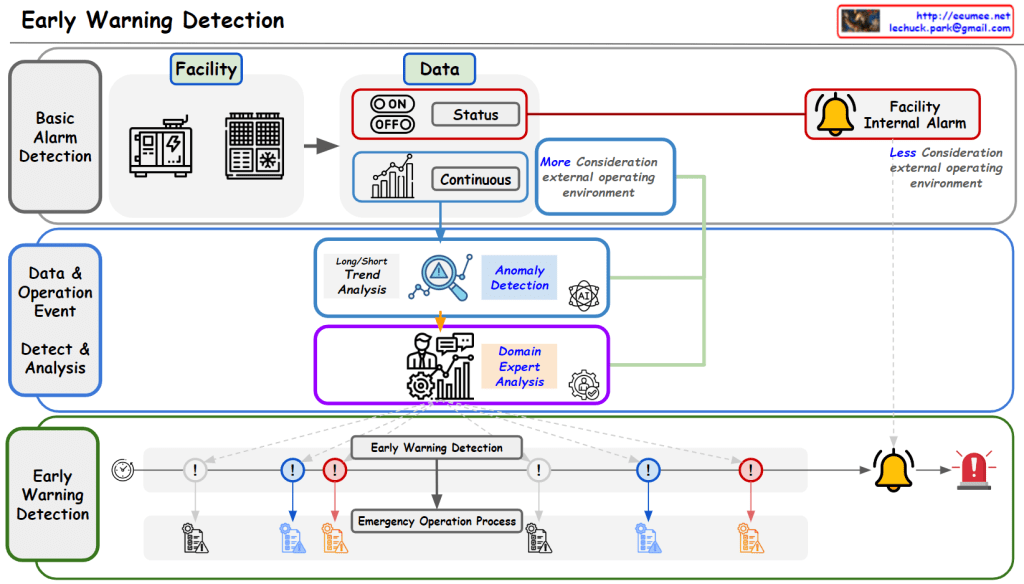
This image illustrates the implementation of an advanced alert system in facilities, extending beyond basic equipment alarms to incorporate data-driven anomaly detection, potentially utilizing AI technologies. The system engages domain experts to analyze data patterns, identifying deviations and planning for event-based responses. These events are systematized with defined levels such as alarms or warnings, and corresponding emergency operation processes are established. By considering the external operating environment, this comprehensive system enhances facility stability and operational efficiency.

Unchanging data

from DALL-E with some prompting
The image illustrates a process of monitoring typically unchanging data to detect system malfunctions. The ‘Traffic / User(s)’ data reflects the relative amount of traffic between two connected users, which generally remains constant. The heat generated by the CPU, as well as electrical elements like voltage and current, are also considered unchanging data in a stable state. A fault detection sensor sends an alert when anomalies are detected in these data points. The ‘Detect it!!’ sensor shows no changes under normal conditions but identifies deviations when an event occurs, enabling a response to potential issues.

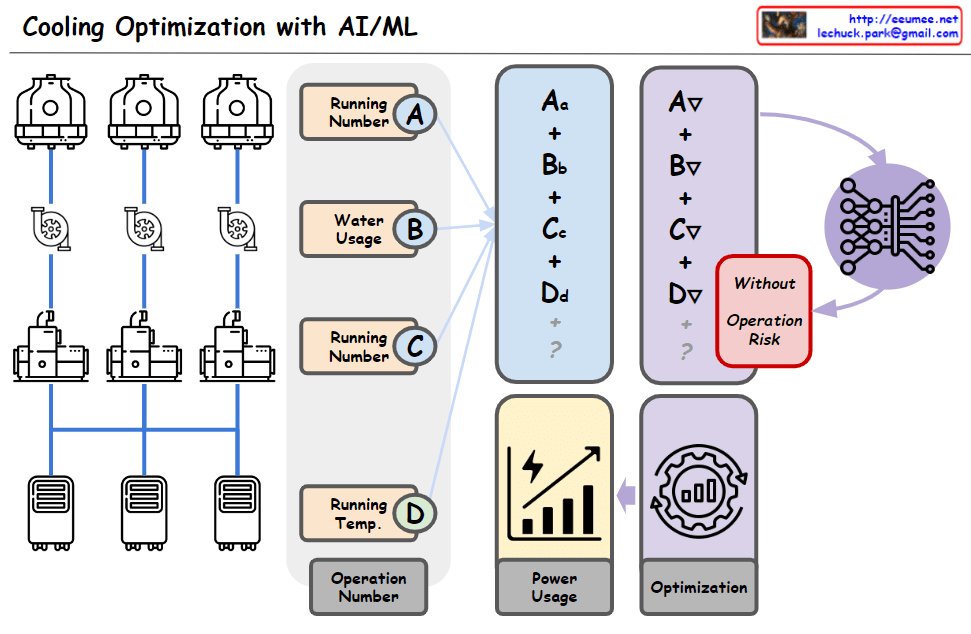
Cooling Optimization

From DALL-E with some prompting
The illustration depicts a process where key operational metrics related to energy usage in cooling systems are analyzed by AI to achieve energy optimization. The AI model evaluates essential data such as running numbers, water usage, and operational temperature to continuously optimize the system while emphasizing stable operation without disruptions. This represents an advanced approach to managing cooling systems that enhances energy efficiency while minimizing operational risks.