Operation with AI

From Claude with some prompting
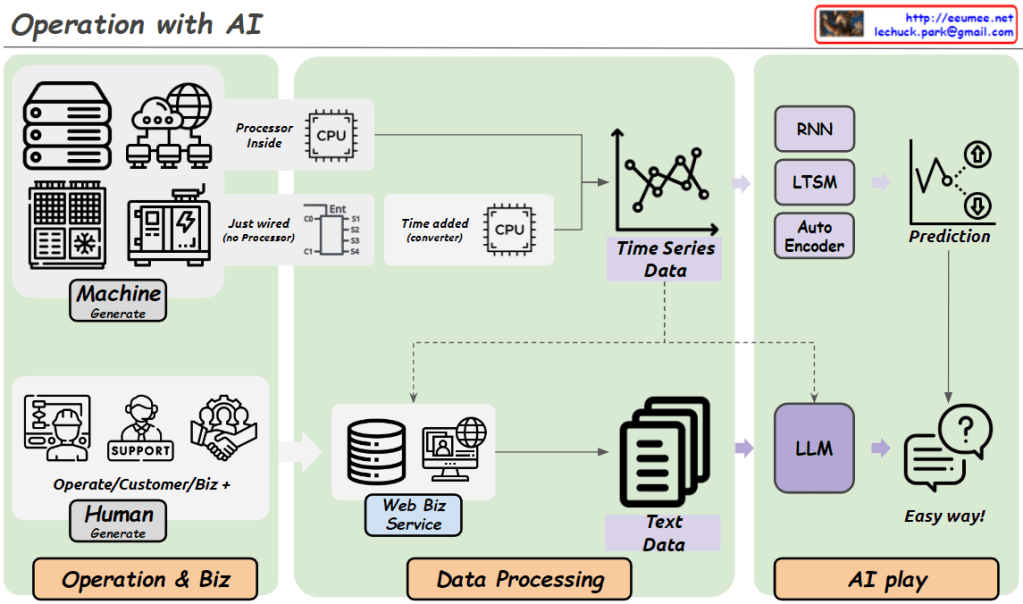
This diagram illustrates an integrated approach to modern operational management. The system is divided into three main components: data generation, data processing, and AI application.

The Operation & Biz section shows two primary data sources. First, there’s metric data automatically generated by machines such as servers and network equipment. Second, there’s textual data created by human operators and customer service representatives, primarily through web portals.

These collected data streams then move to the central Data Processing stage. Here, metric data is processed through CPUs and converted into time series data, while textual data is structured via web business services.

Finally, in the AI play stage, different AI models are applied based on data types. For time series data, models like RNN, LSTM, and Auto Encoder are used for predictive analytics. Textual data is processed through a Large Language Model (LLM) to extract insights.

This integrated system effectively utilizes data from various sources to improve operational efficiency, support data-driven decision-making, and enable advanced analysis and prediction through AI. Ultimately, it facilitates easy and effective management even in complex operational environments.

The image emphasizes how different types of data – machine-generated metrics and human-generated text – are processed and analyzed using appropriate AI techniques, all from the perspective of operational management.

Data Center Management Upgrade

From Claude with some prompting
explain the image in more detail from the data collection perspective and how the data analysis platform facilitates the expansion of AI services.

First, we can see the data collection stage where data is gathered from various systems within the data center building, such as electrical, mechanical, security, and so on, through subsystems like EPMS, BAS, ETC. This collected data is stored in the Data Gathering DB.

Next, this accumulated data is transmitted to the Data Analysis Platform via an API. The necessity of the data analysis platform arises from the need to process the vast amount of collected data and derive meaningful insights.

Within the Data Analysis Platform, tools like Query, Program, and Visualization are utilized for data analysis and monitoring purposes. Based on this, services such as Energy Optimization and Predictive Failure Detection are provided.

Furthermore, by integrating AI technology, data-driven insights can be enhanced. AI models can leverage the data and services from the data analysis platform to perform advanced analytics, automated decision-making, and more.

In summary, the flow is as follows: Data Collection -> Data Processing/Analysis on the Data Analysis Platform -> Provision of services like Energy Optimization and Failure Prediction -> Integration of AI technology for advanced analysis and automation, all contributing to effective data center management.

Integration DC

From Claude with some prompting
This diagram depicts an architecture for data center (DC) infrastructure expansion and integrated operations management across multiple sites. The key features include:

  1. Integration and monitoring of comprehensive IT infrastructure at the site level, including networks, servers, storage, power, cooling, and security.
  2. Centralized management of infrastructure status, events, and alerts from each site through the “Integration & Alert Main” system.
  3. The central integration system collects diverse data from sites and performs data integration and analysis through the “Service Integration” layer:
    • Data integration, private networking, synchronization, and analysis of new applications
    • Inclusion of advanced AI-based data analytics capabilities
  4. Leveraging analysis results to support infrastructure system optimization and upgrade decisions at each site.
  5. Improved visibility, control, and efficiency over the entire DC infrastructure through centralized monitoring and integration.

This architecture enables unified management of distributed infrastructure resources in an expanded DC environment and enhances operational efficiency through data-driven optimization.

By consolidating monitoring and integrating data analytics, organizations can gain comprehensive insights, make informed decisions, and streamline operations across their distributed data center footprint.

Trend & Prediction

From Claude with some prompting
The image presents a “Trend & Predictions” process, illustrating a data-driven prediction system. The key aspect is the transition from manual validation to automation.

  1. Data Collection & Storage: Digital data is gathered from various sources and stored in a database.
  2. Manual Selection & Validation: a. User manually selects which metric (data) to use b. User manually chooses which AI model to apply c. Analysis & Confirmation using selected data and model
  3. Transition to Automation:
    • Once optimal metrics and models are confirmed in the manual validation phase, the system learns and switches to automation mode. a. Automatically collects and processes data based on selected metrics b. Automatically applies validated models c. Applies pre-set thresholds to prediction results d. Automatically detects and alerts on significant predictive patterns or anomalies based on thresholds

The core of this process is combining user expertise with system efficiency. Initially, users directly select metrics and models, validating results to “educate” the system. This phase determines which data is meaningful and which models are accurate.

Once this “learning” stage is complete, the system transitions to automation mode. It now automatically collects, processes data, and generates predictions using user-validated metrics and models. Furthermore, it applies preset thresholds to automatically detect significant trend changes or anomalies.

This enables the system to continuously monitor trends, providing alerts to users whenever important changes are detected. This allows users to respond quickly, enhancing both the accuracy of predictions and the efficiency of the system.

Data Center Efficiency Metric

From Claude with some prompting
This image is a diagram explaining “Data Center Efficiency Metrics.” It visually outlines various metrics that measure the efficiency of resource usage in data centers. The key metrics are as follows:

  1. ITUE (IT Utilization Effectiveness): Measures the ratio of useful output to input for IT equipment.
  2. PUE (Power Usage Effectiveness): Total power consumption (IT equipment and cooling systems) divided by IT equipment power consumption.
  3. DCIE (Data Center Infrastructure Efficiency): IT power divided by the sum of IT power and cooling power; it’s the inverse of PUE.
  4. WUE (Water Usage Effectiveness): Water usage divided by IT power.
  5. CUE (Carbon Usage Effectiveness): Total energy consumption multiplied by the carbon emission factor, measuring the data center’s carbon footprint.

The image also provides carbon emission factors for various energy sources (coal, natural gas, oil, wind, solar, KEPCO), showing how the energy source impacts carbon emissions.

This diagram helps data center operators comprehensively evaluate and improve their efficiency in terms of power, cooling, water usage, and carbon emissions. From my analysis, the content of this image is accurate and effectively explains the standard metrics for measuring data center efficiency.

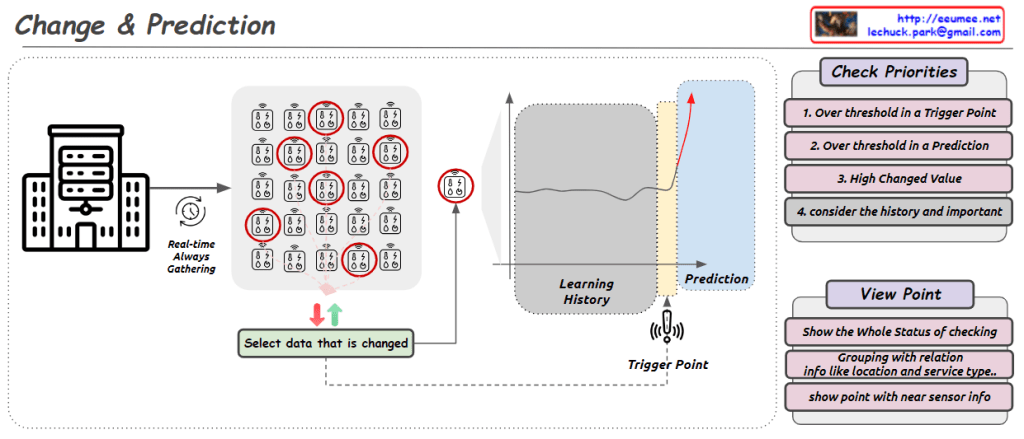
Change & Prediction

From Claude with some prompting
This image illustrates a process called “Change & Prediction” which appears to be a system for monitoring and analyzing real-time data streams. The key components shown are:

  1. Real-time data gathering from some source (likely sensors represented by the building icon).
  2. Selecting data that has changed significantly.
  3. A “Learning History” component that tracks and learns from the incoming data over time.
  4. A “Trigger Point” that detects when data values cross certain thresholds.
  5. A “Prediction” component that likely forecasts future values based on the learned patterns.

The “Check Priorities” box lists four criteria for determining which data points deserve attention: exceeding trigger thresholds, predictions crossing thresholds, high change values, and considering historical context.

The “View Point” section suggests options for visualizing the status, grouping related data points (e.g., by location or service type), and showing detailed sensor information.

Overall, this seems to depict an automated monitoring and predictive analytics system for identifying and responding to important changes in real-time data streams from various sources or sensors.

Time Series Data in a DC

From Claude with some prompting
This image illustrates the concept of time series data analysis in a data center environment. It shows various infrastructure components like IT servers, networking, power and cooling systems, security systems, etc. that generate continuous data streams around the clock (24 hours, 365 days).

This time series data is then processed and analyzed using different machine learning and deep learning techniques such as autoregressive integrated moving average models, generalized autoregressive conditional heteroskedasticity, isolation forest algorithms, support vector machines, local outlier factor, long short-term memory models, and autoencoders.

The goal of this analysis is to gain insights, make predictions, and uncover patterns from the continuous data streams generated by the data center infrastructure components. The analysis results can be further utilized for applications like predictive maintenance, resource optimization, anomaly detection, and other operational efficiency improvements within the data center.