
The Computing for the Fair Human Life.

This illustration visually represents the philosophical exploration of the relationship between humans and technology, particularly AI. It emphasizes how technological advancements may narrow the gap between humans and machines, yet a fundamental difference will always persist. The concept of “reducing infinity” is depicted, showing that while AI can become more human-like, it can never be entirely the same. Ultimately, the image highlights that despite technological evolution, human judgment remains irreplaceable in final decision-making.
With ChatGPT

The image titled “New Coding” illustrates the historical evolution of programming languages and the emerging paradigm of AI-assisted coding.
On the left side, it shows the progression of programming languages:
Below these languages is text reading “Workload for understanding computers” with a blue gradient arrow, indicating how these programming approaches have strengthened our understanding of computers through their evolution.
The bottom section labeled “Using AI with LLM” shows a human profile communicating with an AI chip/processor, suggesting that AI can now code through natural language based on this historical programming experience and data.
On the right side, a large purple arrow points toward the future concepts:
The overall message of the diagram is that programming has evolved from low-level languages to high-level ones, and now we’re entering a new era where AI enables coding directly through human thought, speech, and logical reasoning – representing a fundamental shift in how we create software.
With Claude

This image depicts a conceptual diagram of the “MOE (Mixture of Expert)” system, effectively illustrating the similarities between human expert collaboration structures and AI model MoE architectures.
The key points of the diagram are:
This diagram emphasizes that human expert systems and AI MoE architectures are fundamentally similar. The approach of utilizing multiple experts’ knowledge to solve complex problems has been used in human settings for a long time, and the AI MoE structure applies this human-centered collaborative model to AI systems. The core message of this diagram is that AI models are essentially performing the roles that human experts would traditionally fulfill.
This perspective suggests that mimicking human problem-solving approaches can be effective in AI system design.
With Claude
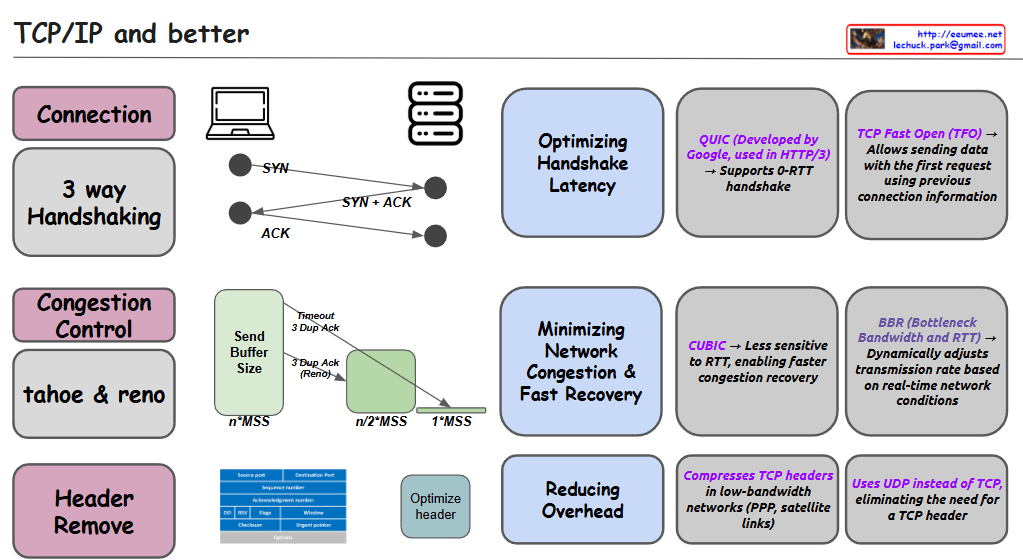
This image is an informational diagram titled “TCP/IP and better” that explains various aspects of network protocols and optimizations.
The diagram is organized into three main sections:
The diagram appears to be an educational resource about TCP/IP protocols and various optimizations that have been developed to improve network performance, particularly focused on connection establishment, congestion control, and overhead reduction.
With Claude

The image shows a data quality infographic with key dimensions that affect AI systems.
At the top of the image, there’s a header titled “Data Quality”. Below that, there are five key data quality dimensions illustrated with icons:
The bottom section features a light gray background with a conceptual illustration showing how these data quality dimensions contribute to AI. On the left side is a network of connected databases, devices, and information systems. An arrow points from this to a neural network representation on the right side, with the text “Data make AI” underneath.
The image appears to be explaining that these five quality dimensions are essential for creating effective AI systems, emphasizing that the quality of data directly impacts AI performance.
With Claude

This image shows a diagram titled “LLM RAG Agentic” that illustrates the components and relationships in an AI system architecture.
The diagram is organized in a grid-like layout with three rows and three columns. Each row appears to represent different functional aspects of the system:
Top row:
Middle row:
Bottom row:
Arrows connect these components, showing how information and processes flow between them. The diagram appears to illustrate how a large language model integrates with retrieval-augmented generation capabilities and agentic (autonomous action-taking) functionality to form a complete AI system.
With Claude
 Lechuck Park