Tahoe & Reno

From Claude with some prompting
This image is a diagram explaining the TCP Congestion Control mechanisms, particularly comparing the congestion control algorithms of two TCP versions: Tahoe and Reno.

Key points:

  1. Both algorithms use a Slow Start Threshold (ssthresh) to determine the initial congestion window size.
  2. The congestion window grows exponentially (2^n) at first, then switches to linear growth (+1) once it reaches ssthresh.
  3. Both algorithms reduce the congestion window to 1 and adjust ssthresh to half of the current size upon a timeout.
  4. When receiving 3 duplicate ACKs (3 DUP ACK), both algorithms halve their ssthresh.

Difference:

  • On 3 DUP ACK:
    • Tahoe: Reduces congestion window to 1
    • Reno: Multiplicatively decreases congestion window

There doesn’t appear to be any incorrect information in this image. It accurately shows the key difference between Tahoe and Reno in their response to 3 DUP ACK situations, and correctly explains other aspects of congestion control as well.

Data Center Efficiency Metric

From Claude with some prompting
This image is a diagram explaining “Data Center Efficiency Metrics.” It visually outlines various metrics that measure the efficiency of resource usage in data centers. The key metrics are as follows:

  1. ITUE (IT Utilization Effectiveness): Measures the ratio of useful output to input for IT equipment.
  2. PUE (Power Usage Effectiveness): Total power consumption (IT equipment and cooling systems) divided by IT equipment power consumption.
  3. DCIE (Data Center Infrastructure Efficiency): IT power divided by the sum of IT power and cooling power; it’s the inverse of PUE.
  4. WUE (Water Usage Effectiveness): Water usage divided by IT power.
  5. CUE (Carbon Usage Effectiveness): Total energy consumption multiplied by the carbon emission factor, measuring the data center’s carbon footprint.

The image also provides carbon emission factors for various energy sources (coal, natural gas, oil, wind, solar, KEPCO), showing how the energy source impacts carbon emissions.

This diagram helps data center operators comprehensively evaluate and improve their efficiency in terms of power, cooling, water usage, and carbon emissions. From my analysis, the content of this image is accurate and effectively explains the standard metrics for measuring data center efficiency.

Anyway, The probability

From Claude with some prompting
Traditional View: AI’s probability-based decisions are seen in contrast to human’s logical, “100% certain” decisions, and this difference could be perceived as problematic.

New Insight: In reality, the concept of human’s “100% certainty” itself might be an illusion. Human judgments are also based on limited data and experiences, making them inherently probabilistic in nature.

Finding Common Ground: Both humans and AI make decisions based on incomplete information. Even human’s logical certainty ultimately stems from restricted data, making it fundamentally probability-based.

Paradigm Shift: This perspective suggests that AI’s probabilistic approach isn’t a flaw but rather a more accurate modeling of human decision-making processes. What we believe to be “100% certainty” is actually a high-probability estimation based on limited information.

Implications: This prompts a reevaluation of the perceived gap between AI and human decision-making styles. AI’s probabilistic approach might not be inferior to human logic; instead, it may more accurately reflect our cognitive processes.

This viewpoint encourages us to see AI’s probabilistic tendencies not as a problem, but as a tool providing deeper insights into human thought processes. It invites us to reconsider how AI and humans collaborate, opening new possibilities to complementarily leverage the strengths of both sides.

The image and your interpretation together challenge the notion that human reasoning is purely logical and certain. Instead, they suggest that both human and AI decisions are fundamentally based on probabilities derived from limited data. This realization can foster a more harmonious and effective partnership between humans and AI, recognizing that our decision-making processes may be more similar than previously thought.

Change & Prediction

From Claude with some prompting
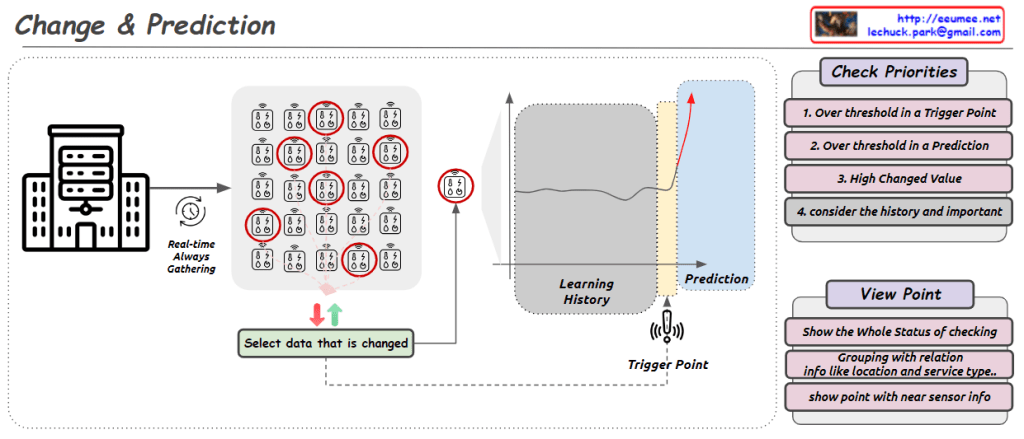
This image illustrates a process called “Change & Prediction” which appears to be a system for monitoring and analyzing real-time data streams. The key components shown are:

  1. Real-time data gathering from some source (likely sensors represented by the building icon).
  2. Selecting data that has changed significantly.
  3. A “Learning History” component that tracks and learns from the incoming data over time.
  4. A “Trigger Point” that detects when data values cross certain thresholds.
  5. A “Prediction” component that likely forecasts future values based on the learned patterns.

The “Check Priorities” box lists four criteria for determining which data points deserve attention: exceeding trigger thresholds, predictions crossing thresholds, high change values, and considering historical context.

The “View Point” section suggests options for visualizing the status, grouping related data points (e.g., by location or service type), and showing detailed sensor information.

Overall, this seems to depict an automated monitoring and predictive analytics system for identifying and responding to important changes in real-time data streams from various sources or sensors.

Inside H100

From Claude with some prompting
This image illustrates the internal architecture of the Nvidia H100 GPU. It shows the key components and interconnections within the GPU. A few key points from the image:

The PCIe Gen5 interface connects the H100 GPU to the external system, CPUs, storage devices, an

The NVLink allows interconnecting multiple H100 GPUs, supporting up to 6 NVlink connections with a 900GB/s bandwidth.

The GPU has an internal HBM3 memory of 80GB, which is 2x faster than the previous HBM2 memory.

Not Real-Simultaneous Works

From Claude with some prompting
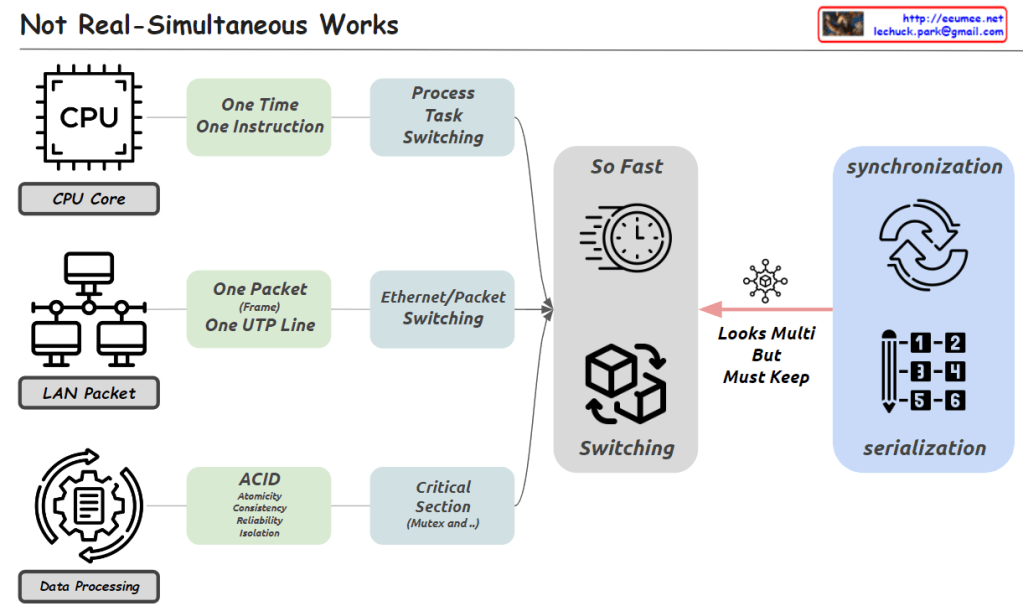
The image emphasizes that while it may appear to be simultaneous processing, it is actually very fast serial processing.

From the perspectives of the CPU, LAN, and data processing, each can only handle one unit of work at a time. The CPU can execute one instruction, the network can transmit one packet line, and in data processing, critical sections require mutual exclusion and serialization.

However, due to very fast switching techniques like process/task switching and Ethernet/packet switching, multiple tasks appear to be happening concurrently. But in reality, it is processing single units of work in rapid serial fashion.

So concurrency is achieved through fast serial processing, not parallel processing. Even so, in critical areas, synchronization and serialization are required to maintain data integrity.

In essence, the image highlights that while it looks like simultaneous processing, concurrency is actually implemented through extremely fast serial processing of single work units at a time.

Questions

From Claude with some prompting
This image highlights the significance of questions in the AI era and how those questions originate from humanity’s accumulated knowledge. The process begins with “Sensing the world” by gathering various inputs. However, the actual generation of questions is driven by humans. Drawing upon their existing knowledge and insights, humans formulate meaningful inquiries.

These human-generated questions then drive a combined research and analysis effort leveraging both AI systems and human capabilities. AI provides immense data processing power, while humans contribute analysis and interpretation to create new knowledge. This cyclical process allows for continuously refining and advancing the questions.

The ultimate goal is to “Figure out!!” – to achieve better understanding and solutions through the synergy of human intellect and AI technologies. For this, the unique human capacity for insight and creativity in asking questions is essential.

The image underscores that even in an AI-driven world, the seeds of inquiry and the formulation of profound questions stem from the knowledge foundation built by humans over time. AI then complements and accelerates the path toward enhanced comprehension by augmenting human cognition with its processing prowess.