Sovereign AI Foundation Model

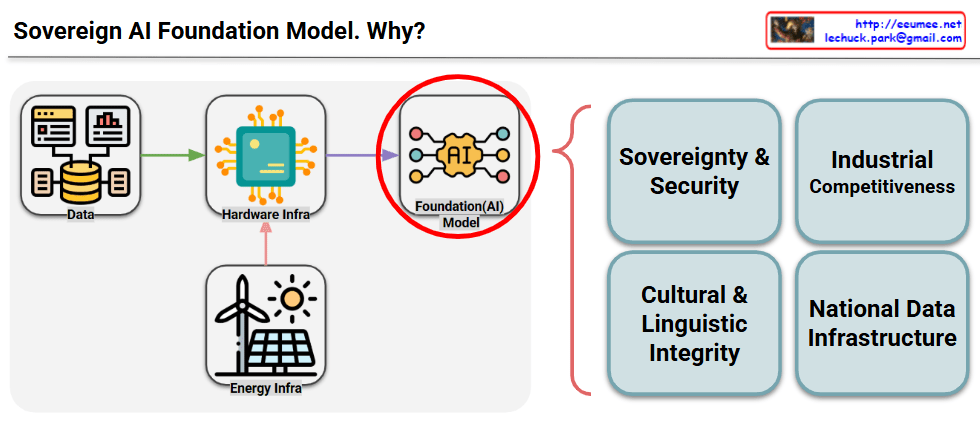
This diagram illustrates the concept of “Sovereign AI Foundation Model” and explains why it’s necessary.

Structure Analysis

Left Side (Infrastructure Elements):

  • Data
  • Hardware Infrastructure (Hardware Infra)
  • Energy Infrastructure (Energy Infra)

These three elements are connected to the central Foundation AI Model.

Why Sovereign AI is Needed (Four boxes on the right)

  1. Sovereignty & Security
    • Securing national AI technology independence
    • Data security and technological autonomy
    • Digital Sovereignty, National Security, Avoid Tech-Colonization, Data Jurisdiction, On-Premise Control.
  2. Industrial Competitiveness
    • Strengthening AI-based competitiveness of national industries
    • Gaining advantages in technological hegemony competition
    • Ecosystem Enabler, Beyond ‘Black Box’, Deep Customization, Innovation Platform, Future Industries.
  3. Cultural & Linguistic Integrity
    • Developing AI models specialized for national language and culture
    • Preserving cultural values and linguistic characteristics
    • Cultural Context, Linguistic Nuance, Mitigate Bias, Preserve Identity, Social Cohesion.
  4. National Data Infrastructure
    • Systematic data management at the national level
    • Securing data sovereignty
    • Data Standardization, Break Data Silos, High-Quality Structured Data, AI-Ready Infrastructure, Efficiency & Scalability.

Key Message

This diagram systematically presents why each nation should build independent AI foundation models based on their own data, hardware, and energy infrastructure, rather than relying on foreign companies’ AI models. It emphasizes the necessity from the perspectives of technological sovereignty, competitiveness, cultural identity, and data independence.

The diagram essentially argues that nations need to develop their own AI capabilities to maintain control over their digital future and protect their national interests in an increasingly AI-driven world.

WIth Claude

Human & Data with AI

Data Accumulation Perspective

History → Internet: All knowledge and information accumulated throughout human history is digitized through the internet and converted into AI training data. This consists of multimodal data including text, images, audio, and other formats.

Foundation Model: Large language models (LLMs) and multimodal models are pre-trained based on this vast accumulated data. Examples include GPT, BERT, CLIP, and similar architectures.

Human to AI: Applying Human Cognitive Patterns to AI

1. Chain of Thoughts

  • Implementation of human logical reasoning processes in the Reasoning stage
  • Mimicking human cognitive patterns that break down complex problems into step-by-step solutions
  • Replicating the human approach of “think → analyze → conclude” in AI systems

2. Mixture of Experts

  • AI implementation of human expert collaboration systems utilized in the Experts domain
  • Architecting the way human specialists collaborate on complex problems into model structures
  • Applying the human method of synthesizing multiple expert opinions for problem-solving into AI

3. Retrieval-Augmented Generation (RAG)

  • Implementing the human process of searching existing knowledge → generating new responses into AI systems
  • Systematizing the human approach of “reference material search → comprehensive judgment”

Personal/Enterprise/Sovereign Data Utilization

1. Personal Level

  • Utilizing individual documents, history, preferences, and private data in RAG systems
  • Providing personalized AI assistants and customized services

2. Enterprise Level

  • Integrating organizational internal documents, processes, and business data into RAG systems
  • Implementing enterprise-specific AI solutions and workflow automation

3. Sovereign Level

  • Connecting national or regional strategic data to RAG systems
  • Optimizing national security, policy decisions, and public services

Overall Significance: This architecture represents a Human-Centric AI system that transplants human cognitive abilities and thinking patterns into AI while utilizing multi-layered data from personal to national levels to evolve general-purpose AI (Foundation Models) into intelligent systems specialized for each level. It goes beyond simple data processing to implement human thinking methodologies themselves into next-generation AI systems.

With Claude

AI DC Changes

The evolution of AI data centers has progressed through the following stages:

  1. Legacy – The initial form of data centers, providing basic computing infrastructure.
  2. Hyperscale – Evolved into a centralized (Centric) structure with these characteristics:
    • Led by Big Tech companies (Google, Amazon, Microsoft, etc.)
    • Focused on AI model training (Learning) with massive computing power
    • Concentration of data and processing capabilities in central locations
  3. Distributed – The current evolutionary direction with these features:
    • Expansion of Edge/On-device computing
    • Shift from AI training to inference-focused operations
    • Moving from Big Tech centralization to enterprise and national data sovereignty
    • Enabling personalization for customized user services

This evolution represents a democratization of AI technology, emphasizing data sovereignty, privacy protection, and the delivery of optimized services tailored to individual users.

AI data centers have evolved from legacy systems to hyperscale centralized structures dominated by Big Tech companies focused on AI training. The current shift toward distributed architecture emphasizes edge/on-device computing, inference capabilities, data sovereignty for enterprises and nations, and enhanced personalization for end users.

with Claude