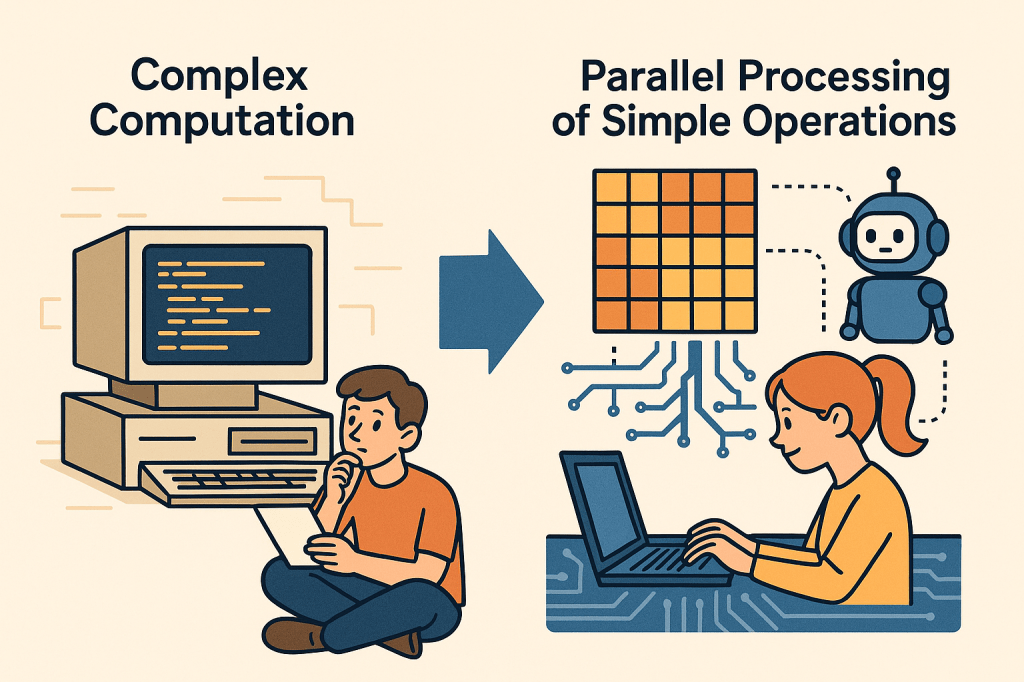
Massive simple parallel computing

This diagram presents a systematic framework that defines the essence of AI LLMs as “Massive Simple Parallel Computing” and systematically outlines the resulting issues and challenges that need to be addressed.

Core Definition of AI LLM: “Massive Simple Parallel Computing”

Massive: Enormous scale with billions of parameters Simple: Fundamentally simple computational operations (matrix multiplications, etc.) Parallel: Architecture capable of simultaneous parallel processing Computing: All of this implemented through computational processes

Core Issues Arising from This Essential Nature

Big Issues:

  • Black-box unexplainable: Incomprehensibility due to massive and complex interactions
  • Energy-intensive: Enormous energy consumption inevitably arising from massive parallel computing

Essential Requirements Therefore Needed

Very Required:

  • Verification: Methods to ensure reliability of results given the black-box characteristics
  • Optimization: Approaches to simultaneously improve energy efficiency and performance

The Ultimate Question: “By What?”

How can we solve all these requirements?

In other words, this framework poses the fundamental question about specific solutions and approaches to overcome the problems inherent in the essential characteristics of current LLMs. This represents a compressed framework showing the core challenges for next-generation AI technology development.

The diagram effectively illustrates how the defining characteristics of LLMs directly lead to significant challenges, which in turn demand specific capabilities, ultimately raising the critical question of implementation methodology.

With Claude
Many Simple with THE AI

From Claude with some prompting
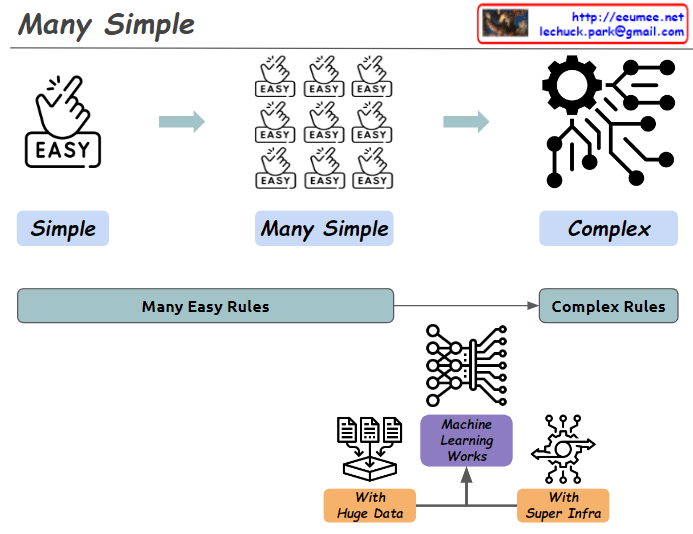
This image illustrates the concept of “Many Simple” and demonstrates how simple elements combine to create complexity.

  1. Top diagram:
    • “Simple”: Starts with a single “EASY” icon.
    • “Many Simple”: Shows multiple “EASY” icons grouped together.
    • “Complex”: Depicts a system of intricate gears and connections.
  2. Bottom diagram:
    • Shows the progression from “Many Easy Rules” to “Complex Rules”.
    • Centers around the concept of “Machine Learning Works”.
    • This is supported by “With Huge Data” and “With Super Infra”.

The image provides a simplified explanation of how machine learning operates. It visualizes the process of numerous simple rules being processed through massive amounts of data and powerful infrastructure to produce complex systems.

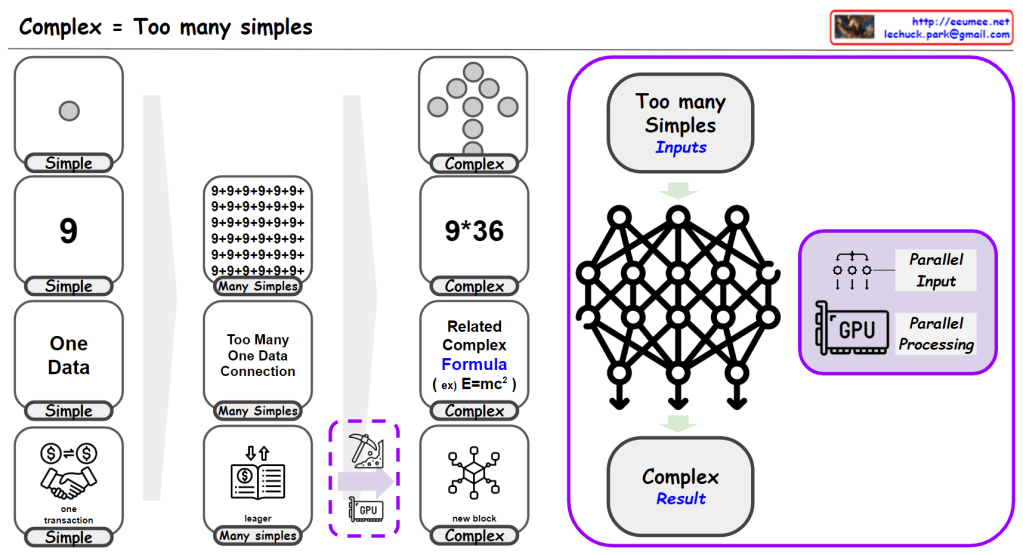
Simple & Complex

This image illustrates the evolution of problem-solving approaches, contrasting traditional methods with modern AI-based solutions:

‘Before’ stage:

  1. Starts with Simple data
  2. Proceeds through Research
  3. Find out Rules with formula
  4. Resolves Complex problems

This process represents the traditional approach where humans collect simple data, conduct research, and discover rules to solve complex problems.

‘Now with AI Infra’ stage:

  1. Begins with Simple data
  2. Accumulates too much Simple data
  3. Utilizes Computing for big data and Computing AI
  4. Solves Complex problems by too much simple

This new process showcases a modern approach based on AI infrastructure. It involves analyzing vast amounts of simple data using computational power to address more evolved forms of complexity.

The ‘Complex Evolution’ arrow indicates that the level of complexity we can handle is evolving due to this shift in approach.

In essence, the image conveys that while the past relied on limited data to discover simple rules for solving complexity, the present leverages AI and big data to analyze enormous amounts of simple data, enabling us to tackle more sophisticated and complex problems. This shift represents a significant evolution in our problem-solving capabilities, allowing us to address complexities that were previously beyond our reach.