AI from the base

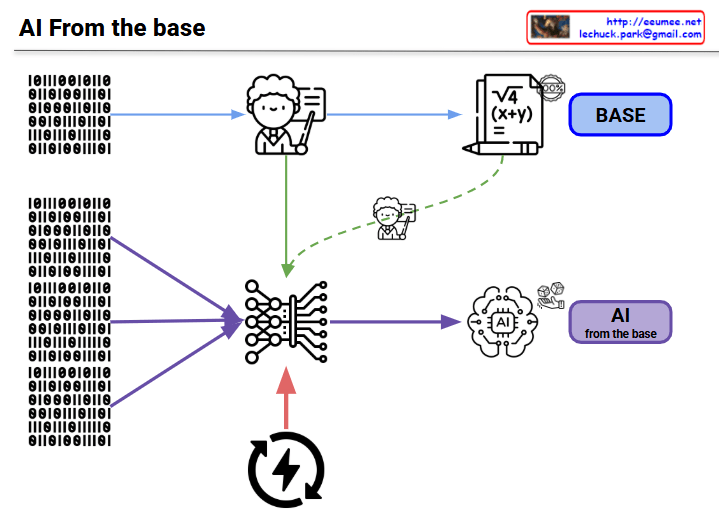
This diagram contrasts two approaches: traditional rule-based systems that achieve 100% accuracy within limited scope using human-designed logic, versus AI systems that handle massive datasets through neural networks with probabilistic reasoning. While traditional methods guarantee perfect results in narrow domains, AI offers scalable, adaptive solutions for complex real-world problems despite requiring significant energy and operating with uncertainty rather than absolute certainty

Upper Process (Traditional Approach):

  • Data → Human Rule Creation: Based on binary data, humans design clear logical rules
  • Mathematical Operations (√(x+y)): Precise and deterministic calculations
  • “BASE”: Foundation system with 100% certainty
  • Human-created rules guarantee complete accuracy (100%) but operate only within limited scope

Lower Process (AI-Based Approach):

  • Large-Scale Data Processing: Capable of handling vastly more extensive and complex data than traditional methods
  • Neural Network Pattern Learning: Discovers complex patterns and relationships that are difficult for humans to explicitly define
  • Adaptive Learning: The circular arrow (⚡) represents continuous improvement and adaptability to new situations
  • Advantages of Probabilistic Reasoning: Flexibility to handle uncertain and complex real-world problems

Key Advantages:

  • Traditional Approach: Clear and predictable but limited for complex real-world problems
  • AI Approach: While probabilistic, provides scalability and adaptability to solve complex problems that are difficult for humans to design solutions for. Though imperfect, it offers practical solutions that can respond to diverse and unpredictable real-world situations

AI may not be perfect, but it opens up innovative possibilities in areas that are difficult to approach with traditional methods, serving as a powerful tool for tackling previously intractable problems.

With Claude

Amazing ML

From Claude with some prompting
This diagram effectively illustrates the core principles of machine learning.

Basic Components:

  1. Number Pattern at the Top: 1 → 4 → 7 → 10 → 14
  • Presented with the question “Have a pattern??”
  1. Neural Network Diagram in the Center
  • Visualizes the machine learning process of pattern discovery
  1. Discovered Rule at the Bottom: Y = 3x + 1
  • Mathematical expression of the pattern found in the data

Key Messages:

  1. Pattern Discovery from Data
  • Using just 5 data points
  • Clear mathematical pattern can be discovered
  • Rule where each number adds 3 to the previous one
  1. Infinite Scalability
  • One simple discovered rule (Y = 3x + 1)
  • Can predict infinite data points (Infinite Data)
  • Demonstrates machine learning’s power of ‘generalization’

This diagram showcases machine learning’s most powerful characteristic:

  • Learning from limited data
  • Discovering simple yet powerful rules
  • Ability to predict infinite new cases

It’s similar to how physical laws like E = mc² can explain infinite natural phenomena with a single equation. The diagram effectively shows how machine learning serves as a powerful tool for discovering these fundamental patterns hidden within data.

The beauty of this concept lies in its simplicity and power:

  • Using just 5 visible data points
  • Finding a mathematical pattern
  • Creating a rule that can predict an infinite number of future points

This demonstrates the essence of machine learning: the ability to take finite observations and transform them into a universal rule that can make predictions far beyond the original training data.

The infinite is in the hands

From Claude with some prompting
This image illustrates the profound concept of capturing infinity through a simple human-made equation, y = 2x. Here’s an updated interpretation:

  1. The title “Y=2x, The infinite is in the hands” suggests humanity’s ability to grasp and manipulate the concept of infinity.
  2. The large circular area on the left represents various instances of the equation, showing both finite and seemingly infinite cases (e.g., very large numbers, algebraic expressions).
  3. The arrow pointing to the right symbolizes the unification of all these cases into a single, elegant formula: y = 2x.
  4. The rectangle on the right, containing “y = 2x” with “include ∞”, represents how this human-created formula can encompass infinite possibilities.
  5. The infinity symbols (∞) scattered throughout the image emphasize the all-encompassing nature of this relationship.

The core message is one of wonder and potential:

  1. Wonder: It expresses amazement at how a simple, human-devised equation can capture and represent infinite cases and possibilities.
  2. Potential: It implies that by understanding and harnessing such powerful concepts, humans can use them as building blocks for further creativity and innovation.

This visualization celebrates human ingenuity in mathematics, showing how we can encapsulate the vastness of infinity within a concise formula. It suggests that by creating such tools to understand and work with infinity, we open doors to new realms of thought and creation.

The image invites viewers to appreciate the elegance of mathematics and to consider how such fundamental concepts can lead to further breakthroughs and applications across various fields of human endeavor.

Simple & Complex

This image illustrates the evolution of problem-solving approaches, contrasting traditional methods with modern AI-based solutions:

‘Before’ stage:

  1. Starts with Simple data
  2. Proceeds through Research
  3. Find out Rules with formula
  4. Resolves Complex problems

This process represents the traditional approach where humans collect simple data, conduct research, and discover rules to solve complex problems.

‘Now with AI Infra’ stage:

  1. Begins with Simple data
  2. Accumulates too much Simple data
  3. Utilizes Computing for big data and Computing AI
  4. Solves Complex problems by too much simple

This new process showcases a modern approach based on AI infrastructure. It involves analyzing vast amounts of simple data using computational power to address more evolved forms of complexity.

The ‘Complex Evolution’ arrow indicates that the level of complexity we can handle is evolving due to this shift in approach.

In essence, the image conveys that while the past relied on limited data to discover simple rules for solving complexity, the present leverages AI and big data to analyze enormous amounts of simple data, enabling us to tackle more sophisticated and complex problems. This shift represents a significant evolution in our problem-solving capabilities, allowing us to address complexities that were previously beyond our reach.

AI vs Human

From Claude with some prompting
Sure, here’s an explanation of the image in English, with a detailed description of the graph’s contents:

This image contrasts the capabilities of rule-based human logic and data-driven AI. The graph shows two curves:

  1. The blue curve represents rule-based human logic, which is stated to be “Always 100%” accurate. However, the curve flattens out, indicating that as data volume increases, human logic reaches its limits and analysis stagnates.
  2. The purple curve represents data-driven AI output, which starts at 0% accuracy but increases “dramatically based on more data” as computing power increases. The curve asymptotically approaches but never quite reaches 100%, with values like 99.99%, 99.999% mentioned.

The key points made are:

  • Rule-based human logic is 100% accurate but limited in its ability to process excessive data volumes.
  • Data-driven AI has lower initial accuracy but can approach near-perfect accuracy (99.99%+) by analyzing vast amounts of data powered by immense computing capabilities.
  • As more data and computing power become available, the effectiveness of data-driven AI surpasses the limits of human logic analysis.

So the image suggests that while human logic is perfect within its constraints, the future lies with data-driven AI systems that can harness massive data and computing resources to deliver extremely high accuracy, potentially exceeding human capabilities.


Human tools

From DALL-E with some prompting
This image provides an overview of the evolution of human technology from manual labor to artificial intelligence, illustrating the impact of this evolution on social status and the distribution of power. It reflects how the balance of power between rulers and the masses changes with progress and poses questions about how the advent of AI may introduce new dynamics into future social structures.