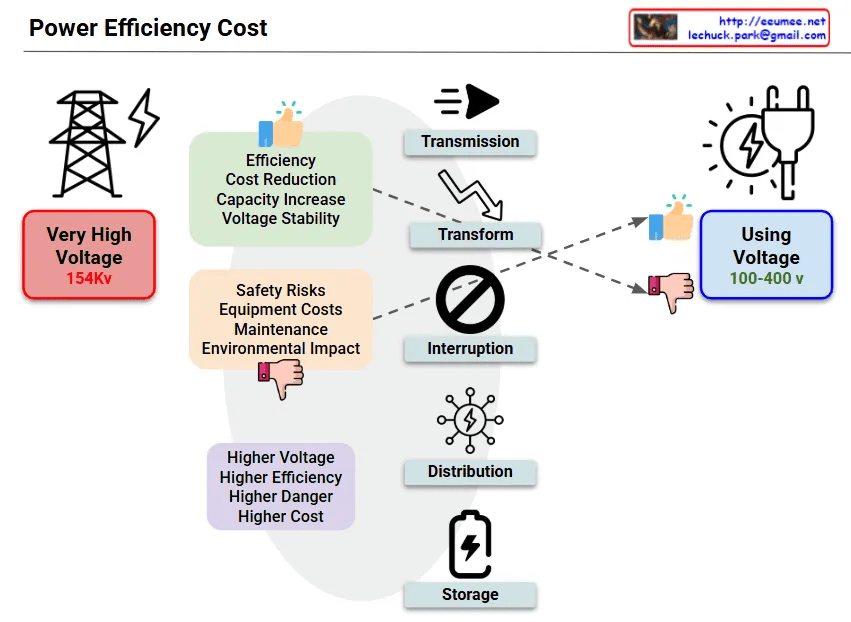
Power Efficiency Cost

AI Data Center Power Efficiency Analysis

The Power Design Dilemma in AI Data Centers

AI data centers, comprised of power-hungry GPU clusters and high-performance servers, face critical decisions where power efficiency directly impacts operational costs and performance capabilities.

The Need for High-Voltage Distribution Systems

  • AI Workload Characteristics: GPU training operations consume hundreds of kilowatts to megawatts continuously
  • Power Density: High power density of 50-100kW per rack demands efficient power transmission
  • Scalability: Rapid power demand growth following AI model size expansion

Efficiency vs Complexity Trade-offs

Advantages (Efficiency Perspective):

  • Minimized Power Losses: High-voltage transmission dramatically reduces I²R losses (potential 20-30% power cost savings)
  • Cooling Efficiency: Reduced power losses mean less heat generation, lowering cooling costs
  • Infrastructure Investment Optimization: Fewer, larger cables can deliver massive power capacity

Disadvantages (Operational Complexity):

  • Safety Risks: High-voltage equipment requires specialized expertise, increased accident risks
  • Capital Investment: Expensive high-voltage transformers, switchgear, and protection equipment
  • Maintenance Complexity: Specialized technical staff required, extended downtime during outages
  • Regulatory Compliance: Complex permitting processes for electrical safety and environmental impact

AI DC Power Architecture Design Strategy

  1. Medium-Voltage Distribution: 13.8kV → 480V stepped transformation balancing efficiency and safety
  2. Modularization: Pod-based power delivery for operational flexibility
  3. Redundant Backup Systems: UPS and generator redundancy preventing AI training interruptions
  4. Smart Monitoring: Real-time power quality surveillance for proactive fault prevention

Financial Impact Analysis

  • CAPEX: 15-25%(?) higher initial investment for high-voltage infrastructure
  • OPEX: 20-35%(?) reduction in power and cooling costs over facility lifetime
  • ROI: Typically 18-24(?) months payback period for hyperscale AI facilities

Conclusion

AI data centers must identify the optimal balance between power efficiency and operational stability. This requires prioritizing long-term operational efficiency over initial capital costs, making strategic investments in sophisticated power infrastructure that can support the exponential growth of AI computational demands while maintaining grid-level reliability and safety standards.

with Claude

AI driven Machine Operation Optimization 

From DALL-E with some prompting
The image illustrates an AI-driven approach to machine operation optimization, with a detailed operation plan that incorporates expert risk assessments. The process is structured as follows:

  1. AI Guide:
    • AI recommends strategies for optimizing operations, including metrics like the number of operations, operating ratio, and load balancing.
  2. Operation Plan:
    • This section emphasizes the creation of a comprehensive operation plan that includes expert assessments of risk and importance in case of failures, alongside safety and emergency response strategies. It also suggests a methodical plan for incrementally applying AI to operations.
  3. Operation Risk and Step-by-Step Operation Expansion:
    • It involves managing operational risks identified by domain experts and the systematic expansion of operations using AI guidance. The gradual application of AI is based on expert risk assessments, leading to a refined approach to risk management and the transformation of operations towards AI-driven processes.

In summary, the key to successfully optimizing operations through AI involves leveraging the expertise of domain professionals to assess risks and guide the step-by-step implementation of AI strategies, ensuring operations are both efficient and secure. 

Facility with AI

From DALL-E with some prompting
The image represents the integration of AI into facility operation optimization. The process begins with AI suggesting guidelines based on predictive models that take into account variables like weather temperature and cooling load. These models undergo evaluation and analysis to assess risks and efficiency before being validated.

Guidance for optimization is then provided, focusing on reducing power usage in cooling towers, chillers, and pumps. A domain operator analyzes the risks and efficiency gains from the proposed changes.

The final stage involves a gradual application of the AI recommendations to the actual operation, with continuous updates to the AI model ensuring real-time adaptability. The percentage indicates the extent to which the AI’s guidance is applied, suggesting that while the guide may be 100% complete, the actual application may vary.

This is followed by the application and analysis (monitoring) phase, which ensures that the optimizations are working as intended and provides feedback for further improvements. This iterative process emphasizes the importance of continuously refining AI-driven operations to maintain optimal performance with minimal risk.

AI-Driven Facility Operations Implementation

From DALL-E with some prompting
The image depicts the process of applying operational optimization to machinery using AI-driven data analysis. It emphasizes the necessity of incrementally and step-by-step implementing AI-suggested optimizations while considering operational stability. AI collects and analyzes machine data to propose optimizations, which are then tested and verified in stages before full operational implementation. This approach underlines the importance of minimizing operational risks while effectively deploying AI solutions