HTTP/3 with QUIC & TLS1.3

From Claude with some prompting
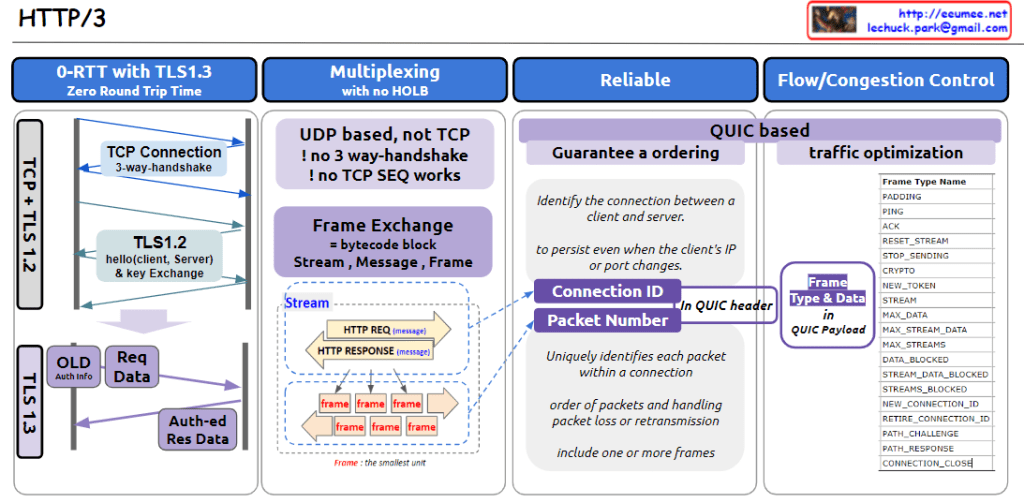
This image provides an overview of HTTP/3, highlighting its key features and components:

  1. 0-RTT with TLS1.3 (Zero Round Trip Time):
    • Compares TLS 1.2 and 1.3 connection processes.
    • TLS 1.3 offers faster handshake, reducing latency.
  2. Multiplexing with no HOLB (Head-of-Line Blocking):
    • UDP-based, eliminating TCP’s 3-way handshake and TCP SEQ.
    • Uses frame exchange, structured as streams, messages, and frames.
  3. Reliable:
    • QUIC-based, ensuring reliable data transfer.
    • Uses Connection ID to maintain connections despite client IP or port changes.
    • Packet Number uniquely identifies each packet within a connection.
  4. Flow/Congestion Control:
    • Lists various frame types for traffic optimization.

The diagram emphasizes that HTTP/3 is UDP-based and utilizes the QUIC protocol to enhance connection reliability and efficiency. It illustrates core concepts such as frame-based data exchange and the use of Connection IDs.

The image also details the QUIC header structure, explains how packet ordering and loss handling work, and provides a comprehensive list of frame types used in HTTP/3.

Overall, this diagram effectively visualizes the improvements HTTP/3 brings over its predecessors in terms of speed, reliability, and efficiency in data transfer.
TCP Reliable 1

From Claude with some prompting
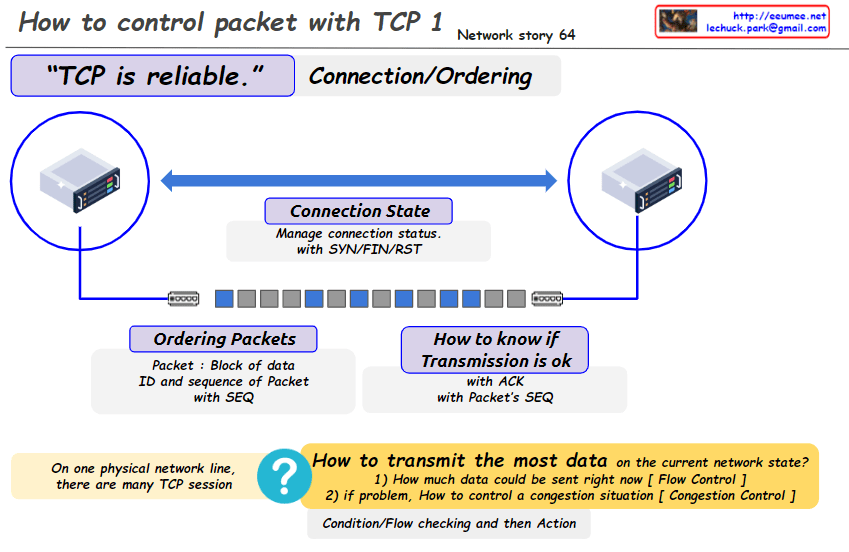
This image explains how packets are controlled and transmitted using TCP (Transmission Control Protocol), which is a reliable communication protocol.

The key points are:

  1. TCP is reliable and provides connection/ordering of packets.
  2. Connection state is managed using SYN/FIN/RST packets to establish, maintain, and tear down connections.
  3. Packets are organized into an ordered sequence using sequence numbers (SEQ).
  4. Acknowledgments (ACK) with the packet’s SEQ number indicate successful transmission.

The image also raises two main questions:

  1. How much data can be sent right now based on the current network state? (Flow Control)
  2. If there is a problem, how to control congestion? (Congestion Control)

The image suggests that condition/flow checking should be performed, and then appropriate action taken for transmitting the most data possible on the current network state while handling potential congestion situations.

Data Quality

From Claude with some prompting
This image is an infographic explaining the concept of data quality. It shows the flow of data from a facility or source, going through various stages of power consumption like generating, medium, converting, network, and computing power. The goal is to ensure reliable data with good performance and high resolution for optimal analysis and better insights represented by icons and graphs.

The key aspects highlighted are:

  1. Data origin at a facility
  2. Different power requirements at each data stage (generating, medium, converting, network, computing)
  3. Desired qualities of reliable data, good performance, high resolution
  4. End goal of collecting/analyzing data for better insights

The infographic uses a combination of text labels, icons, and diagrams to illustrate the data quality journey from source to valuable analytical output in a visually appealing manner.

RAG

From Claude with some prompting
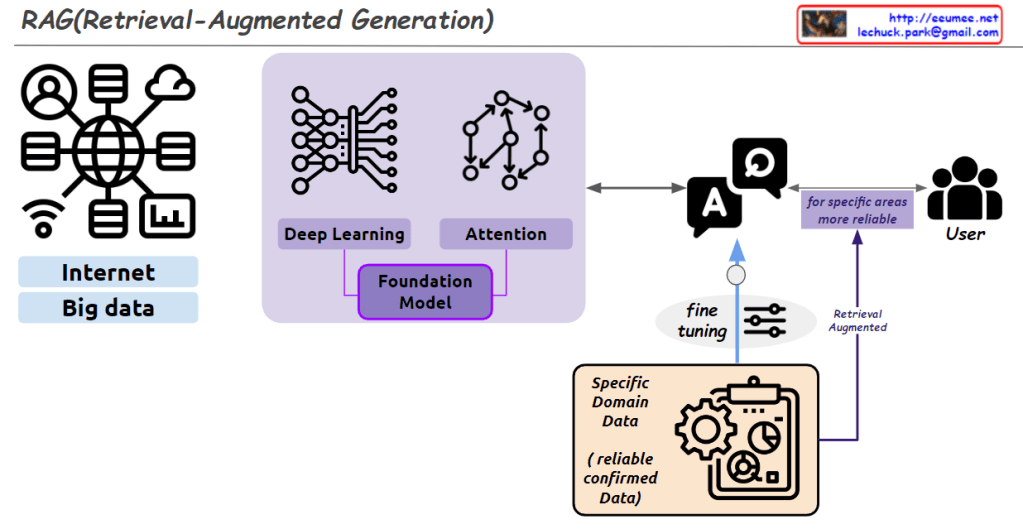
This image explains the concept and structure of the RAG (Retrieval-Augmented Generation) model.

First, a large amount of data is collected from the “Internet” and “Big Data” to train a Foundation Model. This model utilizes Deep Learning and Attention mechanisms.

Next, the Foundation Model is fine-tuned using reliable and confirmed data from a Specific Domain (Specific Domain Data). This process creates a model specialized for that particular domain.

Ultimately, this allows the model to provide more reliable responses to users in that specific area. The overall process is summarized by the concept of Retrieval-Augmented Generation.

The image visually represents the components of the RAG model and the flow of data through the system effectively.

TCP vs UDP

From DALL-E with some prompting
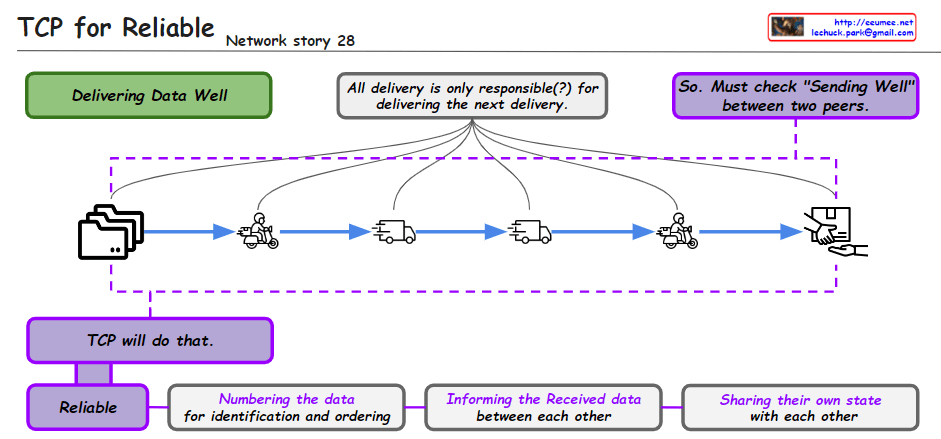
This image explains how TCP provides reliable data transmission compared to UDP and underscores the reasons for this reliability. While UDP has a simple header structure utilizing basic port numbers and checksums, TCP includes additional fields in its header to ensure reliability. These supplementary fields encompass sequence and acknowledgment numbers for confirming data transmission and ordering, flags for connection state management, window size for flow control, and mechanisms for congestion control. The reliability of TCP is enabled through this complex header structure, with each field playing an essential role in ensuring accurate and dependable data transfer. Therefore, the reliability of all TCP communications is established through these specific fields in the header, emphasizing that TCP not just ‘enables’ reliability but ‘implements’ it in practice.