Intelligent Event Analysis Framework

Intelligent Event Processing Architecture Analysis

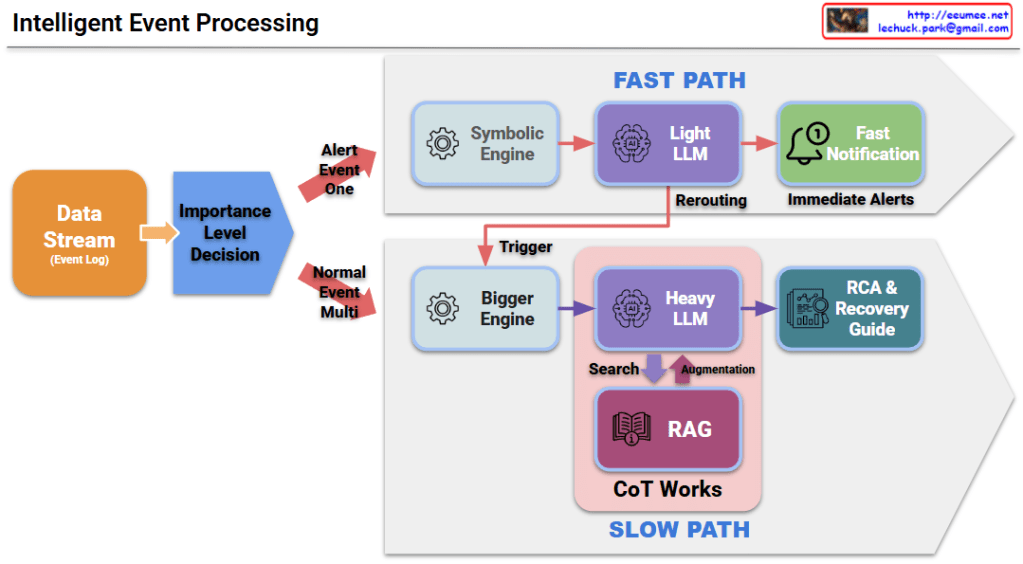
The provided diagrams, titled Event Level Flow and Intelligent Event Processing, illustrate a sophisticated dual-path framework designed to optimize incident response within data center environments. This architecture effectively balances the need for immediate awareness with the requirement for deep, evidence-based diagnostics.


1. Data Ingestion and Intelligent Triage

The process begins with a continuous Data Stream of event logs. An Importance Level Decision gate acts as a triage point, routing traffic based on urgency and complexity:

  • Critical, single-source issues are designated as Alert Event One and sent to the Fast Path.
  • Standard or bulk logs are labeled Normal Event Multi and directed to the Slow Path for batch or deeper processing.

2. Fast Path: The Low-Latency Response Track

This path minimizes the time between event detection and operator awareness.

  • A Symbolic Engine handles rapid, rule-based filtering.
  • A Light LLM (typically a smaller parameter model) summarizes the event for human readability.
  • The Fast Notification system delivers immediate alerts to operators.
  • Crucially, a Rerouting function triggers the Slow Path, ensuring that even rapidly reported issues receive full analytical scrutiny.

3. Slow Path: The Comprehensive Diagnostic Track

The Slow Path focuses on precision, using advanced reasoning to solve complex problems.

  • Upon receiving a Trigger, a Bigger Engine prepares the data for high-level inference.
  • The Heavy LLM executes Chain of Thought (CoT) Works, breaking down the incident into logical steps to avoid errors.
  • This is supported by a Retrieval-Augmented Generation (RAG) system that performs a Search across internal knowledge bases (like manuals) and performs an Augmentation to enrich the LLM prompt with specific context.
  • The final output is a comprehensive Root Cause Analysis (RCA) and an actionable Recovery Guide.

Summary

  1. This architecture bifurcates incident response into a Fast Path for rapid awareness and a Slow Path for in-depth reasoning.
  2. By combining lightweight LLMs for speed and heavyweight LLMs with RAG for accuracy, it ensures both rapid alerting and reliable recovery guidance.
  3. The integration of symbolic rules and AI-driven Chain of Thought logic enhances both the operational efficiency and the technical reliability of the system.

#AIOps #LLM #RAG #DataCenter #IncidentResponse #IntelligentMonitoring #AI_Operations #RCA #Automation

With Gemini
Event Processing

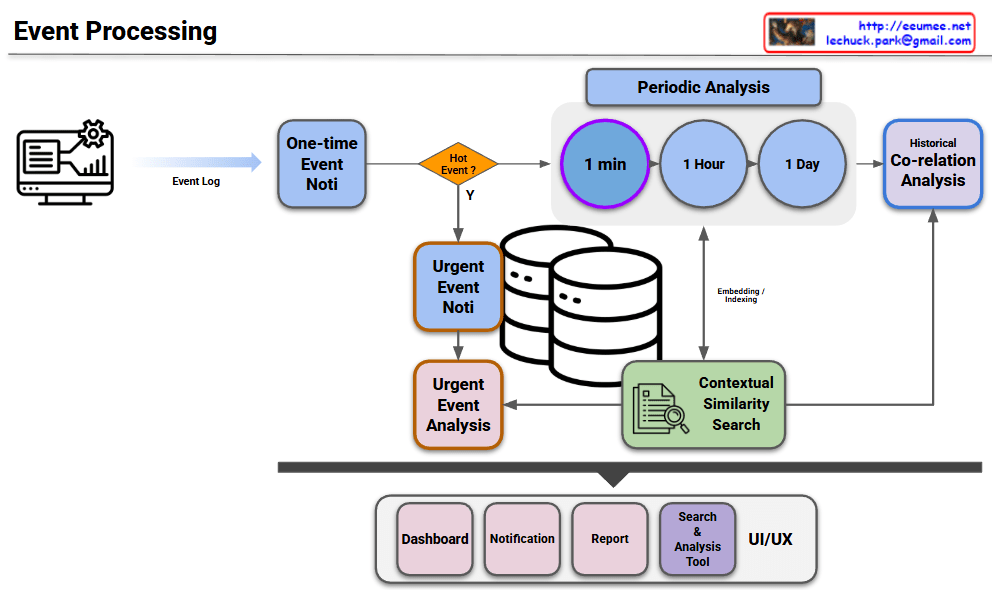
This diagram illustrates a workflow that handles system logs/events by dividing them into real-time urgent responses and periodic deep analysis.

1. Data Ingestion & Filtering

  • Event Log → One-time Event Noti: The process begins with incoming event logs triggering an initial, single-instance notification.
  • Hot Event Decision: A decision node determines if the event is critical (“Hot Event?”). This splits the workflow into two distinct paths: a Hot Path for emergencies and an Analytical Path for deeper insights.

2. Hot Path (Real-time Response)

  • Urgent Event Noti & Analysis: If identified as a “Hot Event,” the system immediately issues an urgent notification and performs an urgent analysis while persisting the data to the database. This path appears designed to minimize MTTD (Mean Time To Detect) for critical failures.

3. Periodic & Contextual Analysis (AIOps Layer)

This section indicates a shift from simple monitoring to intelligent AIOps.

  • Periodic Analysis: Events are aggregated and analyzed over fixed time windows (1 min, 1 Hour, 1 Day). The purple highlight on “1 min” suggests the current focus is on short-term trend analysis.
  • Contextual Similarity Search: This is a critical advanced feature. By explicitly mentioning “Embedding / Indexing,” the architecture suggests the use of Vector Search (likely via a Vector DB). It implies the system doesn’t just match keywords but understands the semantic context of an error to find similar past cases.
  • Historical Co-relation Analysis: This module synthesizes the periodic trends and similarity search results to correlate the current event with historical patterns, aiding in Root Cause Analysis (RCA).

4. User Interface (UI/UX)

The processed insights are delivered to the user through four channels:

  • Dashboard: High-level status visualization.
  • Notification: Alerts for urgent issues.
  • Report: Summarized periodic findings.
  • Search & Analysis Tool: A tool for granular log investigation.

Summary

  1. Hybrid Architecture: Efficiently separates critical “Hot Event” handling (Real-time) from deep “Periodic Analysis” (Batch) to balance speed and insight.
  2. Semantic Intelligence: Incorporates “Contextual Similarity Search” using Embeddings, enabling the system to identify issues based on meaning rather than just keywords.
  3. Holistic Observability: interconnected modules (Urgent, Periodic, Historical) feed into a comprehensive UI/UX to support rapid decision-making and post-mortem analysis.

#EventProcessing #SystemArchitecture #VectorSearch #Observability #RCA