Human language simplifies the world into words and symbols, but its limits soon appear. Through mathematical abstraction, these simplified ideas transform into precise equations. Only then can the hidden reality of quantum mechanics—waves, probability, and uncertainty—be revealed.
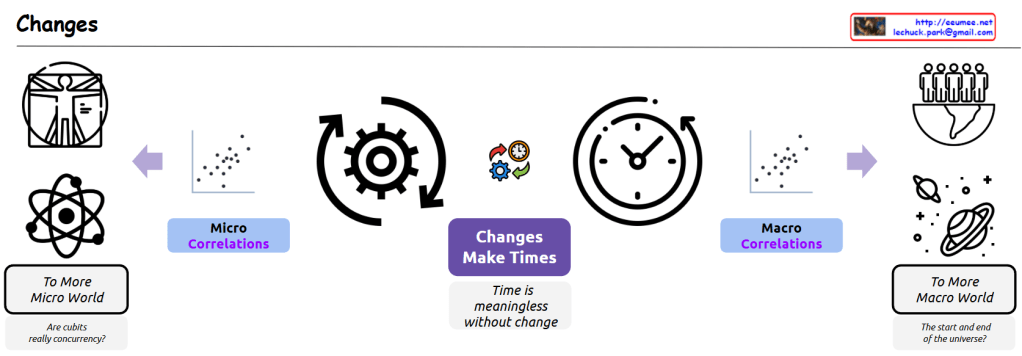
This image is a conceptual diagram titled “Changes” that explores the relationship between time and change. Let me break down its key components:
In the center:
There’s a large gear icon and clock symbol with the text “Changes Make Times”
Below it states “Time is meaningless without change”
On the left side:
Icons showing the Vitruvian Man and an atomic structure
Labeled “Micro Correlations”
Text reading “To More Micro World”
Poses the question “Are qubits really concurrency?”
On the right side:
Icons depicting humanity on Earth and celestial objects
Labeled “Macro Correlations”
Text reading “To More Macro World”
Poses the question “The start and end of the universe?”
Throughout the diagram, there are scatter plot graphs and arrows suggesting connections between these different scales.
This diagram appears to be exploring a philosophical and scientific concept about how change and time are interconnected across all scales – from the quantum level (micro) to the cosmic scale (macro). The central thesis seems to be that change is fundamental to our understanding and experience of time, as suggested by the statement that time is meaningless without change.
The diagram suggests a continuous spectrum of investigation from quantum mechanics (represented by qubits) all the way to cosmology (represented by questions about the universe’s beginning and end), with change being the common thread that connects these different scales of existence.
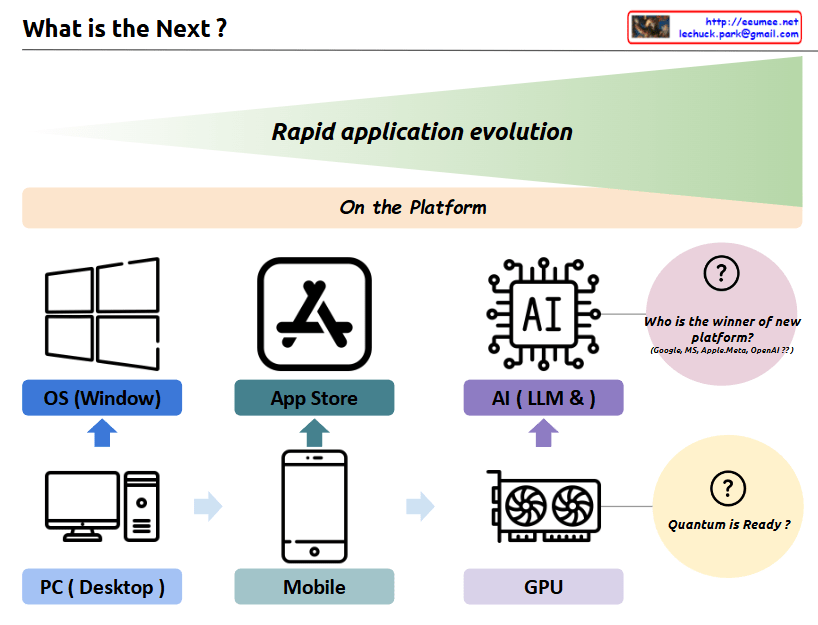
With Claude a comprehensive interpretation of the image and its concept of “Rapid application evolution”:
The diagram illustrates the parallel evolution of both hardware infrastructure and software platforms, which has driven rapid application development and user experiences:
Hardware Infrastructure Evolution:
PC/Desktop → Mobile Devices → GPU
Represents the progression of core computing power platforms
Each transition brought fundamental changes in how users interact with technology
Software Platform Evolution:
Windows OS → App Store → AI/LLM
Shows the evolution of application ecosystems
Each platform created new possibilities for user applications
The symbiotic relationship between these two axes:
PC Era: Integration of PC hardware with Windows OS
Mobile Era: Combination of mobile devices with app store ecosystems
AI Era: Marriage of GPU infrastructure with LLM/AI platforms
Each transition has led to exponential growth in application capabilities and user experiences, with hardware and software platforms developing in parallel and reinforcing each other.
Future Outlook:
“Who is the winner of new platform?”
Current competition between Google, MS, Apple/Meta, OpenAI
Platform leadership in the AI era remains undecided
Possibility for new players to emerge
“Quantum is Ready?”
Suggests quantum computing as the next potential hardware revolution
Implies the possibility of new software platforms emerging to leverage quantum capabilities
Continues the pattern of hardware-software co-evolution
This cyclical pattern of hardware-software evolution suggests that we’ll continue to see new infrastructure innovations driving platform development, and vice versa. Each cycle has dramatically expanded the possibilities for applications and user experiences, and this trend is likely to continue with future technological breakthroughs.
The key insight is that major technological leaps happen when both hardware infrastructure and software platforms evolve together, creating new opportunities for application development and user experiences that weren’t previously possible.
With a Claude’s Help This image illustrates a comparison between key quantum physics characteristics and human society, titled “Quantum likes humans.”
It presents three main quantum properties:
Superposition
Quantum: 0 and 1 exist at the same time, with many (0|1) q-bits existing simultaneously
Human society parallel: Many people exist in mankind at the same time
Entanglement
Quantum: All (0|1) q-bits are connected, even from a distance
Human society parallel: All people are connected
Interference
Quantum: Can adjust overall probability through one q-bit
Human society parallel: One could influence the group (humans)
The image is structured with:
Left column: Quantum-related icons/symbols
Middle: Blue boxes with quantum physics concepts and their descriptions in gray boxes
Right: Green boxes showing human society analogies with simple stick figure illustrations
Each concept is visualized to make complex quantum principles more relatable by drawing parallels with human social dynamics.
This visualization effectively simplifies complex quantum mechanics concepts by relating them to familiar human social behaviors and relationships, making the concepts more accessible to a general audience.
From Claude with some prompting The image illustrates “The Quantum of Communication”. Here, ‘quantum’ doesn’t refer to the physics concept, but rather to numbers as the smallest unit of communication that can be understood uniformly among humans with minimal misinterpretation.
Key elements of the image:
Natural language communication:
At the top, two human figures are shown with speech bubbles and intermediary elements between them.
Both sides state “Same Words Diff Meanings by Personals”.
The center reads “Never Exist Perfect Communications.” This represents how natural language can lead to misunderstandings, as the same words may be interpreted differently by individuals.
Numerical communication:
The lower section has a circular area labeled “By Numbers”.
Inside this circle, there’s an icon representing binary code (01) and what appears to be a mathematical formula or equation.
The bottom text reads “More Better Perfect Communications.” This suggests that communication using numbers can be more precise and less prone to misinterpretation.
The image presents the idea that in human communication, ‘numbers’ can serve as the clearest and most universally understood minimal unit – the ‘quantum’ of communication. It contrasts the ambiguity and potential for misunderstanding in natural language with the precision of numerical expression. The overall message is that numerical or mathematical communication offers a more accurate and perfect form of information exchange compared to the variability in natural language interpretation.
From Claude with some prompting “The image presents an intriguing perspective on Matter and Energy, which aligns with your interpretation. Let me break it down:
Equivalence of Matter and Energy: The image shows matter and energy as essentially the same concept, symbolized by the equation ‘Matter = Energy’. This aligns with Einstein’s famous equation E=mc².
Energy Units: The diagram depicts ‘Energy Units’ as having ‘Pulling Power’. This corresponds to your mention of gravity or attractive forces being inherent in these fundamental units.
Nature of Matter: Matter is represented as a ‘Packet of Energy’ or ‘Packet of Mass’. This supports your view that matter is essentially a highly concentrated form of energy.
Pulling Power: The image shows ‘Pulling Power’ both inside and outside the energy packet, which could represent internal binding forces and external gravitational forces.
Unified Concept: The overall message seems to be that matter is simply energy in a very condensed form, with each fundamental unit exhibiting some form of attractive force.
This approach shares similarities with some concepts in modern physics, particularly aspects of quantum mechanics and relativity theory. It emphasizes the fundamental connection between matter and energy, potentially offering a more unified understanding of the universe.
However, it’s important to note that while this is an interesting conceptual model, real-world physics involves more complex interactions and phenomena. Nevertheless, this perspective provides a thought-provoking philosophical and conceptual approach to understanding the relationship between matter and energy.”



 Lechuck Park