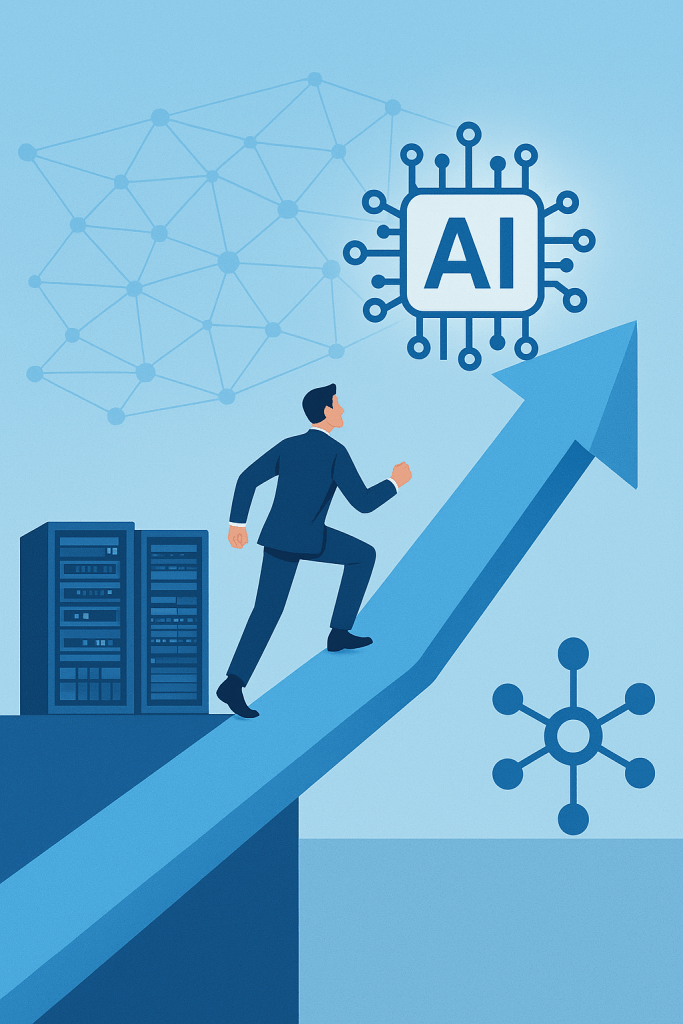
This image visualizes humanity’s endless desire for ‘difference’ as the creative force behind ‘newness.’ The organic human brain fuses with the logical AI circuitry, and from their core, a burst of light emerges. This light symbolizes not just the expansion of knowledge, but the very moment of creation, transforming into unknown worlds and novel concepts.
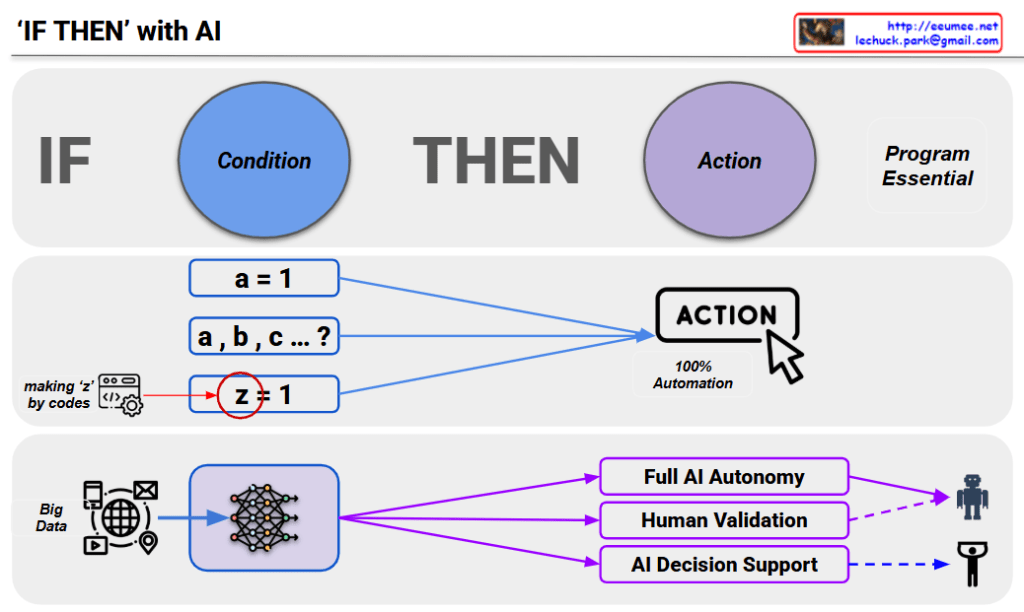
This image is a diagram titled “IF-THEN with AI” that explains conditional logic and automation levels in AI systems.
Top Section: Basic IF-THEN Structure
IF (Condition): Conditional part shown in blue circle
THEN (Action): Execution part shown in purple circle
Marked as “Program Essential,” emphasizing it as a core programming element
Middle Section: Evolution of Conditional Complexity
AI is ultimately a program, and like humans who wanted to predict by sensing data, making judgments, and taking actions based on those criteria. IF-THEN is essentially prediction – the foundation of programming that involves recognizing situations, making judgments, and taking actions.
Evolution stages of data/formulas:
a = 1: Simple value
a, b, c … ?: Processing multiple complex values simultaneously
Z ≠ 1: A condition that finds the z value through code on the left and compares it to 1 (highlighted with red circle, with annotation “making ‘z’ by codes”)
Now we input massive amounts of data and analyze with AI, though it has somewhat probabilistic characteristics.
Bottom Section: Evolution of AI Decision-Making Levels
Starting from Big Data through AI networks, three development directions:
Full AI Autonomy: Complete automation that evolved to “Fine, just let AI handle it”
Human Validation: Stage where humans evaluate AI judgments and incorporate them into operations
AI Decision Support: Approach where humans initially handle the THEN action
Key Perspective: While these three development directions exist, there’s a need for judgment regarding decisions based on the quality of data used in analysis/judgment. This diagram shows that it’s not just about automation levels, but that data quality-based reliability assessment is a crucial consideration.
Summary
This diagram illustrates the evolution from simple conditional programming to complex AI systems, emphasizing that AI fundamentally operates on IF-THEN logic for prediction and decision-making. The key insight is that regardless of automation level, the quality of input data remains critical for reliable AI decision-making processes.
Theory Driven: Based on mathematical theories and logical reasoning
Programmable with Design: Implemented through explicit rules and algorithms
Sequential by CPU: Tasks are processed one at a time in sequence
Precise & Explainable: Results are accurate and decision-making processes are transparent
Empirical Approach
Data Driven: Based on real data and observations
Deep Learning with Learn: Neural networks automatically learn from data
Parallel by GPU: Multiple tasks are processed simultaneously for improved efficiency
Approximate & Unexplainable: Results are approximations and internal workings are difficult to explain
Summary
This diagram illustrates the key differences between traditional programming methods and modern machine learning approaches. The analytical approach follows clearly defined rules designed by humans and can precisely explain results, while the empirical approach learns patterns from data and improves efficiency through parallel processing but leaves decision-making processes as a black box.
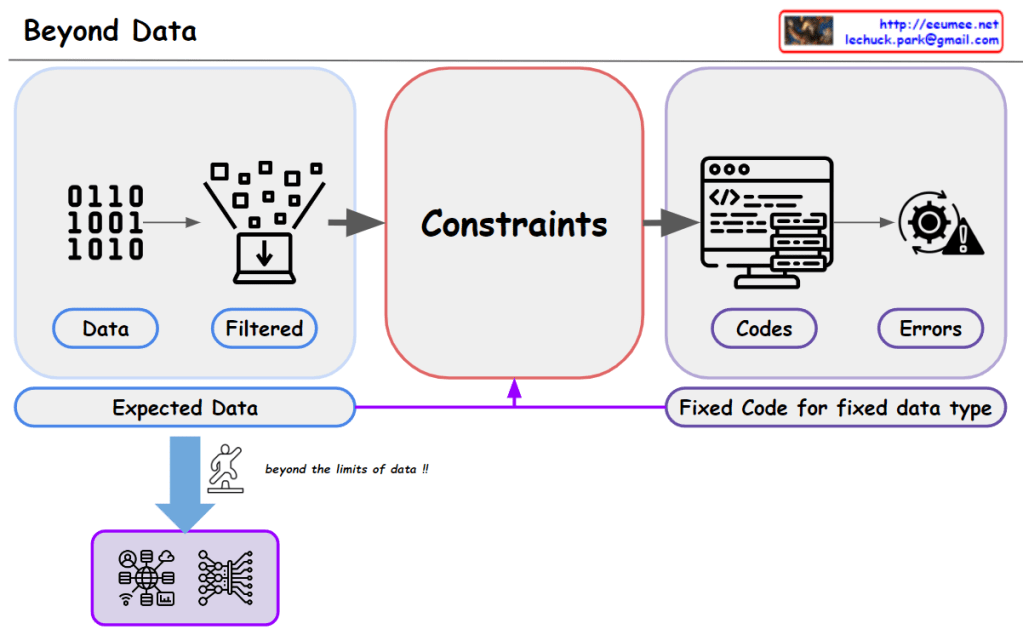
From DALL-E with some prompting This image depicts the process of overcoming the constraints of traditional programming based on expected data through big data and deep learning. Starting on the left, binary digits labeled as “Data” are processed through a “Filtered” stage to become the necessary “Expected Data.” The box labeled “Constraints” in the center represents the limitations that can occur in programming. These constraints suggest barriers that can be overcome with big data processing and deep learning technologies. On the right, there’s a section transitioning from “Codes” to “Errors,” which signifies possible errors during the coding process. However, the text “Fixed Code for fixed data type” reflects that program code is pre-established for expected data types and does not transcend the boundaries of this data, thereby limiting its potential. The phrase “beyond the limits of data!!” at the bottom expresses the ambition of future programming to surpass the limitations of data processing by utilizing big data and deep learning.
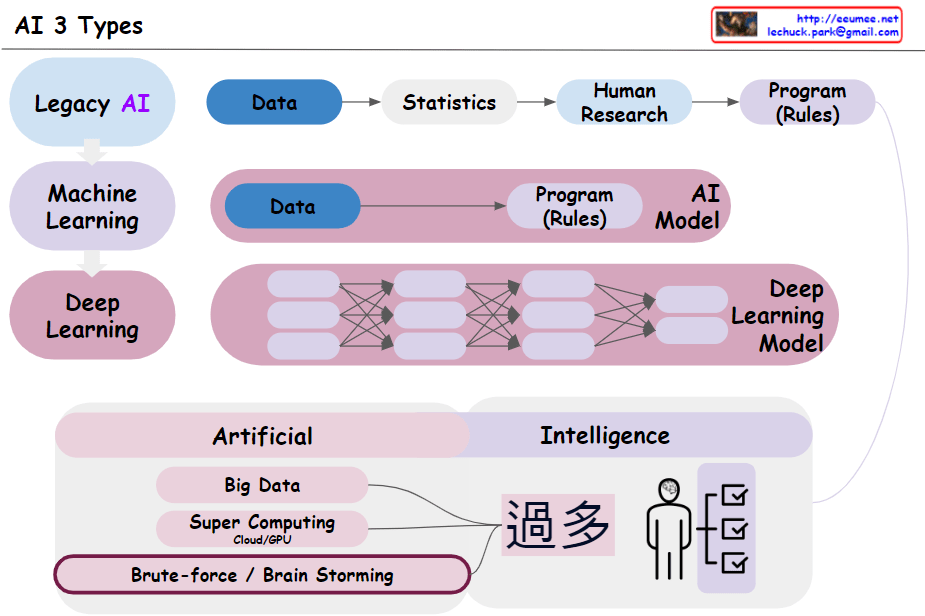
From DALL-E with some prompting The image depicts the three stages of AI forming artificial intelligence through repeated classification tasks based on data:
Legacy AI derives statistics from data and transforms them into rule-based programs through human research.
Machine Learning evolves these rules into AI models capable of executing more complex functions.
Deep Learning uses deep neural networks to process data and create complex models that perform cognitive tasks.
In this process, AI leverages extensive data for repetitive classification tasks, and the result is what we refer to as ‘intelligence.’ However, this intelligence is not an emulation of human thought processes but rather a product of data processing and algorithms, which qualifies it as ‘artificial intelligence.’ This underlines that the ‘artificial’ in AI corresponds to intelligence derived artificially rather than naturally through human cognition.
From DALL-E with some prompting The image highlights the centrality of data in digital operations. Data manifests in various forms and is at the core of all digital processes, from traditional CPU tasks to contemporary AI/ML services. The CPU utilizes the Von Neumann architecture to execute instructions that process data. Programs manipulate this data to perform desired operations. Databases store and manage this data, while AI/ML learns from the data and generates predictive models. Ultimately, all these processes culminate in services that are delivered to users. Throughout these stages, the fundamental programming principle of ‘If’ (condition) and ‘Then’ (action) is applied, facilitating data-driven decisions and enabling automated processing.



 Lechuck Park