Transformer

From Claude with some prompting
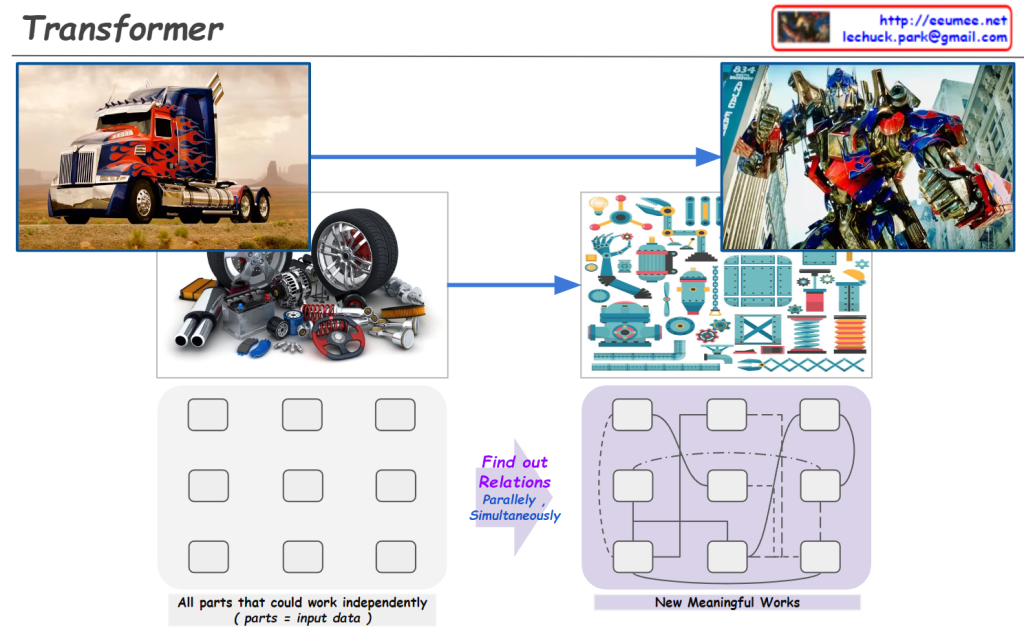
The image is using an analogy of transforming vehicles to explain the concept of the Transformer architecture in AI language models like myself.

Just like how a vehicle can transform into a robot by having its individual components work in parallel, a Transformer model breaks down the input data (e.g. text) into individual elements (tokens/words). These elements then go through a series of self-attention and feed-forward layers, processing the relationships between all elements simultaneously and in parallel.

This allows the model to capture long-range dependencies and derive contextual meanings, eventually transforming the input into a meaningful representation (e.g. understanding text, generating language). The bottom diagram illustrates this parallel and interconnected nature of processing in Transformers.

So in essence, the image draws a clever analogy between transforming vehicles and how Transformer models process and “transform” input data into contextualized representations through its parallelized and self-attentive computations.

GPU works for

From ChatGPT with some prompting
The image is a schematic representation of GPU applications across three domains, emphasizing the GPU’s strength in parallel processing:

Image Processing: GPUs are employed to perform parallel updates on image data, which is often in matrix form, according to graphical instructions, enabling rapid rendering and display of images.

Blockchain Processing: For blockchain, GPUs accelerate the calculation of new transaction hashes and the summing of existing block hashes. This is crucial in the race of mining, where the goal is to compute new block hashes as efficiently as possible.

Deep Learning Processing: In deep learning, GPUs are used for their ability to process multidimensional data, like tensors, in parallel. This speeds up the complex computations required for neural network training and inference.

A common thread across these applications is the GPU’s ability to handle multidimensional data structures—matrices and tensors—in parallel, significantly speeding up computations compared to sequential processing. This parallelism is what makes GPUs highly effective for a wide range of computationally intensive tasks.

The parallel world

From DALL-E with some prompting
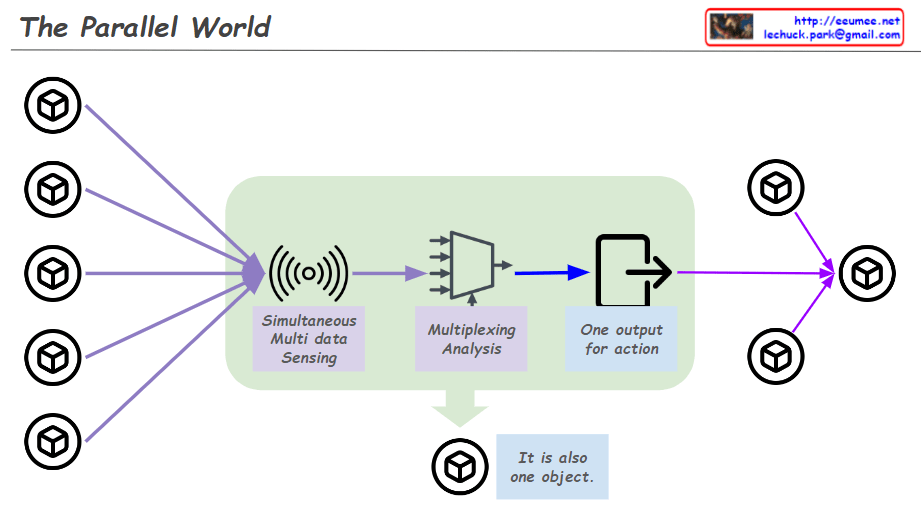
The Parallel World diagram showcases a robust system architecture where multiple hexagon-shaped data sources represent a concurrent data collection network. Each source simultaneously sends information to a central processing unit, highlighted by a symbol of radio waves, indicating simultaneous multi-data sensing. This information undergoes parallel processing within the green-shaded area, where a ‘Multiplexing Analysis’ mechanism filters and combines the various data streams. Although the visible outcome is a single decisive output for action, this representation underscores the substantial parallel processing that occurs behind the scenes. This parallelism ensures that the system maximizes efficiency and response times, embodying the concept that, in the grand scheme, the majority of operations are processed in parallel, even if they converge into a singular action.

GPU techs

From DALL-E with some prompting
The image illustrates various aspects of GPU technology. Firstly, ‘Multi Input’ and ‘Direct Memory Access’ signify that GPUs efficiently receive data from multiple sources and optimize memory access. PCIe NVMe represents the hardware interface for fast data transfer.

Secondly, ‘Multi Computing’ and ‘Parallel Processing’ highlight the core capabilities of GPUs, which can process multiple operations simultaneously. ‘Nano Superconductivity no loss power’ suggests the use of nano-technology and superconductivity for efficient power transmission without energy loss.

Thirdly, the cooling system of the GPU is essential for managing heat and maintaining performance, indicating the importance of cooling technologies in high-performance computing to keep GPU temperatures stable.

Finally, ‘AI output’ shows that all these technologies are ultimately employed for processing data and outputting results for artificial intelligence applications.

This diagram provides an overview of the entire process of GPU technology, from data input through complex calculations and cooling systems, to the output for AI applications.