Massive simple parallel computing

This diagram presents a systematic framework that defines the essence of AI LLMs as “Massive Simple Parallel Computing” and systematically outlines the resulting issues and challenges that need to be addressed.

Core Definition of AI LLM: “Massive Simple Parallel Computing”

Massive: Enormous scale with billions of parameters Simple: Fundamentally simple computational operations (matrix multiplications, etc.) Parallel: Architecture capable of simultaneous parallel processing Computing: All of this implemented through computational processes

Core Issues Arising from This Essential Nature

Big Issues:

  • Black-box unexplainable: Incomprehensibility due to massive and complex interactions
  • Energy-intensive: Enormous energy consumption inevitably arising from massive parallel computing

Essential Requirements Therefore Needed

Very Required:

  • Verification: Methods to ensure reliability of results given the black-box characteristics
  • Optimization: Approaches to simultaneously improve energy efficiency and performance

The Ultimate Question: “By What?”

How can we solve all these requirements?

In other words, this framework poses the fundamental question about specific solutions and approaches to overcome the problems inherent in the essential characteristics of current LLMs. This represents a compressed framework showing the core challenges for next-generation AI technology development.

The diagram effectively illustrates how the defining characteristics of LLMs directly lead to significant challenges, which in turn demand specific capabilities, ultimately raising the critical question of implementation methodology.

With Claude

Together is not easy

This infographic titled “Together” emphasizes the critical importance of parallel processing = working together across all domains – computing, AI, and human society.

Core Concept:

The Common Thread Across All 5 Domains – ‘Parallel Processing’:

  1. Parallel Processing – Simultaneous task execution in computer systems
  2. Deep Learning – AI’s multi-layered neural networks learning in parallel
  3. Multi Processing – Collaborative work across multiple processors
  4. Co-work – Human collaboration and teamwork
  5. Social – Collective cooperation among community members

Essential Elements of Parallel Processing:

  • Sync (Synchronization) – Coordinating all components to work harmoniously
  • Share (Sharing) – Efficient distribution of resources and information
  • Optimize (Optimization) – Maximizing performance while minimizing energy consumption
  • Energy (Energy) – The inevitable cost required when working together

Reinterpreted Message: “togetherness is always difficult, but it’s something we have to do.”

This isn’t merely about the challenges of cooperation. Rather, it conveys that parallel processing (working together) in all systems requires high energy costs, but only through optimization via synchronization and sharing can we achieve true efficiency and performance.

Whether in computing systems, AI, or human society – all complex systems cannot advance without parallel cooperation among individual components. This is an unavoidable and essential process for any sophisticated system to function and evolve. The insight reveals a fundamental truth: the energy investment in “togetherness” is not just worthwhile, but absolutely necessary for progress.

With Claude

Parallel Processing

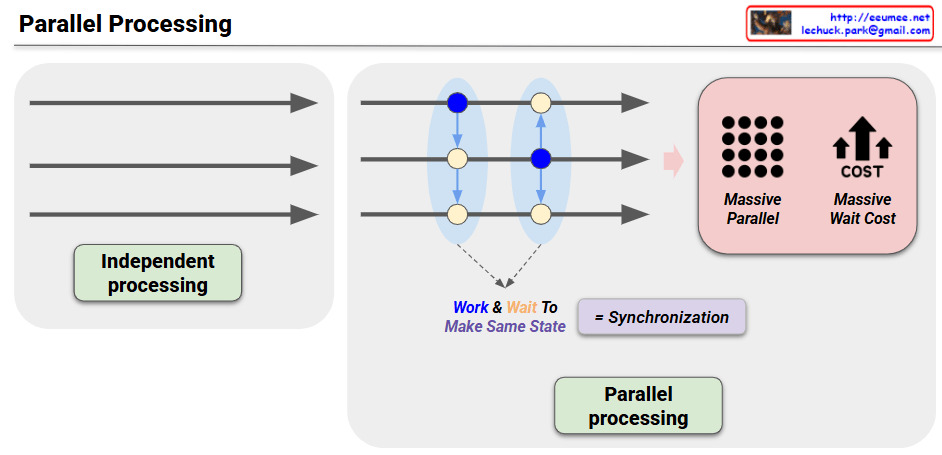
Parallel Processing System Analysis

System Architecture

1. Input Stage – Independent Processing

  • Multiple tasks are simultaneously input into the system in parallel
  • Each task can be processed independently of others

2. Central Processing Network

Blue Nodes (Modification Work)

  • Processing units that perform actual data modifications or computations
  • Handle parallel incoming tasks simultaneously

Yellow Nodes (Propagation Work)

  • Responsible for propagating changes to other nodes
  • Handle system-wide state synchronization

3. Synchronization Stage

  • Objective: “Work & Wait To Make Same State”
  • Wait until all nodes reach identical state
  • Essential process for ensuring data consistency

Performance Characteristics

Advantage: Massive Parallel

  • Increased throughput through large-scale parallel processing
  • Reduced overall processing time by executing multiple tasks simultaneously

Disadvantage: Massive Wait Cost

  • Wait time overhead for synchronization
  • Entire system must wait for the slowest node
  • Performance degradation due to synchronization overhead

Key Trade-off

Parallel processing systems must balance performance enhancement with data consistency:

  • More parallelism = Higher performance, but more complex synchronization
  • Strong consistency guarantee = Longer wait times, but stable data state

This concept is directly related to the CAP Theorem (Consistency, Availability, Partition tolerance), which is a fundamental consideration in distributed system design.

With Claude

3 Computing in AI

AI Computing Architecture

3 Processing Types

1. Sequential Processing

  • Hardware: General CPU (Intel/ARM)
  • Function: Control flow, I/O, scheduling, Data preparation
  • Workload Share: Training 5%, Inference 5%

2. Parallel Stream Processing

  • Hardware: CUDA core (Stream process)
  • Function: FP32/FP16 Vector/Scalar, memory management
  • Workload Share: Training 10%, Inference 30%

3. Matrix Processing

  • Hardware: Tensor core (Matrix core)
  • Function: Mixed-precision (FP8/FP16) MMA, Sparse matrix operations
  • Workload Share: Training 85%+, Inference 65%+

Key Insight

The majority of AI workloads are concentrated in matrix processing because matrix multiplication is the core operation in deep learning. Tensor cores are the key component for AI performance improvement.

With Claude

Analytical vs Empirical

Analytical vs Empirical Approaches

Analytical Approach

  1. Theory Driven: Based on mathematical theories and logical reasoning
  2. Programmable with Design: Implemented through explicit rules and algorithms
  3. Sequential by CPU: Tasks are processed one at a time in sequence
  4. Precise & Explainable: Results are accurate and decision-making processes are transparent

Empirical Approach

  1. Data Driven: Based on real data and observations
  2. Deep Learning with Learn: Neural networks automatically learn from data
  3. Parallel by GPU: Multiple tasks are processed simultaneously for improved efficiency
  4. Approximate & Unexplainable: Results are approximations and internal workings are difficult to explain

Summary

This diagram illustrates the key differences between traditional programming methods and modern machine learning approaches. The analytical approach follows clearly defined rules designed by humans and can precisely explain results, while the empirical approach learns patterns from data and improves efficiency through parallel processing but leaves decision-making processes as a black box.

with claude

Sequential vs Parallel

This image illustrates a crucial difference in predictability between single-factor and multi-factor systems.

In the Sequential (Serial) model:

  • Each step (A→B→C→D) proceeds independently without external influences.
  • All causal relationships are clearly defined by “100% accurate rules.”
  • Ideally, with no other associations, each step can perfectly predict the next.
  • The result is deterministic (100%) with no uncertainty.
  • However, such single-factor models only truly exist in human-made abstractions or simple numerical calculations.

In contrast, the Parallel model shows:

  • Multiple factors (a, b, c, d) exist simultaneously and influence each other in complex ways.
  • The system may not include all possible factors.
  • “Not all conditions apply” – certain influences may not manifest in particular situations.
  • “Difficult to make all influences into one rule” – complex interactions cannot be simplified into a single rule.
  • Thus, the result becomes probabilistic, making precise predictions impossible.
  • All phenomena in the real world closely resemble this parallel model.

In our actual world, purely single-factor systems rarely exist. Even seemingly simple phenomena consist of interactions between various elements. Weather, economics, ecosystems, human health, social phenomena – all real systems comprise numerous variables and their complex interrelationships. This is why real-world phenomena exhibit probabilistic characteristics, which is not merely due to our lack of knowledge but an inherent property of complex systems.

With Claude

The Optimization of Parallel Works

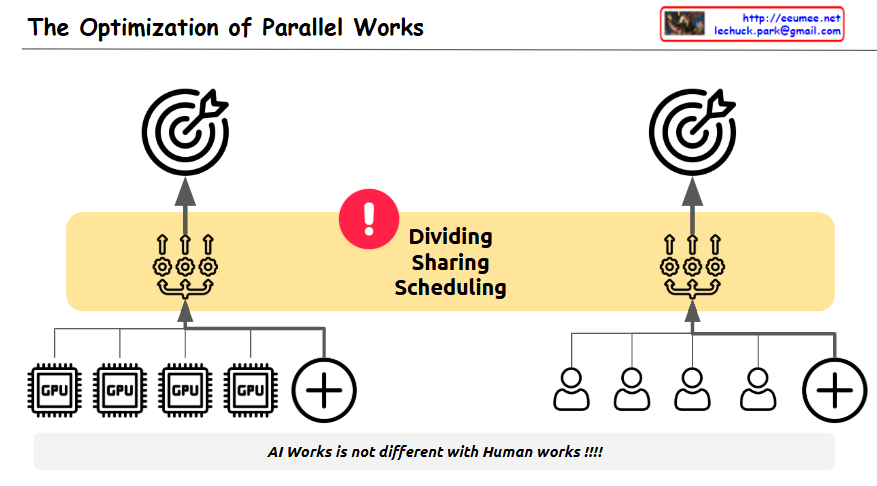
The image illustrates “The Optimization of Parallel Works,” highlighting the inherent challenges in optimizing parallel processing tasks.

The diagram cleverly compares two parallel systems:

  • Left side: Multiple CPU processors working in parallel
  • Right side: Multiple humans working in parallel

The central yellow band emphasizes three critical challenges in both systems:

  • Dividing (splitting tasks appropriately)
  • Sharing (coordinating resources and information)
  • Scheduling (timing and sequencing activities)

Each side shows a target/goal at the top, representing the shared objective that both computational and human systems strive to achieve.

The exclamation mark in the center draws attention to these challenges, while the message at the bottom states: “AI Works is not different with Human works!!!!” – emphasizing that the difficulties in coordinating independent processors toward a unified goal are similar whether we’re talking about computer processors or human teams.

The diagram effectively conveys that just as it’s difficult for people to work together toward a single objective, optimizing independent parallel processes in computing faces similar coordination challenges – requiring careful attention to division of labor, resource sharing, and timing to achieve optimal results.

With Claude