Data Standardization

From DALL-E with some prompting
The image emphasizes the importance of data quality in the digital transformation of large-scale operations. By securing “Data Quality” through data standardization, optimized operations based on verified data enable reliable decision-making, monitoring, and optimization. AI-enhanced analysis and optimization accelerate business transformation, drive data-led innovation, and achieve sustainable operation and customer satisfaction.

  1. Data Standardization: Emphasizes the importance of “Data Quality,” indicating that high-quality, standardized data is foundational.
  2. Operation based on verified data/system: Shows the use of verified data to ensure reliable decision-making, monitoring, and optimization, leading to sustainable operations, business intelligence, and customer satisfaction.
  3. Accelerating (AI) digital business transformation: Describes how optimized and customized processing, along with an AI data analysis platform, can accelerate digital transformation. This leads to work automation, user customization, resource optimization, data-driven innovation, AI predictions and analytics, and expanding standardization.

The overall message suggests that standardizing data quality is crucial for building AI systems that can drive digital transformation and improve business operations and customer satisfaction.
Optimization 2

From DALL-E with some prompting
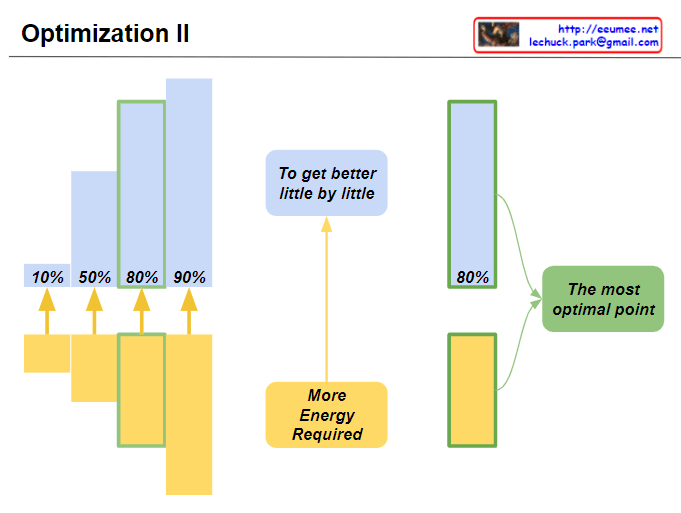
The image represents an optimization process depicted by a bar graph. The left side of the graph displays efficiency levels at 10%, 50%, 80%, and 90%, with increasing energy requirements indicated by golden arrows for each efficiency milestone. It visually communicates that while efficiency can be incrementally improved through optimization, achieving higher levels of efficiency demands progressively more energy.

On the right, a bar indicating 80% efficiency is highlighted as “the most optimal point,” suggesting a balance between efficiency and energy demand. This point reflects the trade-off where further increases in efficiency may not be economically justified due to the additional energy cost. The phrase “To get better little by little” suggests that the ideal point of optimization can be reached through gradual improvement.

Cooling Optimization

From DALL-E with some prompting
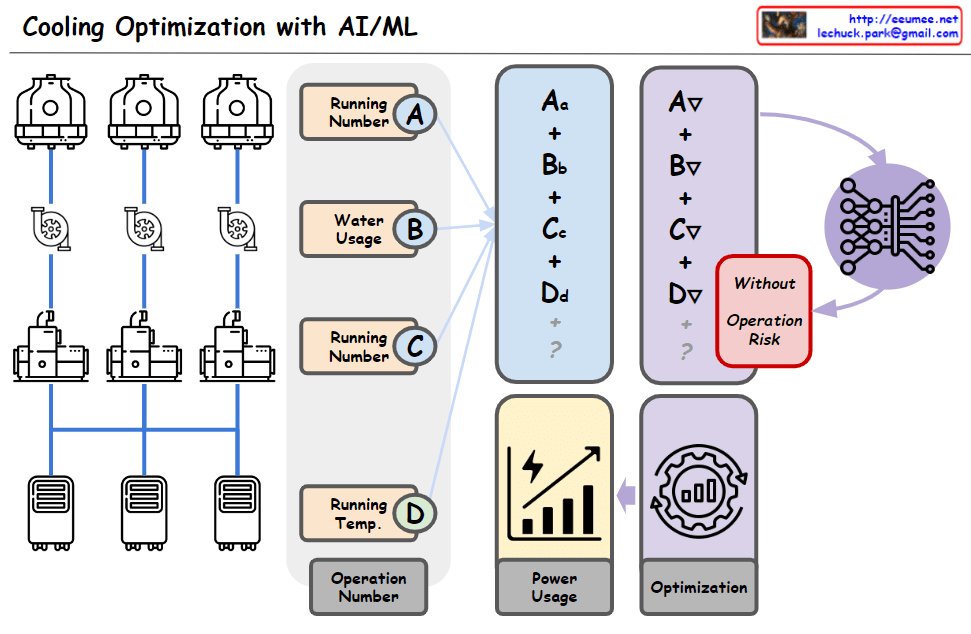
The illustration depicts a process where key operational metrics related to energy usage in cooling systems are analyzed by AI to achieve energy optimization. The AI model evaluates essential data such as running numbers, water usage, and operational temperature to continuously optimize the system while emphasizing stable operation without disruptions. This represents an advanced approach to managing cooling systems that enhances energy efficiency while minimizing operational risks.

Optimization

from DALL-E with some prompting
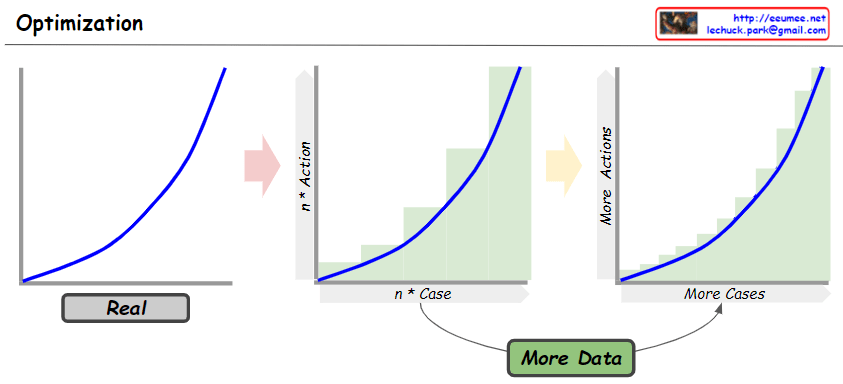
This diagram demonstrates that the optimization process becomes more sophisticated with the increase of data. The first graph represents the actual analog conditions, and as more data is introduced, the bar chart in the middle shows that actions can be more finely differentiated for various cases. The last graph illustrates how this refinement enhances the optimization curve. In essence, optimization can be more precisely adjusted based on a diverse range of data and scenarios.