Event Processing

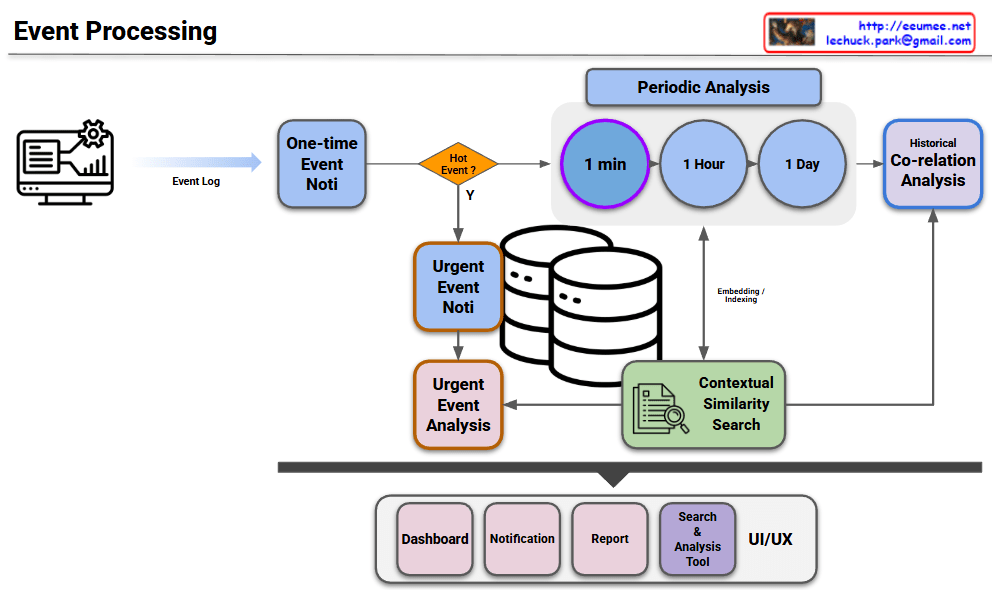
This diagram illustrates a workflow that handles system logs/events by dividing them into real-time urgent responses and periodic deep analysis.

1. Data Ingestion & Filtering

  • Event Log → One-time Event Noti: The process begins with incoming event logs triggering an initial, single-instance notification.
  • Hot Event Decision: A decision node determines if the event is critical (“Hot Event?”). This splits the workflow into two distinct paths: a Hot Path for emergencies and an Analytical Path for deeper insights.

2. Hot Path (Real-time Response)

  • Urgent Event Noti & Analysis: If identified as a “Hot Event,” the system immediately issues an urgent notification and performs an urgent analysis while persisting the data to the database. This path appears designed to minimize MTTD (Mean Time To Detect) for critical failures.

3. Periodic & Contextual Analysis (AIOps Layer)

This section indicates a shift from simple monitoring to intelligent AIOps.

  • Periodic Analysis: Events are aggregated and analyzed over fixed time windows (1 min, 1 Hour, 1 Day). The purple highlight on “1 min” suggests the current focus is on short-term trend analysis.
  • Contextual Similarity Search: This is a critical advanced feature. By explicitly mentioning “Embedding / Indexing,” the architecture suggests the use of Vector Search (likely via a Vector DB). It implies the system doesn’t just match keywords but understands the semantic context of an error to find similar past cases.
  • Historical Co-relation Analysis: This module synthesizes the periodic trends and similarity search results to correlate the current event with historical patterns, aiding in Root Cause Analysis (RCA).

4. User Interface (UI/UX)

The processed insights are delivered to the user through four channels:

  • Dashboard: High-level status visualization.
  • Notification: Alerts for urgent issues.
  • Report: Summarized periodic findings.
  • Search & Analysis Tool: A tool for granular log investigation.

Summary

  1. Hybrid Architecture: Efficiently separates critical “Hot Event” handling (Real-time) from deep “Periodic Analysis” (Batch) to balance speed and insight.
  2. Semantic Intelligence: Incorporates “Contextual Similarity Search” using Embeddings, enabling the system to identify issues based on meaning rather than just keywords.
  3. Holistic Observability: interconnected modules (Urgent, Periodic, Historical) feed into a comprehensive UI/UX to support rapid decision-making and post-mortem analysis.

#EventProcessing #SystemArchitecture #VectorSearch #Observability #RCA

Numeric Data Processing


Architecture Overview

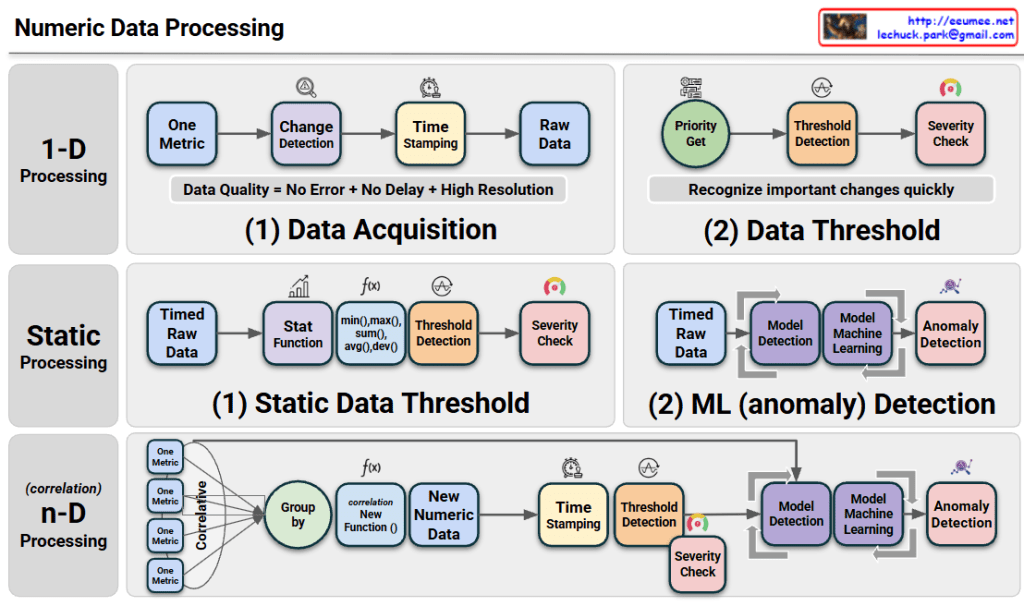
The diagram illustrates a tiered approach to Numeric Data Processing, moving from simple monitoring to advanced predictive analytics:

  • 1-D Processing (Real-time Detection): This layer focuses on individual metrics. It emphasizes high-resolution data acquisition with precise time-stamping to ensure data quality. It uses immediate threshold detection to recognize critical changes as they happen.
  • Static Processing (Statistical & ML Analysis): This stage introduces historical context. It applies statistical functions (like averages and deviations) to identify trends and uses Machine Learning (ML) models to detect anomalies that simple thresholds might miss.
  • n-D Processing (Correlative Intelligence): This is the most sophisticated layer. It groups multiple metrics to find correlations, creating “New Numeric Data” (synthetic metrics). By analyzing the relationship between different data points, it can identify complex root causes in highly interleaved systems.

Summary

  1. The framework transitions from reactive 1-D monitoring to proactive n-D correlation, enhancing the depth of system observability.
  2. It integrates statistical functions and machine learning to filter noise and identify true anomalies based on historical patterns rather than just fixed limits.
  3. The ultimate goal is to achieve high-fidelity data processing that enables automated severity detection and complex pattern recognition across multi-dimensional datasets.

#DataProcessing #AIOps #MachineLearning #Observability #Telemetry #SystemArchitecture #AnomalyDetection #DigitalTwin #DataCenterOps #InfrastructureMonitoring

With Gemini