personalized RAG

from Claude with some prompting
This diagram illustrates a personalized RAG (Retrieval-Augmented Generation) system that allows individuals to use their personal data with various LLM (Large Language Model) implementations. Key aspects include:

  1. User input: Represented by a person icon and notebook on the left, indicating personal data or queries.
  2. On-Premise storage: Contains LLM models that can be managed and run locally by the user.
  3. Cloud integration: An API connects to cloud-based LLM services, represented by icons in the “on cloud” section. These also symbolize different cloud-based LLM models.
  4. Flexible model utilization: The structure enables users to leverage both on-premise and cloud-based LLM models, allowing for combination of different models’ strengths or selection of the most suitable model for specific tasks.
  5. Privacy protection: A “Control a privacy Filter” icon emphasizes the importance of managing privacy filters to prevent inappropriate exposure of sensitive information to LLMs.
  6. Model selection: The “Use proper Foundation models” icon stresses the importance of choosing appropriate base models for different tasks.

This system empowers individual users to safely manage their data while flexibly utilizing various LLM models, both on-premise and cloud-based. It places a strong emphasis on privacy protection, which is crucial in RAG systems dealing with personal data.

The diagram effectively showcases how personal data can be integrated with advanced LLM technologies while maintaining control over privacy and model selection.
Operation with AI

From Claude with some prompting
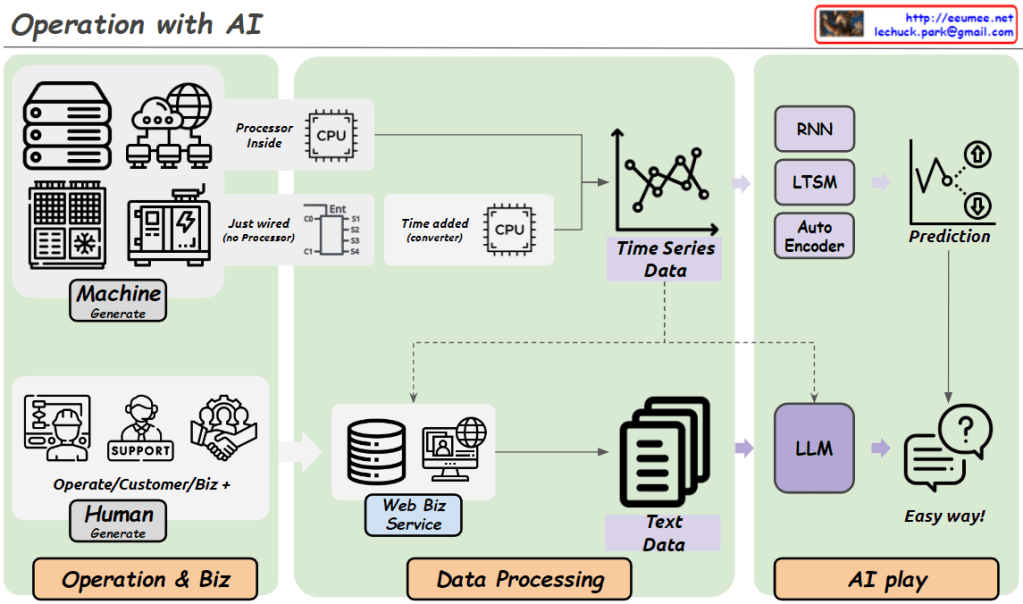
This diagram illustrates an integrated approach to modern operational management. The system is divided into three main components: data generation, data processing, and AI application.

The Operation & Biz section shows two primary data sources. First, there’s metric data automatically generated by machines such as servers and network equipment. Second, there’s textual data created by human operators and customer service representatives, primarily through web portals.

These collected data streams then move to the central Data Processing stage. Here, metric data is processed through CPUs and converted into time series data, while textual data is structured via web business services.

Finally, in the AI play stage, different AI models are applied based on data types. For time series data, models like RNN, LSTM, and Auto Encoder are used for predictive analytics. Textual data is processed through a Large Language Model (LLM) to extract insights.

This integrated system effectively utilizes data from various sources to improve operational efficiency, support data-driven decision-making, and enable advanced analysis and prediction through AI. Ultimately, it facilitates easy and effective management even in complex operational environments.

The image emphasizes how different types of data – machine-generated metrics and human-generated text – are processed and analyzed using appropriate AI techniques, all from the perspective of operational management.

LLM Tuning

From Claude with some prompting
This diagram illustrates various fine-tuning techniques to improve the performance of large language models.

At the center, there is a Tuning Module connected to an Inference Module (for generating answers). The Tuning Module is linked to the Weight DataBase (Parameter), indicating that it fine-tunes the weights and parameters of the model.

On the left, there are Knowledge Base and Vector DataBase, which store the model’s knowledge and data.

In the top right, the RAG (Retrieval Augmented Generation) block retrieves relevant information from Domain Specific External Sources to augment the generation process.

The Prompt Engineering block involves Prompt Tuning to generate massive prompts with expert knowledge.

At the bottom, various parameter-efficient fine-tuning techniques are presented, such as PEFT, Fine Tuning, Bias Fine Tuning, Prefix Tuning, Adapter, and LoRA.

Regarding Prefix Tuning, the description “Attach a virtual prefix sequence” suggests that it involves adding virtual prompt tokens at the beginning of the input sequence.

Overall, this diagram comprehensively illustrates the integration of knowledge, prompt engineering, and diverse fine-tuning methods for enhancing large language models’ performance across various domains.

Transformer

From Claude with some prompting
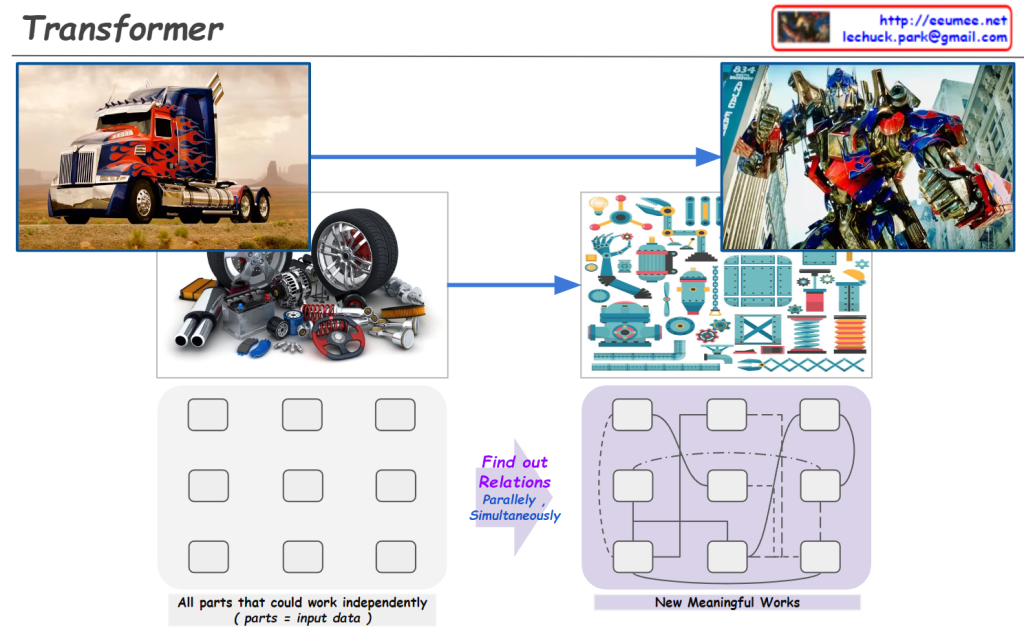
The image is using an analogy of transforming vehicles to explain the concept of the Transformer architecture in AI language models like myself.

Just like how a vehicle can transform into a robot by having its individual components work in parallel, a Transformer model breaks down the input data (e.g. text) into individual elements (tokens/words). These elements then go through a series of self-attention and feed-forward layers, processing the relationships between all elements simultaneously and in parallel.

This allows the model to capture long-range dependencies and derive contextual meanings, eventually transforming the input into a meaningful representation (e.g. understanding text, generating language). The bottom diagram illustrates this parallel and interconnected nature of processing in Transformers.

So in essence, the image draws a clever analogy between transforming vehicles and how Transformer models process and “transform” input data into contextualized representations through its parallelized and self-attentive computations.

RAG

From Claude with some prompting
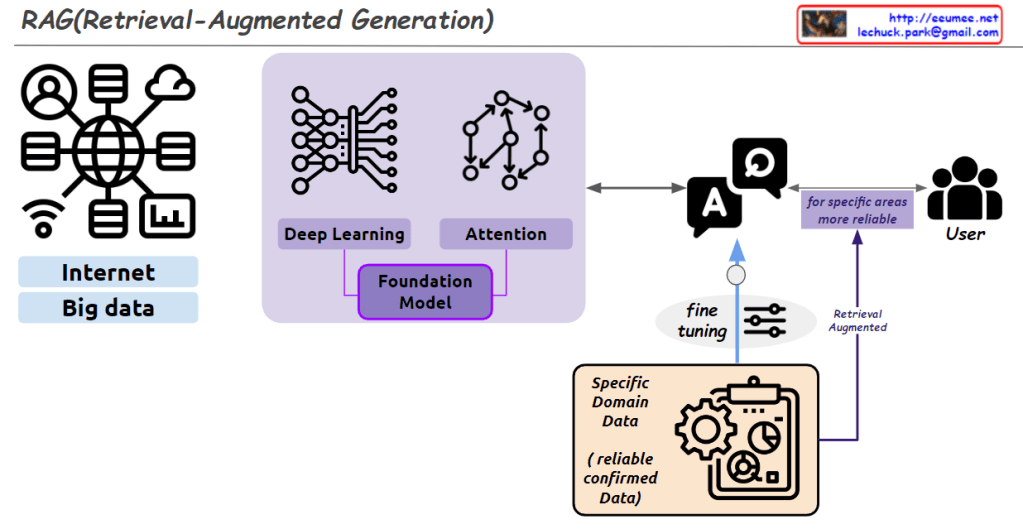
This image explains the concept and structure of the RAG (Retrieval-Augmented Generation) model.

First, a large amount of data is collected from the “Internet” and “Big Data” to train a Foundation Model. This model utilizes Deep Learning and Attention mechanisms.

Next, the Foundation Model is fine-tuned using reliable and confirmed data from a Specific Domain (Specific Domain Data). This process creates a model specialized for that particular domain.

Ultimately, this allows the model to provide more reliable responses to users in that specific area. The overall process is summarized by the concept of Retrieval-Augmented Generation.

The image visually represents the components of the RAG model and the flow of data through the system effectively.

Attention in a LLM

From Copilot with some prompting
Certainly! Let’s discuss the concept of multi-head attention in the context of a Language Learning Model (LLM).

Input Sentence: The sentence “Seagulls fly over the ocean.”
Attention Weight Visualization: The image illustrates how different words in the sentence attend to each other. For instance, if the attention weight between “seagulls” and “ocean” is high, it indicates that these two words are closely related within the sentence.
Multiple Heads: The model employs multiple attention heads (sub-layers) to compute attention from different perspectives. This allows consideration of various contexts and enhances the model’s ability to capture important information.
Multi-head attention is widely used in natural language processing (NLP) tasks, including translation, question answering, and sentiment analysis. It helps improve performance by allowing the model to focus on relevant parts of the input sequence.

through the LLM

From DALL-E with some prompting
The diagram provides a visual summary of how data from industrial facilities is aggregated and transformed through various processes, including equipment operation and business requirements. This data flow is depicted starting from the left, moving through icons representing servers, databases, safety equipment, and surveillance, indicating the collection and integration of diverse data types. The central AI chip symbolizes the analytical engine that processes this vast array of information, optimizing it for business intelligence and operational efficiency.

The processed data then feeds into a Large Language Model (LLM), highlighted in the diagram as the interface for communication. The AI’s capacity to analyze and manage this data results in a conversational output that closely resembles human interaction, as suggested by the “Like Human” label on the diagram. The integration of complex technical data with nuanced language processing allows the AI to communicate effectively with humans, symbolized by the network graphic on the right, which represents human connections.

In essence, the image encapsulates the journey of raw data from mechanical and logistical origins to sophisticated human-like dialogue, emphasizing the role of AI in bridging the gap between the technical and the personal in contemporary business environments.