AI Model 3 Works


Analysis of AI Model 3 Works

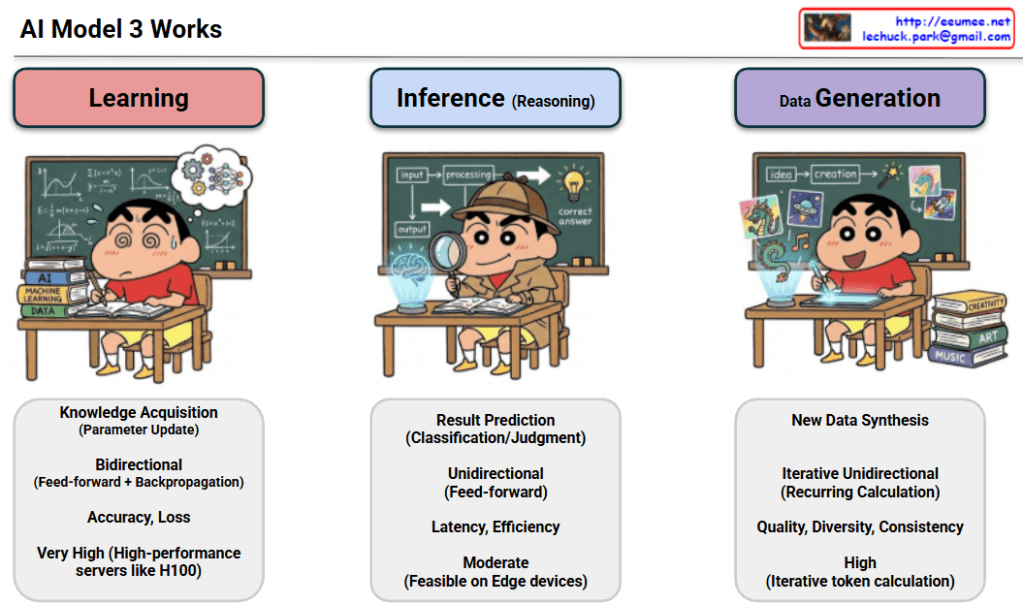
The provided image illustrates the three core stages of how AI models operate: Learning, Inference, and Data Generation.

1. Learning

  • Goal: Knowledge acquisition and parameter updates. This is the stage where the AI “studies” data to find patterns.
  • Mechanism: Bidirectional (Feed-forward + Backpropagation). It processes data to get a result and then goes backward to correct errors by adjusting internal weights.
  • Key Metrics: Accuracy and Loss. The objective is to minimize loss to increase the model’s precision.
  • Resource Requirement: Very High. It requires high-performance server clusters equipped with powerful GPUs like the NVIDIA H100.

2. Inference (Reasoning)

  • Goal: Result prediction, classification, and judgment. This is using a pre-trained model to answer specific questions (e.g., “What is in this picture?”).
  • Mechanism: Unidirectional (Feed-forward). Data simply flows forward through the model to produce an output.
  • Key Metrics: Latency and Efficiency. The focus is on how quickly and cheaply the model can provide an answer.
  • Resource Requirement: Moderate. It is efficient enough to be feasible on “Edge devices” like smartphones or local PCs.

3. Data Generation

  • Goal: New data synthesis. This involves creating entirely new content like text, images, or music (e.g., Generative AI like ChatGPT).
  • Mechanism: Iterative Unidirectional (Recurring Calculation). It generates results piece by piece (token by token) in a repetitive process.
  • Key Metrics: Quality, Diversity, and Consistency. The focus is on how natural and varied the generated output is.
  • Resource Requirement: High. Because it involves iterative calculations for every single token, it requires more power than simple inference.

Summary

  1. AI processes consist of Learning (studying data), Inference (applying knowledge), and Data Generation (creating new content).
  2. Learning requires massive server power for bidirectional updates, while Inference is optimized for speed and can run on everyday devices.
  3. Data Generation synthesizes new information through repetitive, iterative calculations, requiring high resources to maintain quality.

#AI #MachineLearning #GenerativeAI #DeepLearning #TechExplained #AIModel #Inference #DataScience #Learning #DataGeneration

With Gemini

Learning , Reasoning, Inference

This image illustrates the three core processes of AI LLMs by drawing parallels to human learning and cognitive processes.

Learning

  • Depicted as a wise elderly scholar reading books in a library
  • Represents the lifelong process of absorbing knowledge and experiences accumulated by humanity over generations
  • The bottom icons show data accumulation and knowledge storage processes
  • Meaning: Just as AI learns human language and knowledge through vast text data, humans also build knowledge throughout their lives through continuous learning and experience

Reasoning

  • Shows a character deep in thought, surrounded by mathematical formulas
  • Represents the complex mental process of confronting a problem and searching for solutions through internal contemplation
  • The bottom icons symbolize problem analysis and processing stages
  • Meaning: The human cognitive process of using learned knowledge to engage in logical thinking and analysis to solve problems

Inference

  • Features a character confidently exclaiming “THE ANSWER IS CLEAR!”
  • Expresses the confidence and decisiveness when finally finding an answer after complex thought processes
  • The bottom checkmark signifies reaching a final conclusion
  • Meaning: The human act of ultimately speaking an answer or making a behavioral decision through thought and analysis

These three stages visually demonstrate how AI processes information in a manner similar to the natural human sequence of learning → thinking → conclusion, connecting AI’s technical processes to familiar human cognitive patterns.

With Claude

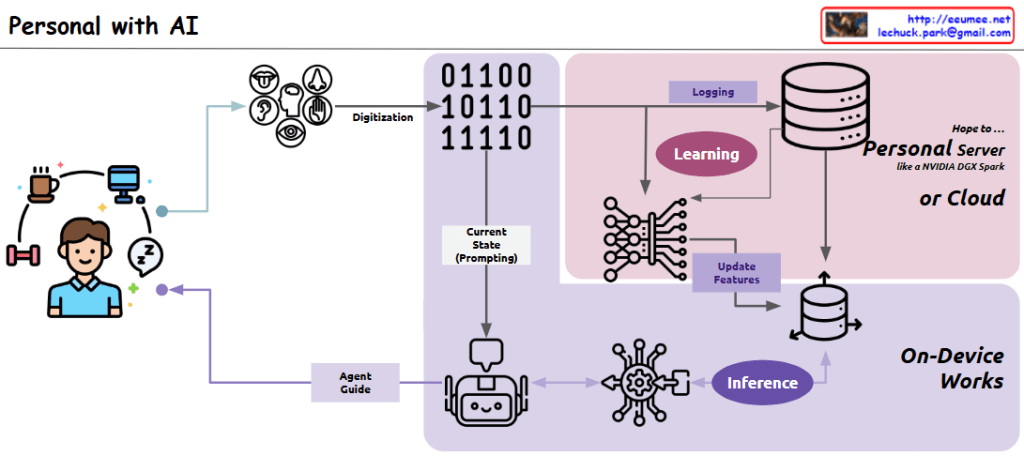
Personal with AI

This diagram illustrates a “Personal Agent” system architecture that shows how everyday life is digitized to create an AI-based personal assistant:

Left side: The user’s daily activities (coffee, computer, exercise, sleep) are represented, which serve as the source for digitization.

Center-left: Various sensors (visual, auditory, tactile, olfactory, gustatory) capture the user’s daily activities and convert them through the “Digitization” process.

Center: The “Current State (Prompting)” component stores the digitized current state data, which is provided as prompting information to the AI agent.

Upper right (pink area): Two key processes take place:

  1. “Learning”: Processing user data from an ML/LLM perspective
  2. “Logging”: Continuously collecting data to update the vector database

This section runs on a “Personal Server or Cloud,” preferably using a personalized GPU server like NVIDIA DGX Spark, or alternatively in a cloud environment.

Lower right: In the “On-Device Works” area, the “Inference” process occurs. Based on current state data, the AI agent infers guidance needed for the user, and this process is handled directly on the user’s personal device.

Center bottom: The cute robot icon represents the AI agent, which provides personalized guidance to the user through the “Agent Guide” component.

Overall, this system has a cyclical structure that digitizes the user’s daily life, learns from that data to continuously update a personalized vector database, and uses the current state as a basis for the AI agent to provide customized guidance through an inference process that runs on-device.

with Claude

The Age of Utilization

This image is an infographic depicting “The Age of Utilization.”

On the left side, a gray oval contains “All knowledge of mankind” represented by various icons including letter and number blocks, books with writing tools, and a globe symbolizing the internet, illustrating the diverse forms of knowledge humanity has accumulated over time.

In the center, there’s a section labeled “Massive parallel processing” showing multiple eye icons with arrows pointing toward a GPU icon. This illustrates how vast amounts of human knowledge are efficiently processed through GPUs.

On the right side, a purple arrow-shaped area labeled “Easy to utilize” demonstrates how processed information can be used. At the top is an “EASY TO USE” icon, with “Inference” and “Learning” stages below it. This section includes Q&A icons, a vector database, and neural network structures.

The infographic comprehensively shows how humanity has entered a new era where accumulated knowledge can be processed using modern technology and easily accessed through question-and-answer formats, making all human knowledge readily available for utilization.

With Claude

GPU vs NPU on Deep learning

This diagram illustrates the differences between GPU and NPU from a deep learning perspective:

GPU (Graphic Process Unit):

  • Originally developed for 3D game rendering
  • In deep learning, it’s utilized for parallel processing of vast amounts of data through complex calculations during the training process
  • Characterized by “More Computing = Bigger Memory = More Power,” requiring high computing power
  • Processes big data and vectorizes information using the “Everything to Vector” approach
  • Stores learning results in Vector Databases for future use

NPU (Neuron Process Unit):

  • Retrieves information from already trained Vector DBs or foundation models to generate answers to questions
  • This process is called “Inference”
  • While the training phase processes all data in parallel, the inference phase only searches/infers content related to specific questions to formulate answers
  • Performs parallel processing similar to how neurons function

In conclusion, GPUs are responsible for processing enormous amounts of data and storing learning results in vector form, while NPUs specialize in the inference process of generating actual answers to questions based on this stored information. This relationship can be summarized as “training creates and stores vast amounts of data, while inference utilizes this at the point of need.”

With Claude

“if then” by AI

From Claude with some prompting
This image titled “IF THEN” by AI illustrates the evolution from traditional programming to modern AI approaches:

  1. Upper section – “Programming”: This represents the traditional method. Here, programmers collect data, analyze it, and explicitly write “if-then” rules. This process is labeled “Making Rules”.
    • Data collection → Analysis → Setting conditions (IF) → Defining actions (THEN)
  2. Lower section – “AI”: This shows the modern AI approach. It uses “Huge Data” to automatically learn patterns through machine learning algorithms.
    • Large-scale data → Machine Learning → AI model generation

Key differences:

  • Traditional method: Programmers explicitly define rules
  • AI method: Automatically learns patterns from data to create AI models that include basic “if-then” logic

The image effectively diagrams the shift in programming paradigms. It demonstrates how AI can process and learn from massive datasets to automatically generate logic that was previously manually defined by programmers.

This visualization succinctly captures how AI has transformed the approach to problem-solving in computer science, moving from explicit rule-based programming to data-driven, pattern-recognizing models.

My own AI agent

From DALL-E with some prompting
This image appears to be a conceptual diagram of an individual’s AI agent, divided into several parts:

  1. Personal Area: There’s a user icon with arrows labeled ‘Control’ and ‘Sensing All’. This suggests the user can direct the AI agent and the AI is capable of gathering comprehensive information from its environment.
  2. Micro & Macro Infinite World: This part features illustrations that seem to represent microorganisms, plants, butterflies, etc., indicating that the AI collects data from both microscopic and macroscopic environments.
  3. Personalized Resource: The icon resembling a human brain could represent personalized services or data tailored to the user.
  4. Cloud Infra: The cloud infrastructure is presumably responsible for data processing and storage.
  5. Cloud Service: Depicted as a server providing various services, connected to the cloud infrastructure.
  6. Internet Connected: A globe icon with various network points suggests that the AI agent is connected to global information and knowledge via the internet.

Overall, the diagram illustrates a personalized AI agent that collects information under the user’s control, processes it through cloud infrastructure and services, and ultimately contributes to collective intelligence through an internet connection.