AI Model 3 Works


Analysis of AI Model 3 Works

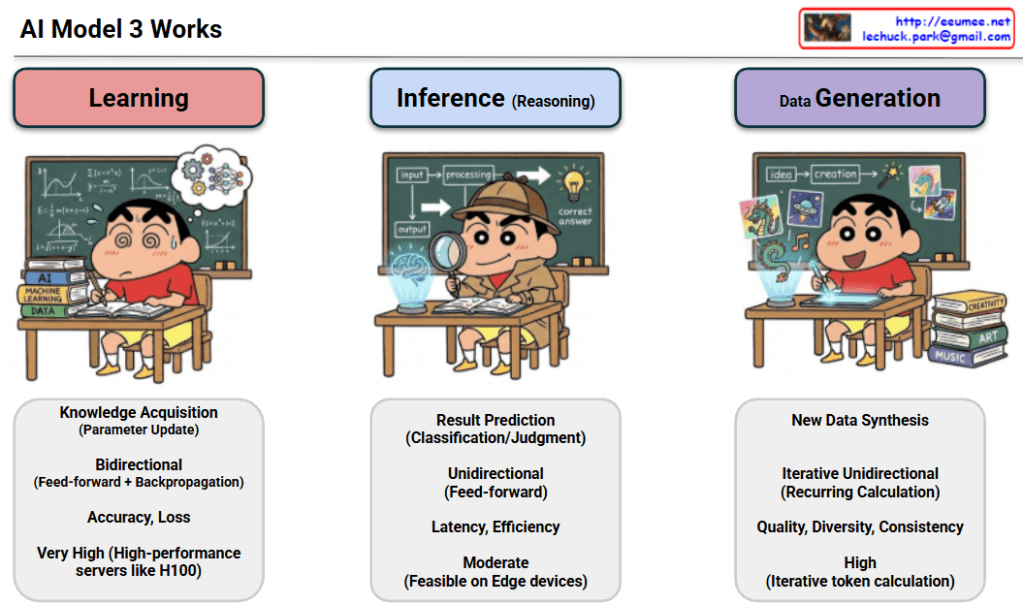
The provided image illustrates the three core stages of how AI models operate: Learning, Inference, and Data Generation.

1. Learning

  • Goal: Knowledge acquisition and parameter updates. This is the stage where the AI “studies” data to find patterns.
  • Mechanism: Bidirectional (Feed-forward + Backpropagation). It processes data to get a result and then goes backward to correct errors by adjusting internal weights.
  • Key Metrics: Accuracy and Loss. The objective is to minimize loss to increase the model’s precision.
  • Resource Requirement: Very High. It requires high-performance server clusters equipped with powerful GPUs like the NVIDIA H100.

2. Inference (Reasoning)

  • Goal: Result prediction, classification, and judgment. This is using a pre-trained model to answer specific questions (e.g., “What is in this picture?”).
  • Mechanism: Unidirectional (Feed-forward). Data simply flows forward through the model to produce an output.
  • Key Metrics: Latency and Efficiency. The focus is on how quickly and cheaply the model can provide an answer.
  • Resource Requirement: Moderate. It is efficient enough to be feasible on “Edge devices” like smartphones or local PCs.

3. Data Generation

  • Goal: New data synthesis. This involves creating entirely new content like text, images, or music (e.g., Generative AI like ChatGPT).
  • Mechanism: Iterative Unidirectional (Recurring Calculation). It generates results piece by piece (token by token) in a repetitive process.
  • Key Metrics: Quality, Diversity, and Consistency. The focus is on how natural and varied the generated output is.
  • Resource Requirement: High. Because it involves iterative calculations for every single token, it requires more power than simple inference.

Summary

  1. AI processes consist of Learning (studying data), Inference (applying knowledge), and Data Generation (creating new content).
  2. Learning requires massive server power for bidirectional updates, while Inference is optimized for speed and can run on everyday devices.
  3. Data Generation synthesizes new information through repetitive, iterative calculations, requiring high resources to maintain quality.

#AI #MachineLearning #GenerativeAI #DeepLearning #TechExplained #AIModel #Inference #DataScience #Learning #DataGeneration

With Gemini

AI Explosion

Analysis of the “AI Explosion” Diagram

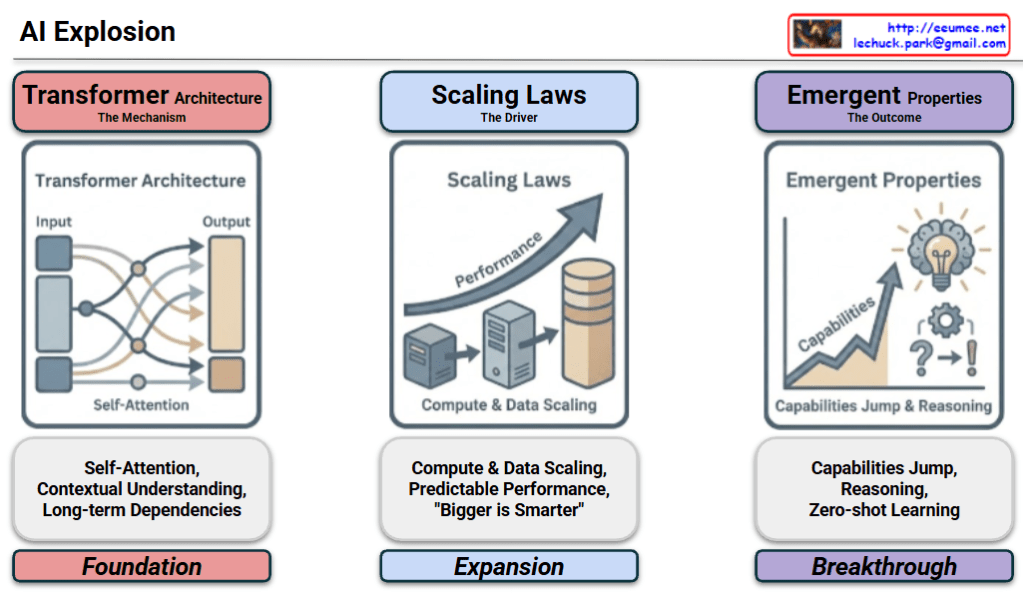
This diagram provides a structured visual narrative of how modern AI (LLM) achieved its rapid advancement, organized into a logical flow: Foundation → Expansion → Breakthrough.

1. The Foundation: Transformer Architecture

  • Role: The Mechanism
  • Analysis: This is the starting point of the explosion. Unlike previous sequential processing models, the “Self-Attention” mechanism allows the AI to grasp context and understand long-term dependencies within data.
  • Significance: It established the technical “container” capable of deeply understanding human language.

2. The Expansion: Scaling Laws

  • Role: The Driver
  • Analysis: This phase represents the massive injection of resources into the established foundation. It follows the principle that performance improves predictably as data and compute power increase.
  • Significance: Driven by the belief that “Bigger is Smarter,” this is the era of quantitative growth where model size and infrastructure were aggressively scaled.

3. The Breakthrough: Emergent Properties

  • Role: The Outcome
  • Analysis: This is where quantitative expansion leads to a qualitative shift. Once the model size crossed a certain threshold, sophisticated capabilities that were not explicitly taught—such as Reasoning and Zero-shot Learning—suddenly appeared.
  • Significance: This marks the “singularity” moment where the system moves beyond simple pattern matching to exhibiting genuine intelligent behaviors.

Summary

The diagram effectively illustrates the causal relationship of AI evolution: The Transformer provided the capability to learn, Scaling Laws amplified that capability through size, and Emergent Properties were the revolutionary outcome of that scale.

#AIExplosion #LLM #TransformerArchitecture #ScalingLaws #EmergentProperties #GenerativeAI #TechTrends

With Gemini

Ready For AI DC


Ready for AI DC

This slide illustrates the “Preparation and Operation Strategy for AI Data Centers (AI DC).”

In the era of Generative AI and Large Language Models (LLM), it outlines the drastic changes data centers face and proposes a specific three-stage operation strategy (Digitization, Solutions, Operations) to address them.

1. Left Side: AI “Extreme” Changes

Core Theme: AI Data Center for Generative AI & LLM

  • High Cost, High Risk:
    • Establishing and operating AI DCs involves immense costs due to expensive infrastructure like GPU servers.
    • It entails high power consumption and system complexity, leading to significant risks in case of failure.
  • New Techs for AI:
    • Unlike traditional centers, new power and cooling technologies (e.g., high-density racks, immersion cooling) and high-performance computing architectures are essential.

2. Right Side: AI Operation Strategy

Three solutions to overcome the “High Cost, High Risk, and New Tech” environment.

A. Digitization (Securing Data)

  • High Precision, High Resolution: Collecting precise, high-resolution operational data (e.g., second-level power usage, chip-level temperature) rather than rough averages.
  • Computing-Power-Cooling All-Relative Data: Securing integrated data to analyze the tight correlations between IT load (computing), power, and cooling systems.

B. Solutions (Adopting Tools)

  • “Living” Digital Twin: Building a digital twin linked in real-time to the actual data center for dynamic simulation and monitoring, going beyond static 3D modeling.
  • LLM AI Agent: Introducing LLM-based AI agents to assist or automate complex data center management tasks.

C. Operations (Innovating Processes)

  • Integration for Multi/Edge(s): Establishing a unified management system that covers not only centralized centers but also distributed multi-cloud and edge locations.
  • DevOps for the Fast: Applying agile DevOps methodologies to development and operations to adapt quickly to the rapidly changing AI infrastructure.

💡 Summary & Key Takeaways

The slide suggests that traditional operating methods are unsustainable due to the costs and risks associated with AI workloads.

Success in the AI era requires precisely integrating IT and facility data (Digitization), utilizing advanced technologies like Digital Twins and AI Agents (Solutions), and adopting fast, integrated processes (Operations).


#AIDataCenter #AIDC #GenerativeAI #LLM #DataCenterStrategy #DigitalTwin #DevOps #AIInfrastructure #TechTrends #SmartOperations #EnergyEfficiency #EdgeComputing #AIInnovation

With Gemini