BAS + EPMS + @ = DCIM

From Claude with some prompting
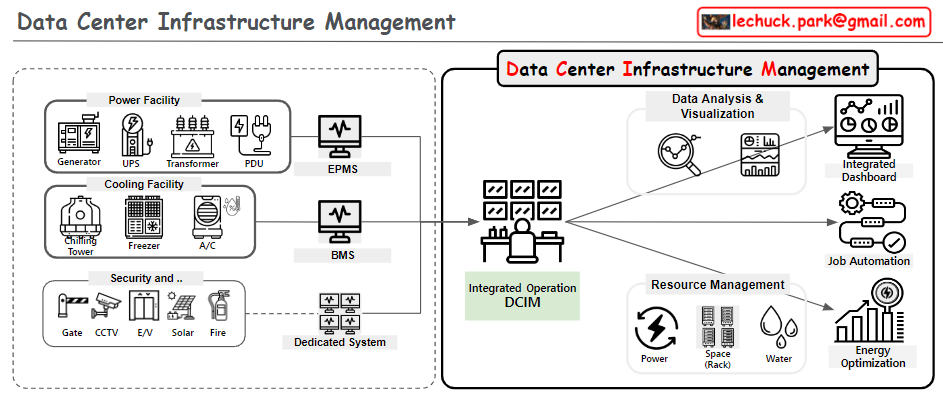
This image illustrates the distinction between BAS (Building Automation System), EPMS (Energy Power Management System), and DCIM (Data Center Infrastructure Management), explaining their development and relationships.

  1. BAS (Building Automation System):
    • Focuses on general buildings
    • Emphasizes water management and HVAC (cooling) systems
    • Named “BAS” because water and air conditioning were crucial elements in building management
    • Primarily deals with low-power usage environments
    • Includes water control, cooling control, flow control, and pipe/plumbing management
  2. EPMS (Energy Power Management System):
    • Specialized for high-power usage environments
    • Concentrates on power generation, distribution, and control
    • Developed separately from BAS due to the unique complexities of high-power environments
  3. DCIM (Data Center Infrastructure Management):
    • Tailored for data center environments
    • Integrates functions of both BAS and EPMS
    • Manages power (EPMS) and cooling/environmental (BAS) aspects
    • Addresses additional requirements specific to data centers

The diagram clearly shows the background and characteristics of each system’s development:

  • BAS evolved from the need to manage water and air conditioning in general buildings
  • EPMS developed separately due to the specific requirements of high-power environments
  • DCIM integrates and expands on BAS and EPMS functionalities to meet the complex needs of data centers

The formula “BAS + EPMS + @ = DCIM” indicates that DCIM incorporates the functions of BAS and EPMS, while also including additional management capabilities (@) specific to data centers.

This structure effectively demonstrates how each system has specialized and evolved to suit particular environments and requirements, and how they are ultimately integrated in DCIM for comprehensive management of data center infrastructures.
SCADA & EPMS

From Perplexity with some prompting
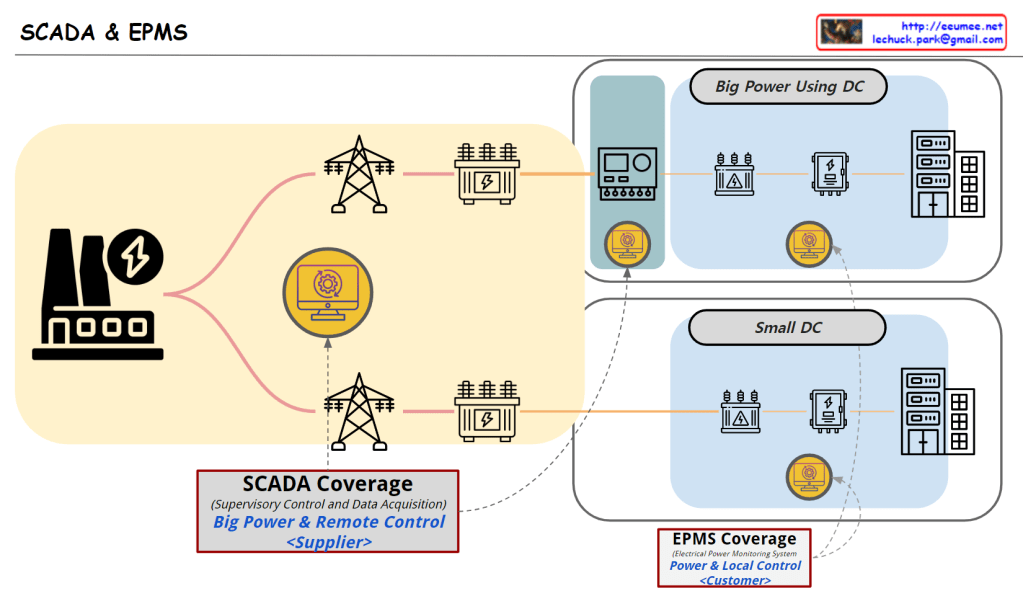
The image illustrates the roles and coverage of SCADA and EPMS systems in power management for data centers.

SCADA System

  • Target: Power Suppliers and Large Power Consumers (Big Power Using DC)
  • Role:
    • Power Suppliers: Remotely monitor and control infrastructure like power plants and substations to ensure the stability of large-scale power grids.
    • Large Data Centers: Manage complex power infrastructure and ensure stable power supply by utilizing some SCADA functionalities.
  • Coverage: Large power management and remote control

EPMS System

  • Target: Small Data Centers (Small DC)
  • Role:
    • Monitor and manage power usage within the data center to optimize energy efficiency.
    • Perform detailed local control of power management.
  • Coverage: Power monitoring and local control

Key Distinctions

  • SCADA focuses on large-scale power management and remote control, suitable for power suppliers and large consumers.
  • EPMS is used primarily in small data centers for optimizing energy consumption through local control.

In conclusion, large data centers benefit from using both SCADA and EPMS to effectively manage complex power infrastructures, while small data centers typically rely on EPMS for efficient energy management.

AI DICM for AI DC

From Claude with some prompting
This diagram illustrates the structure of an AI DCIM (Data Center Infrastructure Management) system for AI Data Centers (AI DC). Here’s an explanation of the key components and their roles:

  1. EPMS BAS(BMS): Energy and Building Management System, controlling the basic infrastructure of the data center.
  2. DCIM: Data Center Infrastructure Management system, integrated with EPMS/BAS to manage overall data center operations.
  3. AI and Big Data: Linked with DCIM to process large-scale data and perform AI-based analysis and decision-making.
  4. Super Computing: Provides high-performance computing capabilities to support complex AI tasks and large-scale data analysis.
  5. Super Power: Represents the high-performance power supply system necessary for AI DC.
  6. Super Cooling: Signifies the high-efficiency cooling system essential for large-scale computing environments.
  7. AI DCIM for AI DC: Integrates all these elements to create a new management system for AI data centers. This enables greater data processing capacity and faster analysis.

The goal of this system is emphasized by “Faster and more accurate is required!!”, highlighting the need for quicker and more precise operations and analysis in AI DC environments.

This structure enhances traditional DCIM systems with AI and big data technologies, presenting a new paradigm of data center management capable of efficiently managing and optimizing large-scale AI workloads. Through this, AI DCs can operate more intelligently and efficiently, smoothly handling the increasing demands for data processing and complex AI tasks.

The integration of these components aims to create a new facility management system for AI DCs, enabling the processing of larger datasets and faster analysis. This approach represents a significant advancement in data center management, tailored specifically to meet the unique demands of AI-driven infrastructures.