Service

From Claude with some prompting
The image is a diagram titled “Service” that illustrates two main processes:

  1. Top left: “Op. Process” (Operational Process)
    • Shown as a circular structure containing:
      • “Event!!”: Represented by an exclamation mark icon
      • “Operator”: Indicated by a person icon
      • “Processing”: Depicted by an icon of connected circles
    • This process is marked with “xN”, suggesting it can be repeated multiple times.
  2. Bottom left: “D/T Service” (presumably Data/Technology Service)
    • Also presented in a circular structure, including:
      • “Data”: Shown as a graph icon
      • “Analysis(Visual)”: Represented by a monitor icon with charts
      • “Program”: Depicted by a code or document icon
    • This process is also marked with “xN”, indicating repeatability.
  3. Right side: Integrated “Op. Process” and “D/T Service”
    • A larger circle contains the “Op. Process”, which in turn encompasses the “D/T Service”
    • Within the “D/T Service” circle, “Data Result” and “Operation” are connected by a bidirectional arrow.

This diagram appears to illustrate how operational processes and data/technology services interact and integrate, likely representing a data-driven operational and decision-making process.

DT for new biz

From DALL-E with some prompting
The image is a diagram that illustrates the process of digital transformation for discovering new business opportunities through the digitization of data center operations. The stages included are as follows:

  1. Digitization: The initial step of converting data into digital form.
  2. Digitalization: The process of enhancing operational know-how and creating new value through the experience and analysis with AI, as indicated by the phrases “Exp & Analysis with AI” and “Selling EXP and more!!”.
  3. Digital Transformation: The stage where insights and ideas gained from digitalization are actualized into new business changes.

At the bottom of the diagram, the phrase “All New for DC By Digital(data)” is accompanied by four boxes labeled Design, Deployment, Operating, and Customer. This indicates that all components of business operations are undergoing new changes based on digital data. The “NEW” marker emphasizes the new business opportunities that arise through digital transformation.

The diagram visually explains how transforming existing data into a digital format and using technologies like AI for analysis can improve operational knowledge and, as a result, generate and implement new business ideas. It specifically highlights that digital transformation in data center operations can provide opportunities for uncovering new business ventures.

Digitalization of the data center

From DALL-E with some prompting
The image represents the digital transformation process in data center operations. The top section labeled ‘AI/DT Services’ showcases a variety of Artificial Intelligence and Digital Transformation services including predictive analytics, energy management, reliability, automation, and customer engagement. These services contribute to establishing service standards and ensure the services stay updated through continuous improvements.

The middle section, ‘Data Processing,’ covers the processes involved in data collection, transformation (ETL), and visualization. These processes are responsible for data control, verification through the network, and feeding into an analysis platform.

The bottom section, ‘DC Facility,’ illustrates the fundamental infrastructure of a data center, including power supply, cooling systems, security, CCTV, and fire detection, which are essential for the efficient operation of a data center.

All three sections are underpinned by a ‘Data-Driven Process’ and suggest a transition from legacy processes to modern, data-centric operations through ‘Digital Trans’ (presumably short for Digital Transformation).

AI DC Operation

from DALL-E with some prompting
The image represents a diagram that outlines the transformation of data center operations through the integration of Artificial Intelligence (AI). The flow from left to right demonstrates the transition from traditional data center operations to a new paradigm facilitated by AI. The diagram begins with legacy operations characterized by machines, alarm systems, and the processes managed by experts.

The section titled ‘DC Growing’ highlights the expansion of data centers and the new challenges that arise, including hyperscale, increased complexity, and shifts in customer demographics from retail to major Cloud Service Providers (CSP).

In the subsequent ‘DT’ and ‘AI’ sections, the diagram showcases how Digital Transformation (DT) and AI are integrated into data center operations, enhancing service reliability, automation, energy optimization, and customer service. The ‘AI Accelerator’ section illustrates the role of AI in speeding up the operations of a data center, setting new benchmarks for AI-driven operations.

This diagram visually summarizes how data centers evolve with technological advancements and how AI and digital transformation technologies are revolutionizing traditional operational practices.

A probability world

From DALL-E with some prompting
The image explores how human decision-making has evolved from data analysis to probabilistic judgments. Initially, rules derived from data led to definitive decisions, but with the advent of AI, we have returned to probabilistic decision-making. The phrases at the top suggest that the real world may be inherently probabilistic and that humans still lack complete knowledge of the quantum realm.

IF/THEN with AI/DT

From DALL-E with some prompting
The image depicts the evolution of decision-making processes from manual to automated, facilitated by AI and Digital Transformation (DT). Initially, decisions were made by humans based on specific conditions (IF condition THEN action). This manual approach did not involve computing. With DT, the process becomes automated through computing, making it faster and more efficient. The transition to AI and Machine Learning (ML) marks a further evolution where decisions are not just automated but are also data-driven, increasing accuracy and the ability to adapt to complex situations. The visual suggests a shift from human-based decision-making to a more sophisticated, automated, and intelligent system of processing and action-taking, indicative of modern advancements in technology.

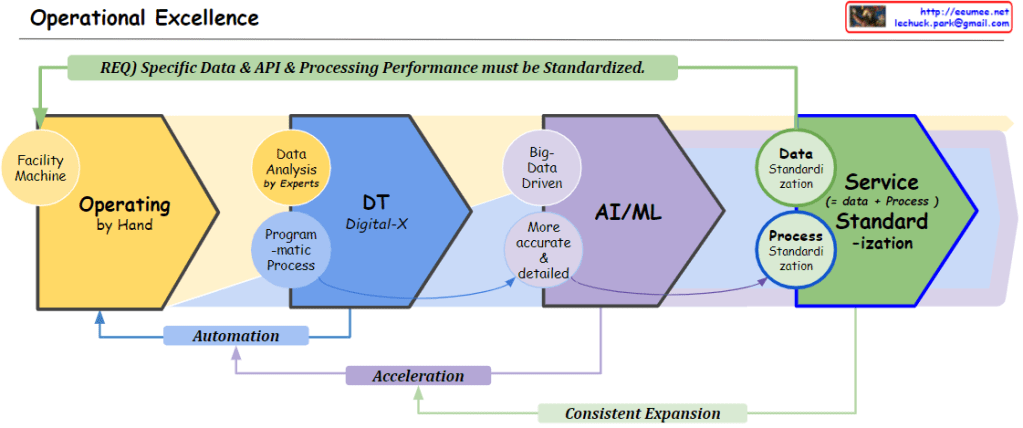
Operational Excellence

From DALL-E with some prompting
The image delineates a progressive digital transformation process aimed at achieving operational efficiency. It comprises four main stages, each incorporating specific elements and influencing improvements in the preceding stages:

  1. Manual Operation (Operating by Hand): This foundational stage involves the hands-on operation of facilities or machinery, focusing on the physical manipulation of equipment.
  2. Digital Transformation (DT): Data derived from manual operations are analyzed by experts and digitized through programmatic processes. This stage fosters automation, enhancing the efficiency and optimization of processes.
  3. AI/ML: The data processed through digital transformation are further analyzed with AI and machine learning technologies, driven by large-scale data to achieve more accurate and detailed insights. These analyses facilitate the acceleration and consistent expansion of processes and services.
  4. Service Standardization: The final stage involves standardizing data and processes based on the insights from AI/ML analysis. Essential for delivering high-quality services, it necessitates a clear definition of necessary data, its integration, and performance parameters from facilities and machinery.

Each of these stages is interdependent, with the arrows at the bottom indicating a feedback loop to the previous stages. For instance, insights from AI/ML promote data standardization, which, in turn, contributes to the improvement of digital transformation and manual operations. This creates a cyclical mechanism where each phase reinforces the others, allowing for continuous enhancement of the overall system.