Modular Data Center Architecture Analysis
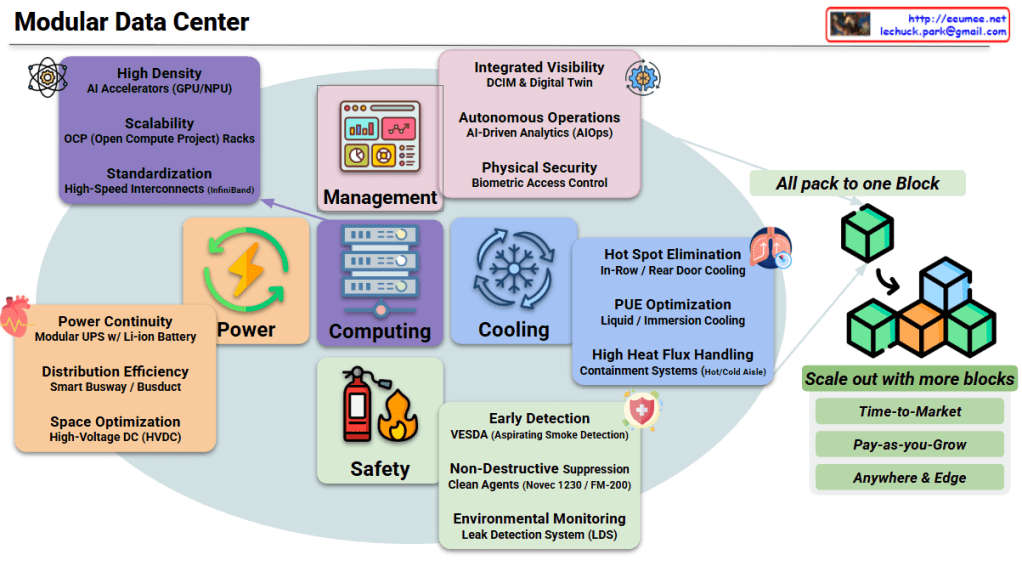
This image illustrates a comprehensive Modular Data Center architecture designed specifically for modern AI/ML workloads, showcasing integrated systems and their key capabilities.
Core Components
1. Management Layer
- Integrated Visibility: DCIM & Digital Twin for real-time monitoring
- Autonomous Operations: AI-Driven Analytics (AIOps) for predictive maintenance
- Physical Security: Biometric Access Control for enhanced protection
2. Computing Infrastructure
- High Density AI Accelerators: GPU/NPU optimized for AI workloads
- Scalability: OCP (Open Compute Project) Racks for standardized deployment
- Standardization: High-Speed Interconnects (InfiniBand) for low-latency communication
3. Power Systems
- Power Continuity: Modular UPS with Li-ion Battery for reliable uptime
- Distribution Efficiency: Smart Busway/Busduct for optimized power delivery
- Space Optimization: High-Voltage DC (HVDC) for reduced footprint
4. Cooling Solutions
- Hot Spot Elimination: In-Row/Rear Door Cooling for targeted heat removal
- PUE Optimization: Liquid/Immersion Cooling for maximum efficiency
- High Heat Flux Handling: Containment Systems (Hot/Cold Aisle) for AI density
5. Safety & Environmental
- Early Detection: VESDA (Very Early Smoke Detection Apparatus)
- Non-Destructive Suppression: Clean Agents (Novec 1230/FM-200)
- Environmental Monitoring: Leak Detection System (LDS)
Why Modular DC is Critical for AI Data Centers
Speed & Agility
Traditional data centers take 18-24 months to build, but AI demands are exploding NOW. Modular DCs deploy in 3-6 months, allowing organizations to capture market opportunities and respond to rapidly evolving AI compute requirements without lengthy construction cycles.
AI-Specific Thermal Challenges
AI workloads generate 3-5x more heat per rack (30-100kW) compared to traditional servers (5-10kW). Modular designs integrate advanced liquid cooling and containment systems from day one, purpose-built to handle GPU/NPU thermal density that would overwhelm conventional infrastructure.
Elastic Scalability
AI projects often start experimental but can scale exponentially. The “pay-as-you-grow” model lets organizations deploy one block initially, then add capacity incrementally as models grow—avoiding massive upfront capital while maintaining consistent architecture and avoiding stranded capacity.
Edge AI Deployment
AI inference increasingly happens at the edge for latency-sensitive applications (autonomous vehicles, smart manufacturing). Modular DCs’ compact, self-contained design enables AI deployment anywhere—from remote locations to urban centers—with full data center capabilities in a standardized package.
Operational Efficiency
AI workloads demand maximum PUE efficiency to manage operational costs. Modular DCs achieve PUE of 1.1-1.3 through integrated cooling optimization, HVDC power distribution, and AI-driven management—versus 1.5-2.0 in traditional facilities—critical when GPU clusters consume megawatts.
Key Advantages
📦 “All pack to one Block” – Complete infrastructure in pre-integrated modules 🧩 “Scale out with more blocks” – Linear, predictable expansion without redesign
- ⏱️ Time-to-Market: 4-6x faster deployment vs traditional builds
- 💰 Pay-as-you-Grow: CapEx aligned with revenue/demand curves
- 🌍 Anywhere & Edge: Containerized deployment for any location
Summary
Modular Data Centers are essential for AI infrastructure because they deliver pre-integrated, high-density compute, power, and cooling blocks that deploy 4-6x faster than traditional builds, enabling organizations to rapidly scale GPU clusters from prototype to production while maintaining optimal PUE efficiency and avoiding massive upfront capital investment in uncertain AI workload trajectories.
The modular approach specifically addresses AI’s unique challenges: extreme thermal density (30-100kW/rack), explosive demand growth, edge deployment requirements, and the need for liquid cooling integration—all packaged in standardized blocks that can be deployed anywhere in months rather than years.
This architecture transforms data center infrastructure from a multi-year construction project into an agile, scalable platform that matches the speed of AI innovation, allowing organizations to compete in the AI economy without betting the company on fixed infrastructure that may be obsolete before completion.
#ModularDataCenter #AIInfrastructure #DataCenterDesign #EdgeComputing #LiquidCooling #GPUComputing #HyperscaleAI #DataCenterModernization #AIWorkloads #GreenDataCenter #DCInfrastructure #SmartDataCenter #PUEOptimization #AIops #DigitalTwin #EdgeAI #DataCenterInnovation #CloudInfrastructure #EnterpriseAI #SustainableTech
With Claude
 Lechuck Park