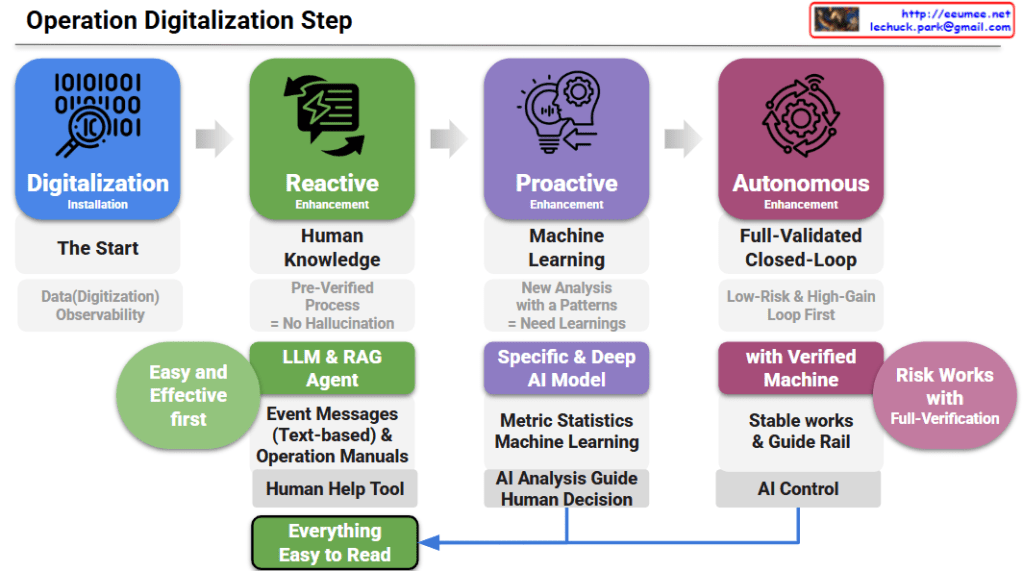
Operation Digitalization Step

Operation Digitalization Step: A 4-Step Roadmap

Step 1: Digitalization (The Start)

  • Goal: Securing data digitization and observability. It is the foundational phase of gathering and monitoring data before applying any advanced automation.

Step 2: Reactive Enhancement (Human Knowledge)

  • Goal: Applying LLM & RAG agents as a “Human Help Tool.”
  • Details: It relies on pre-verified processes to prevent AI hallucinations. By analyzing text-based event messages and operation manuals, it provides an “Easy and Effective first” approach to assist human operators.

Step 3: Proactive Enhancement (Machine Learning)

  • Goal: Deriving new insights through pattern analysis and machine learning.
  • Details: It utilizes specific and deep AI models based on metric statistics to provide an “AI Analysis Guide.” However, the final action still relies on a “Human Decision.”

Step 4: Autonomous Enhancement (Full-Validated Closed-Loop)

  • Goal: Achieving stable, AI-controlled operations.
  • Details: It prioritizes low-risk, high-gain loops. Through verified machines and strict guide rails, the system executes autonomous “AI Control” under full verification to manage risks.
  • Core Feedback Loop: The outcomes from both human decisions (Step 3) and AI control (Step 4) are ultimately designed to make “Everything Easy to Read,” ensuring transparency and intuitive understanding for operators.

  1. Progressive Evolution: The roadmap illustrates a strategic 4-step journey from basic data observability to fully autonomous, AI-controlled operations.
  2. Practical AI Adoption: It emphasizes a safe, low-risk strategy, starting with LLM/RAG as human-assist tools before advancing to predictive machine learning and closed-loop automation.
  3. Human-Centric Transparency: Regardless of the automation level, the ultimate design ensures all AI actions and system insights remain intuitive and “Easy to Read” for human operators.

#OperationDigitalization #AIOps #AutonomousOperations #DataCenterManagement #ITInfrastructure #LLM #RAG #MachineLearning #DigitalTransformation
AI DC : CAPEX to OPEX

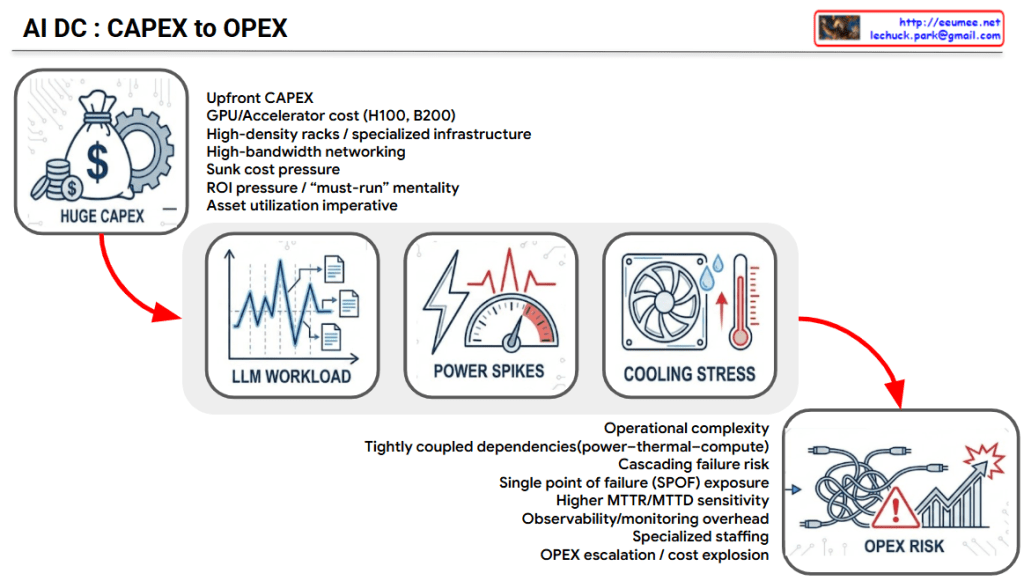
Thinking of an AI Data Center (DC) through the lens of a Rube Goldberg Machine is a brilliant way to visualize the “cascading complexity” of modern infrastructure. In this setup, every high-tech component acts as a trigger for the next, often leading to unpredictable and costly outcomes.


The AI DC Rube Goldberg Chain: From CAPEX to OPEX

1. The Heavy Trigger: Massive CAPEX

The machine starts with a massive “weighted ball”—the Upfront CAPEX.

  • The Action: Billions are poured into H100/B200 GPUs and specialized high-density racks.
  • The Consequence: This creates immense “Sunk Cost Pressure.” Because the investment is so high, there is a “must-run” mentality to ensure maximum asset utilization. You cannot afford to let these expensive chips sit idle.

2. The Erratic Spinner: LLM Workload Volatility

As the ball rolls, it hits an unpredictable spinner: the Workload.

  • The Action: Unlike traditional steady-state cloud tasks, LLM workloads (training vs. inference) are highly “bursty”.
  • The Consequence: The demand for compute fluctuates wildly and unpredictably, making it impossible to establish a smooth operational rhythm.

3. The Power Lever: Energy Spikes

The erratic workload flips a lever that controls the Power Grid.

  • The Action: When the LLM workload spikes, the power draw follows instantly. This creates Power Spikes ($\Delta P$) that strain the electrical infrastructure.
  • The Consequence: These spikes threaten grid stability and increase the sensitivity of Power Distribution Units (PDUs) and UPS systems.

4. The Thermal Valve: Cooling Stress

The surge in power generates intense heat, triggering the Cooling System.

  • The Action: Heat is the literal byproduct of energy consumption. As power spikes, the temperature rises sharply, forcing cooling fans and liquid cooling loops into overdrive.
  • The Consequence: This creates Cooling Stress. If the cooling cannot react as fast as the power spike, the system faces “Thermal Throttling,” which slows down the compute and ruins efficiency.

5. The Tangled Finish: Escalating OPEX Risk

Finally, all these moving parts lead to a messy, high-risk conclusion: Operational Complexity.

  • The Action: Because power, thermal, and compute are “Tightly Coupled,” a failure in one area causes a Cascading Failure across the others.
  • The Consequence: You now face a “Single Point of Failure” (SPOF) risk. Managing this requires specialized staffing and expensive observability tools, leading to an OPEX Explosion.

Summary

  1. Massive CAPEX creates a “must-run” pressure that forces GPUs to operate at high intensity to justify the investment.
  2. The interconnected volatility of workloads, power, and cooling creates a fragile “Rube Goldberg” chain where a single spike can cause a system-wide failure.
  3. This complexity shifts the financial burden from initial hardware costs to unpredictable OPEX, requiring expensive specialized management to prevent a total crash.

#AIDC #CAPEXtoOPEX #LLMWorkload #DataCenterManagement #OperationalRisk #InfrastructureComplexity #GPUComputing


With Gemini

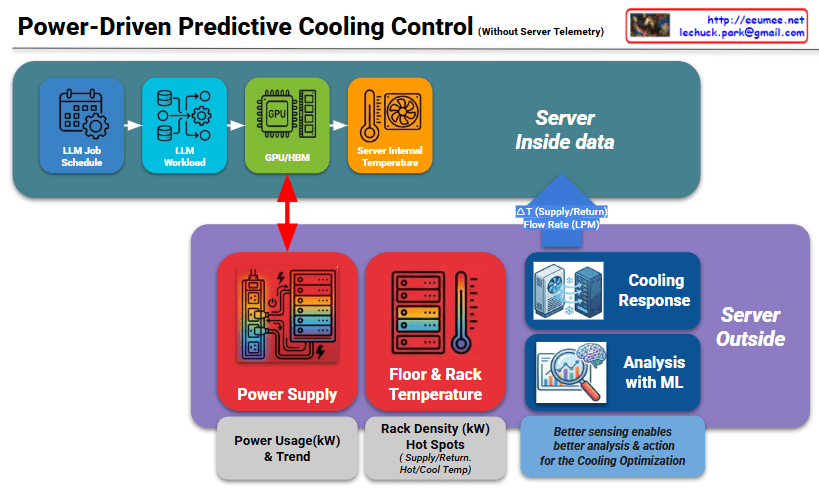
Power-Driven Predictive Cooling Control (Without Server Telemetry)

For a Co-location (Colo) service provider, the challenge is managing high-density AI workloads without having direct access to the customer’s proprietary server data or software stacks. This second image provides a specialized architecture designed to overcome this “data blindness” by using infrastructure-level metrics.


1. The Strategy: Managing the “Black Box”

In a co-location environment, the server internal data—such as LLM Job Schedules, GPU/HBM telemetry, and Internal Temperatures—is often restricted for security and privacy reasons. This creates a “Black Box” for the provider. The architecture shown here shifts the focus from the Server Inside to the Server Outside, where the provider has full control and visibility.

2. Power as the Primary Lead Indicator

Because the provider cannot see when an AI model starts training, they must rely on Power Supply telemetry as a proxy.

  • The Power-Heat Correlation: As indicated by the red arrow, there is a near-instantaneous correlation between GPU activity and power draw ($kW$).
  • Zero-Inference Monitoring: By monitoring Power Usage & Trends at the PDU (Power Distribution Unit) level, the provider can detect a workload spike the moment it happens, often several minutes before the heat actually migrates to the rack-level sensors.

3. Bridging the Gap with ML Analysis

Since the provider is missing the “More Proactive” software-level data, the Analysis with ML component becomes even more critical.

  • Predictive Modeling: The ML engine analyzes power trends to forecast the thermal discharge. It learns the specific “power signature” of AI workloads, allowing it to initiate a Cooling Response (adjusting Flow Rate in LPM and $\Delta T$) before the ambient temperature rises.
  • Optimization without Intrusion: This allows the provider to maintain a strict SLA (Service Level Agreement) and optimize PUE (Power Usage Effectiveness) without requiring the tenant to install agents or share sensitive job telemetry.

Comparison for Co-location Providers

FeatureIdeal Model (Image 1)Practical Colo Model (Image 2)
VisibilityFull-stack (Software to Hardware)Infrastructure-only (Power & Air/Liquid)
Primary MetricLLM Job Queue / GPU TempPower Trend ($kW$) / Rack Density
Tenant PrivacyLow (Requires data sharing)High (Non-intrusive)
Control PrecisionExtremely HighHigh (Dependent on Power Sampling Rate)

Summary

  1. For Co-location providers, this architecture solves the lack of server-side visibility by using Power Usage ($kW$) as a real-time proxy for heat generation.
  2. By monitoring Power Trends at the infrastructure level, the system can predict thermal loads and trigger Cooling Responses before temperature sensors even react.
  3. This ML-driven approach enables high-efficiency cooling and PUE optimization while respecting the strict data privacy and security boundaries of multi-tenant AI data centers.

Hashtags

#Colocation #DataCenterManagement #PredictiveCooling #AICooling #InfrastructureOptimization #PUE #LiquidCooling #MultiTenantSecurity

With Gemini