LLM/RAG/Agentic

This image shows a diagram titled “LLM RAG Agentic” that illustrates the components and relationships in an AI system architecture.

The diagram is organized in a grid-like layout with three rows and three columns. Each row appears to represent different functional aspects of the system:

Top row:

  • Left: “Text QnA” in a blue box
  • Middle: A question mark icon with what looks like document/chat symbols
  • Right: “LLM” (Large Language Model) in a blue box with a brain icon connected to various data sources/APIs in the middle

Middle row:

  • Left: “Domain Specific” in a blue box
  • Middle: A “Decision by AI” circle/node that serves as a central connection point
  • Right: “RAG” (Retrieval-Augmented Generation) in a blue box with database/server icons

Bottom row:

  • Left: “Agentic & Control Automation” in a blue box
  • Middle: A task management or workflow icon with checkmarks and a clock
  • Right: “Agentic AI” in a blue box with UI/interface icons

Arrows connect these components, showing how information and processes flow between them. The diagram appears to illustrate how a large language model integrates with retrieval-augmented generation capabilities and agentic (autonomous action-taking) functionality to form a complete AI system.

With Claude
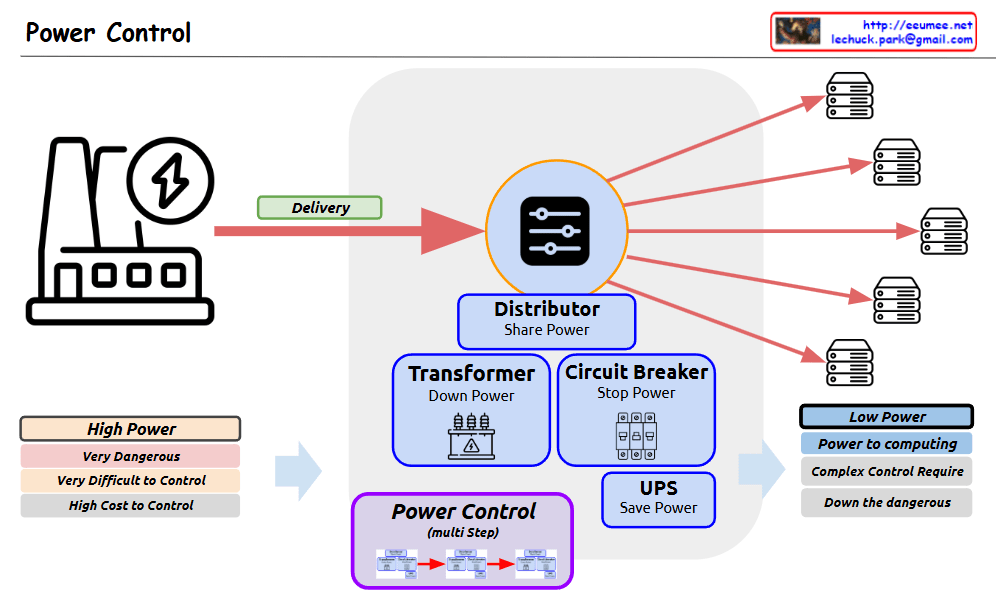
Power Control

Power Control system diagram

  1. Power Source (Left Side)
  • High Power characteristics:
    • Very Dangerous
    • Very Difficult to Control
    • High Cost to Control
  1. Central Control/Distribution System (Center)
  • Distributor: Shares/distributes power
  • Transformer: Steps down power
  • Circuit Breaker: Stops power
  • UPS (Uninterruptible Power Supply): Saves power
  • Power Control (multi-step)
  1. Final Distribution (Right Side)
  • Low Power characteristics:
    • Power for computing
    • Complex Control Required
    • Reduced dangers

The diagram shows the complete process of how high-power electricity is safely and efficiently controlled and converted into low-power suitable for computing systems. The power flow is illustrated through a “Delivery” phase, passing through various protective and control devices before being distributed to multiple servers or computing equipment.

The system emphasizes safety and control through multiple stages:

  • Initial high-power input is marked as dangerous and difficult to control
  • Multiple control mechanisms (transformer, circuit breaker, UPS) manage the power
  • The distributor splits the controlled power to multiple endpoints
  • Final output is appropriate for computing equipment

This setup ensures safe and reliable power distribution while reducing the risks associated with high-power electrical systems.

With Claude

Traffic Control

This image shows a network traffic control system architecture. Here’s a detailed breakdown:

  1. At the top, several key technologies are listed:
  • P4 (Programming Protocol-Independent Packet Processors)
  • eBPF (Extended Berkeley Packet Filter)
  • SDN (Software-Defined Networking)
  • DPI (Deep Packet Inspection)
  • NetFlow/sFlow/IPFIX
  • AI/ML-Based Traffic Analysis
  1. The system architecture is divided into main sections:
  • Traffic flow through IN PORT and OUT PORT
  • Routing based on Destination IP address
  • Inside TCP/IP and over TCP/IP sections
  • Security-Related Conditions
  • Analysis
  • AI/ML-Based Traffic Analysis
  1. Detailed features:
  • Inside TCP/IP: TCP/UDP Flags, IP TOS (Type of Service), VLAN Tags, MPLS Labels
  • Over TCP/IP: HTTP/HTTPS Headers, DNS Queries, TLS/SSL Information, API Endpoints
  • Security-Related: Malicious Traffic Patterns, Encryption Status
  • Analysis: Time-Based Conditions, Traffic Patterns, Network State Information
  1. The AI/ML-Based Traffic Analysis section shows:
  • AI/ML technologies learn traffic patterns
  • Detection of anomalies
  • Traffic control based on specific conditions

This diagram represents a comprehensive approach to modern network monitoring and control, integrating traditional networking technologies with advanced AI/ML capabilities. The system shows a complete flow from packet ingress to analysis, incorporating various layers of inspection and control mechanisms.

with Claude

Anomaly Traffic Detection#1

From DALL-E with some prompting
The flowchart illustrates a four-step network anomaly detection process:

  1. Data Collection: Gather various types of network data.
  2. Protocol Usage: Employ SNMP, SFLOW/NETFLOW, and other methods to extract the data.
  3. Analysis: Analyze Ethernet and TCP/IP header data for irregularities.
  4. Control: Implement countermeasures like blocking traffic or controlling specific IP addresses.

The expected benefits of this process include enhanced network security through early detection of anomalies, the ability to prevent potential breaches by blocking suspicious traffic, and improved network management via real-time analysis and control.

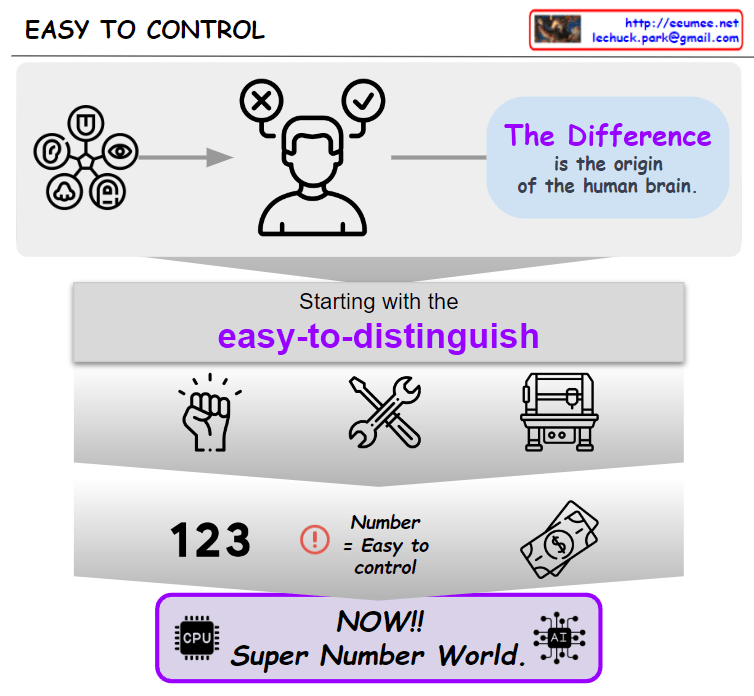
Human like “EASY TO CONTROL”

From DALL-E with some prompting
This image represents the connection between human discernment and numeric-based control systems. Humans possess the ability to detect and understand complex differences, which is crucial for the advancement of capital and business. Starting with simple and distinguishable elements, we have evolved to represent and control increasingly complex economic systems through numbers. The ‘Super Number World’ symbolically represents how we utilize technology, especially computing and artificial intelligence, to manage this complexity. Ultimately, the growth of capital and business is represented and understood through numbers, and controlling these numbers creates the most significant differences in the modern economy.