Digitalization

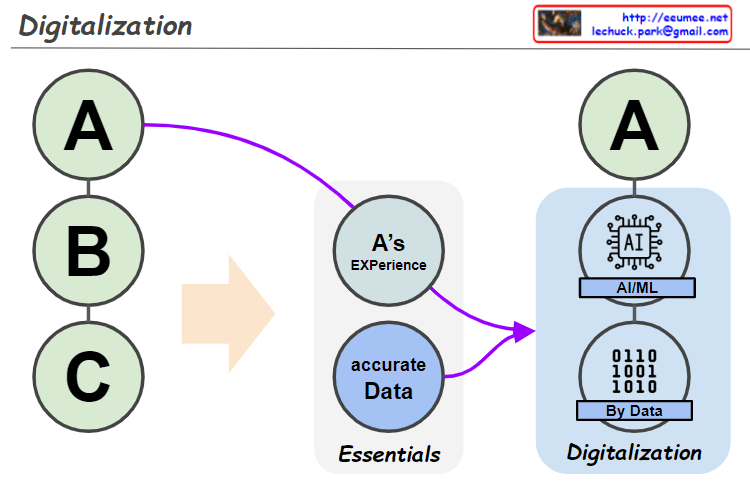
From DALL-E with some prompting
The image depicts three levels of experience, A, B, and C, highlighting that while A represents a high level of experience, levels B and C can be enhanced through digital transformation using data and AI technologies. This transformation underscores that the collection and analysis of accurate data are essential elements, as they lay the foundation for AI systems to perform sophisticated learning, thus improving operational efficiency and precision.

The integration of individual experiences and precise data is not merely a technical shift but also prompts significant changes in human resource management within organizations. By incorporating their expertise into digital platforms, employees can strengthen the organization’s knowledge base and contribute to their own professional development.

Ultimately, this digital transformation should be sustainable and maintain a human-centric approach, ensuring that the increase in operational efficiency through AI alleviates the workload on employees, fostering creativity and enhancing the organizational culture and values.


Start Regression (ML)

From DALL-E with some prompting

Linear Regression:
Yields a continuous output.
Relates independent variable X with dependent variable Y through a linear relationship.
Uses Mean Squared Error (MSE) as a performance metric.
Can be extended to Multi-linear Regression for multiple independent variables.

Linear & Logistic Regression

  • The process begins with data input, as indicated by “from Data.”
  • Machine learning algorithms then process this data.
  • The outcome of this process branches into two types of regression, as indicated by “get Functions.”

Logistics Regression:
Used for classification tasks, distinguishing between two or more categories.
Outputs a probability percentage (between 0 or 1) indicating the likelihood of belonging to a particular class.
Performance is evaluated using Log Loss or Binary Cross-Entropy metrics.
Can be generalized to Softmax/Multinomial Logistic Regression for multi-class classification problems.

The image also graphically differentiates the two types of regression. Linear Regression is represented with a scatter plot and a trend line indicating the predictive linear equation. Logistic Regression is shown with a sigmoid function curve that distinguishes between two classes, highlighting the model’s ability to classify data points based on the probability threshold.

3 for Datacenter

From DALL-E with some prompting
This image visually represents “3 Key Strategies for DC Operation.”

  1. Transform
    • Digitalization: Transitioning data centers to digital technology.
      • KPI (Key Performance Indicators)
      • PUE (Power Usage Effectiveness) & Monitoring
      • Automation
      • Data API Service
  2. Use
    • Data Platform: Establishing platforms for data management and utilization.
      • Standardization
      • Platform
      • Continuous Upgrade
      • New!!
  3. Verify
    • AI: Validating efficiency and performance of data centers through AI.
      • Real AI
      • Early Warning
      • Energy Operation

These three strategies are interconnected with three objectives: “Experience to Digital,” “Continuous Innovation,” and “AI DC Now!!” This illustrates that the operation of data centers is moving towards impacting humans through digitalization, innovation, and the application of AI technology, driving transformation across the industry.

Exp to the AI

From DALL-E with some prompting
The image outlines a transformative process in AI development:

Experience to Data: This depicts the conversion of real-world experiences into digital data. Icons indicate a brain or cognition and a gear mechanism, symbolizing the process of understanding and systematizing experiences.

Digital to Platform: The transformed data is then standardized on a platform. Icons of servers and a microchip suggest data storage and processing.

Platform Makes New & AI: Utilizing the standardized data, the platform facilitates the creation of new AI services. Icons of an AI chip and a symbol for ‘new’ represent the innovation and development of AI applications.

Overall, the image emphasizes the value of converting experiences into a digital format that can be standardized on a platform to drive the creation of innovative AI services.

Network Monitoring with AI

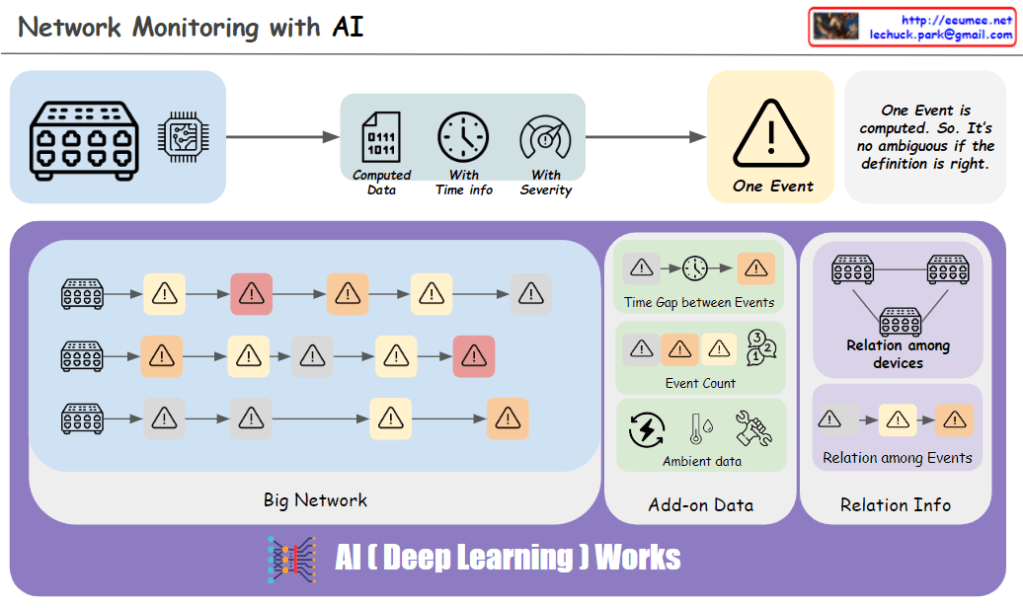
from DALL-E with some prompting
The image portrays a network monitoring system enhanced by AI, specifically utilizing deep learning. It shows a flow from the network infrastructure to the identification of an event, characterized by computed data with time information and severity. The “One Event” is clearly defined to avoid ambiguity. The system identifies patterns such as the time gap between events, event count, and relationships among devices and events, which are crucial for a comprehensive network analysis. AI deep learning algorithms work to process additional data (add-on data) and ambient data to detect anomalies and support predictive maintenance within the network.

AI Operation with numbers

From DALL-E with some prompting
The image illustrates an AI-based operational framework using numerical data for real-time operation, monitoring, and predictive maintenance. Data, such as temperature readings, is collected in digital form (“Get Digitals”). When operating within normal parameters (18°C to 27°C), the system maintains a “Normal Case” status. Any changes in the data trigger alerts and cautions. The AI model learns from numerical data to differentiate between normal and abnormal patterns. Upon detecting an anomaly, the system initiates a recovery process as part of predictive maintenance, aiming to address issues before they escalate.

Statistics ?

From DALL-E with some prompting
The image presents an exploration of perspectives in the context of big data and AI. “Subjective” reflects personal perception, while “Objective” shows a fact-based approach, though limited. “Statistics” introduces a big data-based AI perspective, offering a nearly complete yet unlimited framework for interpretation and judgment. This new perspective highlights the need for fresh terminology and concepts to navigate the advanced analytical landscape shaped by AI, suggesting an evolution from traditional subjective and objective paradigms to a more nuanced, data-centric approach.