AI persona

with a Claude’s Help
This image shows a diagram illustrating the process flow of an AI Persona system. It demonstrates five stages progressing from left to right:

  1. Life Logging:
  • Records daily activities such as listening to music and conversations
  • Data appears to be collected through mobile devices
  1. Digitization:
  • Converting and processing collected data into digital format
  • Shown with settings and document icons
  1. AI Learning:
  • Stage where AI learns from the digitized data
  • Represented by a circuit network icon
  1. AI Agent:
  • Formation of an AI agent based on learned data
  • Symbolized by an icon showing the integration of AI and human elements
  1. Digital World:
  • Final stage where the AI persona operates in the digital world
  • Represented by a global network icon

The diagram effectively illustrates the complete process of how human activities and characteristics are digitized, transformed into AI, and ultimately utilized in the digital world. Each step is clearly labeled and represented with relevant icons that help visualize the transformation from real-world data to digital AI persona.

The image appears to be part of a technical presentation or documentation, as indicated by the email address visible in the top right corner. The flow is presented in a clear, linear fashion with connecting arrows showing the progression between each stage. C
Infinite Diff

with a Claude’s help
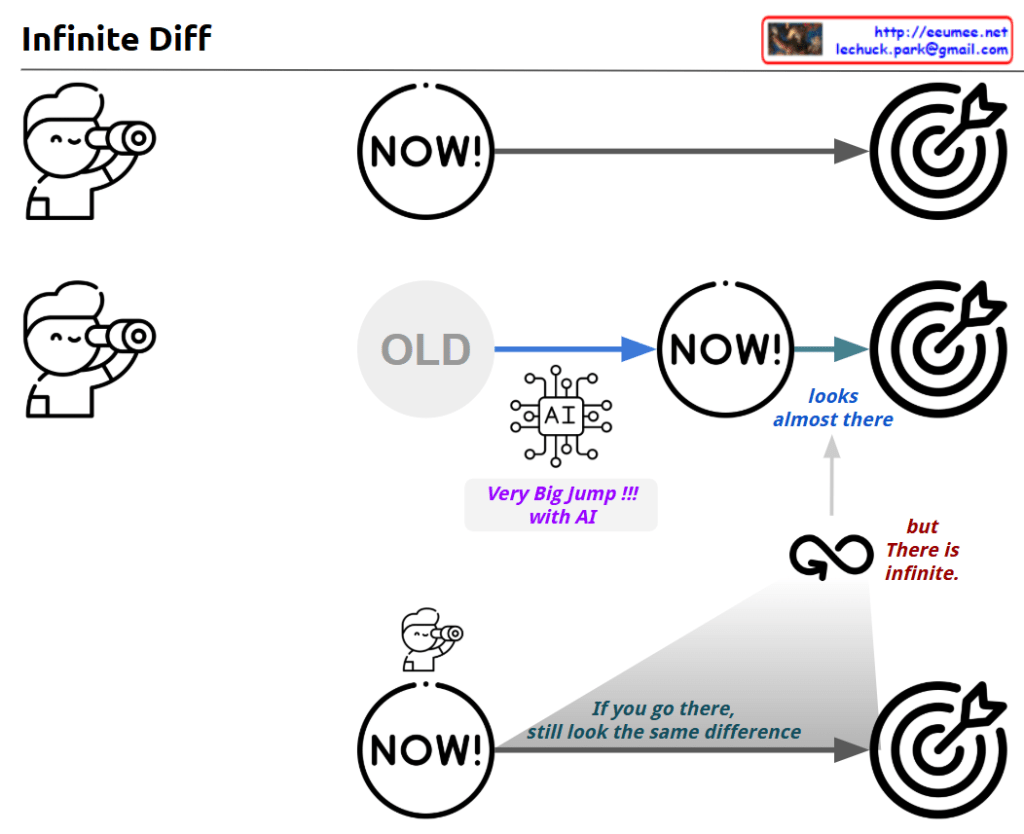
This image, titled “Infinite Diff,” illustrates three scenarios about reaching goals with and without AI:

  1. The first scenario shows a simple direct path: a straight line from “NOW!” to the target (bullseye).
  2. The second scenario demonstrates the intervention of AI:
    • Starting from “OLD” through AI to reach “NOW!”
    • Makes a “Very Big Jump!!!” with AI assistance, getting “looks almost there” to the target
    • However, there’s an infinity symbol (∞) with the note “but There is infinite”
  3. The final scenario shows a distance to the target with the message “If you go there, still look the same difference,” suggesting that regardless of progress, there remains a constant gap to perfection.

The diagram conveys a philosophical message about progress and perfection: while AI can help make significant leaps forward, there will always be infinite room for improvement. Even as we get closer to our goals, there’s always space to grow and improve further.

This visual metaphor effectively communicates the concept that while AI can accelerate progress dramatically, achieving absolute perfection remains an infinite journey – there’s always room for further improvement, no matter how far we’ve come.

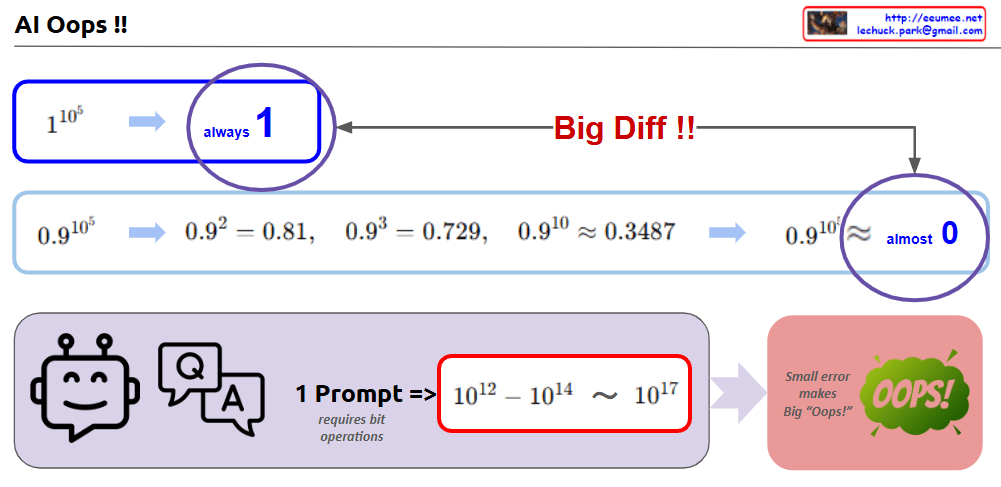
AI Oops!!

with a ChatGPT’s help
This image highlights how small errors in AI or computational operations can lead to significant differences or problems. Here’s a sentence-based explanation:


  1. Small changes lead to big differences
    • 1^10⁵: This consistently equals 1, no matter how many iterations are performed.
    • 0.9^10⁵: On the other hand, this gradually decreases and approaches 0, creating a significant difference.
      • For example:
        • 0.92=0.810.9^2 = 0.810.92=0.81,
        • 0.93=0.7290.9^3 = 0.7290.93=0.729,
        • 0.910≈0.34870.9^{10} ≈ 0.34870.910≈0.3487,
        • 0.9105≈almost00.9^{10^5} ≈ almost 00.9105≈almost0.
  2. The “Oops” in AI or calculations
    • A single incorrect computation or prompt can result in a massive amount of processing (from 10^12 to 10^17 bit operations).
    • This demonstrates how a small error can lead to a big “Oops!” in the overall system.

Summary:
The image visually explains the importance of precision and how minor computational inaccuracies can cascade into significant consequences, especially in AI or large-scale calculations.

Prophet

With a Claude’s help
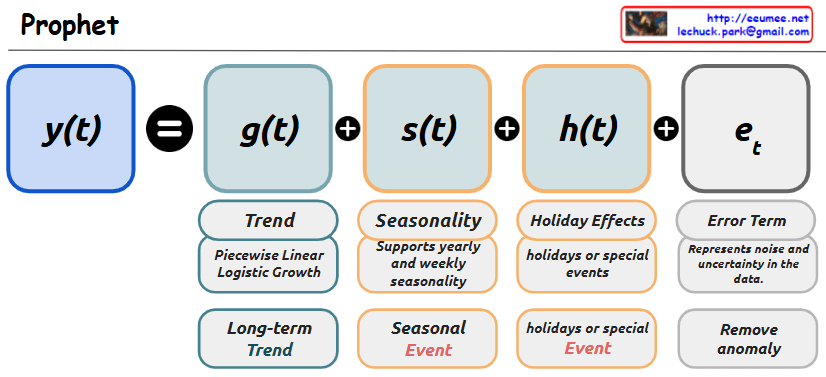
The image appears to be a diagram or concept map that explains the components of the Prophet forecasting model, which is a popular time series forecasting library in Python. Here’s a breakdown of the key elements:

The diagram also shows different types of trend, seasonality, and holiday effects that the Prophet model can handle.

The main function is y(t), which represents the time series data that needs to be forecasted.

y(t) is composed of four additive components:

g(t): The trend component, which represents the long-term linear or piecewise linear growth trend in the data.

s(t): The seasonality component, which captures yearly and weekly seasonality patterns in the data.

h(t): The holiday effects component, which accounts for the impact of holidays or special events on the data.

e: The error term, which represents noise and uncertainty in the data.

The Era of True Artificial Intelligence: Bridging Human and Machine Learning  

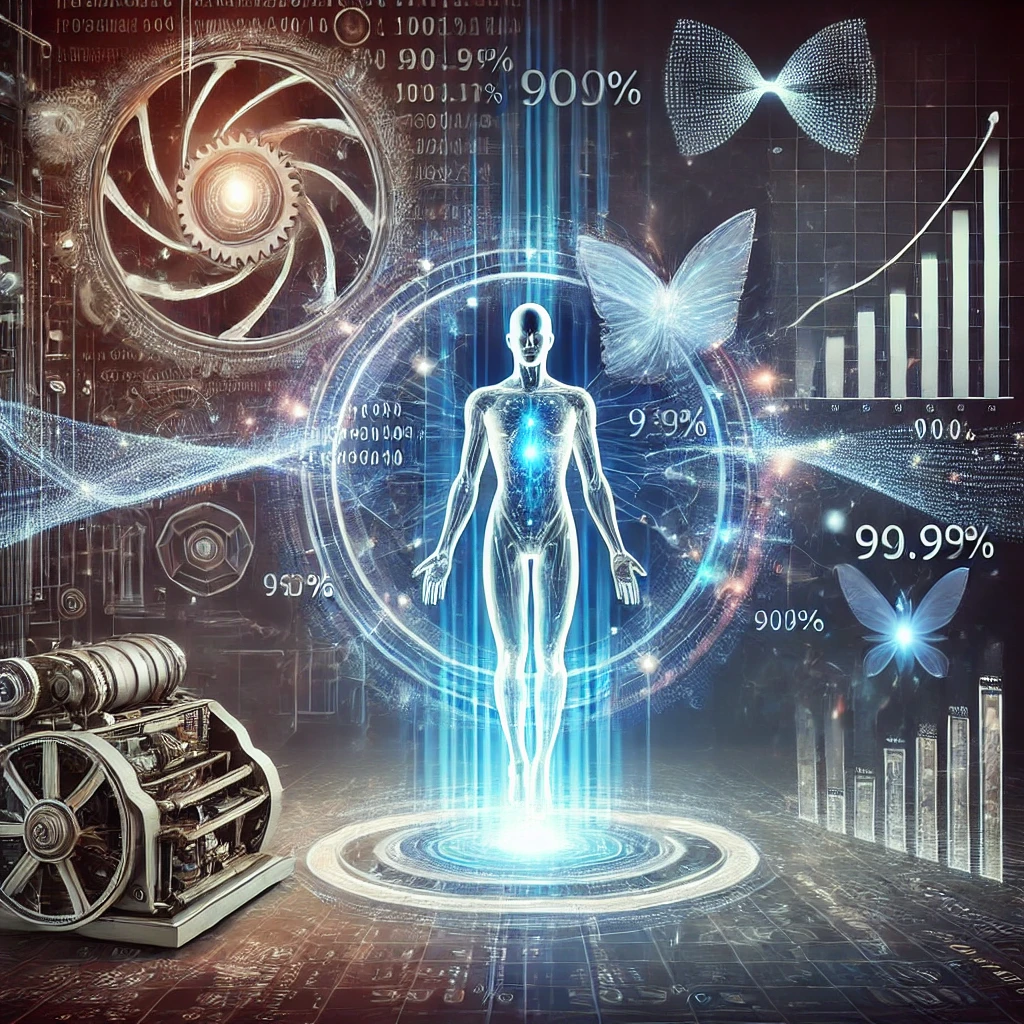
AI has now reached a level that can truly be called Artificial Intelligence. This is especially evident in the era of Machine Learning (ML). Humans learn through experiences—essentially data—and make judgments and take actions based on them. These actions are not always perfect or correct, but through continuous learning and experience, they strive for better outcomes, which inherently reflects a probabilistic and statistical perspective.

Similarly, ML learns from massive datasets to identify rules and minimize errors. However, it cannot achieve 100% perfection because it cannot learn all possible data, which is essentially infinite. Despite this, recent advancements in infrastructure and access to vast amounts of data have enabled AI to reach accuracy levels of 90% to 99.99%, appearing almost perfect.

Nevertheless, there still remains the elusive 0.00…1% of uncertainty, stemming from the fundamental limitation of incomplete data learning. Ultimately, AI is not so different from humans in how it learns and makes probabilistic decisions. For this reason, we can truly call it Artificial Intelligence.

Time Series Prediction : 3 types

with a Claude’s help
This image provides an overview of different time series prediction methods, including their characteristics and applications. The key points are:

ARIMA (Autoregressive Integrated Moving Average):

  • Suitable for linear, stable datasets where interpretability is important
  • Can be used for short-term stock price prediction and monthly energy consumption forecasting

Prophet:

  • A quick and simple forecasting method with clear seasonality and trend
  • Suitable for social media traffic and retail sales predictions

LSTM (Long Short-Term Memory):

  • Suitable for dealing with nonlinear, complex, large-scale, feature-rich datasets
  • Can be used for sensor data anomaly detection, weather forecasting, and long-term financial market prediction

Application in a data center context:

  • ARIMA: Can be used to predict short-term changes in server room temperature and power consumption
  • Prophet: Can be used to forecast daily, weekly, and monthly power usage patterns
  • LSTM: Can be used to analyze complex sensor data patterns and make long-term predictions

Utilizing these prediction models can contribute to energy efficiency improvements and proactive maintenance in data centers. When selecting a prediction method, one should consider the characteristics of the data and the specific forecasting requirements.

Operating with a dev Platform

with a Claude’s help
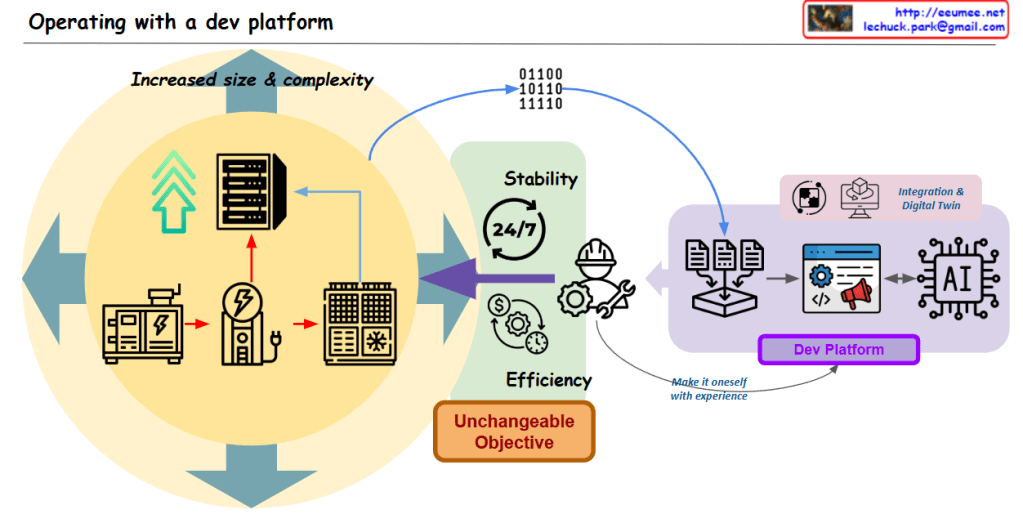
The main points covered in this image are:

  1. Increased Size and Complexity of Data
  • The central upward-pointing arrow indicates that the size and complexity of data is increasing.
  1. Key Operational Objectives
  • The three main operational goals presented are Stability, Efficiency, and an “Unchangeable Objective”.
  • Stability is represented by the 24/7 icon, indicating the need for continuous, reliable operation.
  • Efficiency is depicted through various electrical/mechanical icons, suggesting the need for optimized resource utilization.
  • The “Unchangeable Objective” is presented as a non-negotiable goal.
  1. Integration, Digital Twin, and AI-based Development Platform
  • To manage the increasing data and operations, the image shows the integration of technologies like Digital Twin.
  • An AI-powered Development Platform is also illustrated, which can “make it [the operations] itself with experience”.
  • This Development Platform seems to leverage AI to help achieve the stability, efficiency, and unchangeable objectives.
  1. Interconnected Elements
  • The image demonstrates the interconnected nature of the growing data, the key operational requirements, and the technological solutions.
  • The Development Platform acts as a hub, integrating data and AI capabilities to support the overall operational goals.

In summary, this image highlights the challenges posed by the increased size and complexity of data that organizations need to manage. It presents the core operational objectives of stability, efficiency, and immutable goals, and suggests that an integrated, AI-powered development platform can help address these challenges by leveraging the synergies between data, digital technologies, and autonomous problem-solving capabilities.