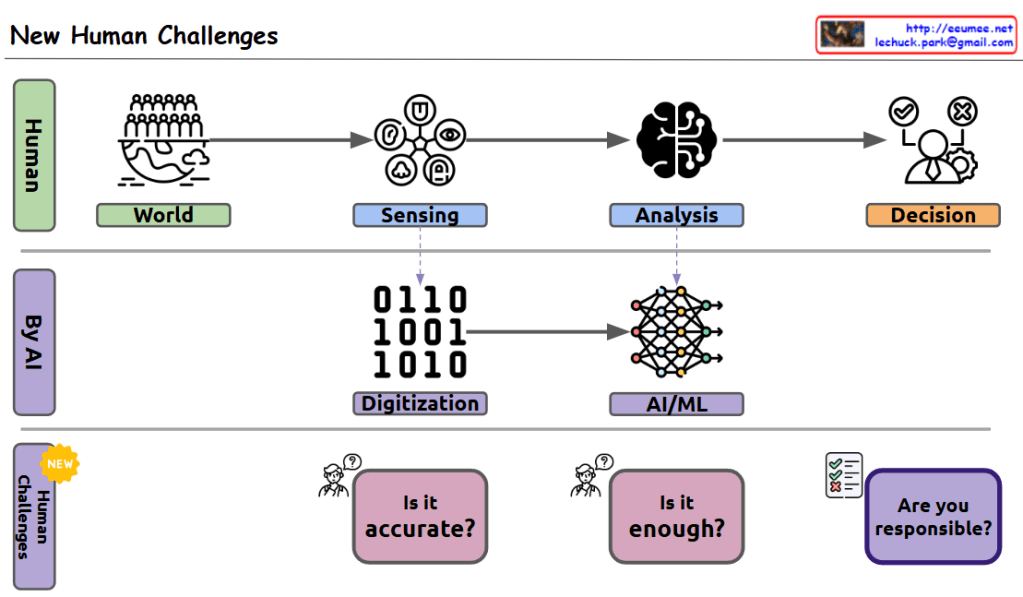
New Human Challenges

This image titled “New Human Challenges” illustrates the paradigm shift in information processing in the AI era and the new roles humans must assume.

The diagram is structured in three tiers:

  1. Human (top row): Shows the traditional human information processing flow. Humans sense information from the “World,” perform “Analysis” using the brain, and make final “Decisions” based on this analysis.
  2. By AI (middle row): In the modern technological environment, information from the world is “Digitized” into binary code, and this data is then processed through “AI/ML” systems.
  3. Human Challenges (bottom row): Highlights three key challenges humans face in the AI era:
    • “Is it accurate?” – Verifying the quality and integrity of data collection processes
    • “Is it enough?” – Ensuring the trained data is sufficient and balanced to reflect all perspectives
    • “Are you responsible?” – Reflecting on whether humans can take ultimate responsibility for decisions suggested by AI

This diagram effectively demonstrates how the information processing paradigm has shifted from human-centered to AI-assisted systems, transforming the human role from direct information processors to supervisors and accountability holders for AI systems. Humans now face new challenges focused on ensuring data quality, data sufficiency and balance, and taking responsibility for final decision-making.

With Claude

The Age of Utilization

This image is an infographic depicting “The Age of Utilization.”

On the left side, a gray oval contains “All knowledge of mankind” represented by various icons including letter and number blocks, books with writing tools, and a globe symbolizing the internet, illustrating the diverse forms of knowledge humanity has accumulated over time.

In the center, there’s a section labeled “Massive parallel processing” showing multiple eye icons with arrows pointing toward a GPU icon. This illustrates how vast amounts of human knowledge are efficiently processed through GPUs.

On the right side, a purple arrow-shaped area labeled “Easy to utilize” demonstrates how processed information can be used. At the top is an “EASY TO USE” icon, with “Inference” and “Learning” stages below it. This section includes Q&A icons, a vector database, and neural network structures.

The infographic comprehensively shows how humanity has entered a new era where accumulated knowledge can be processed using modern technology and easily accessed through question-and-answer formats, making all human knowledge readily available for utilization.

With Claude

EEUMEE (AI-Block share)

The diagram illustrates a blockchain-based AI service system where:

  • At the center is a blockchain network (represented by an interconnected cube structure in a blue square) labeled “All transaction in a Block-chain”
  • Connected to this central blockchain are several components:
    • On the left: A personal AI agent connected to a person with a shopping cart
    • On the top right: A personal AI agent connected to what appears to be a chef or cook
    • On the bottom right: A personal AI agent connected to what looks like a farmer or gardener
    • At the bottom: A money/payment symbol (showing a coin with a dollar sign)

The arrows indicate connections or transactions between these components through the blockchain.

This appears to be illustrating a system where personal AI agents serve different user types (shoppers, cooks, farmers) with their transactions recorded on a blockchain.

With Claude

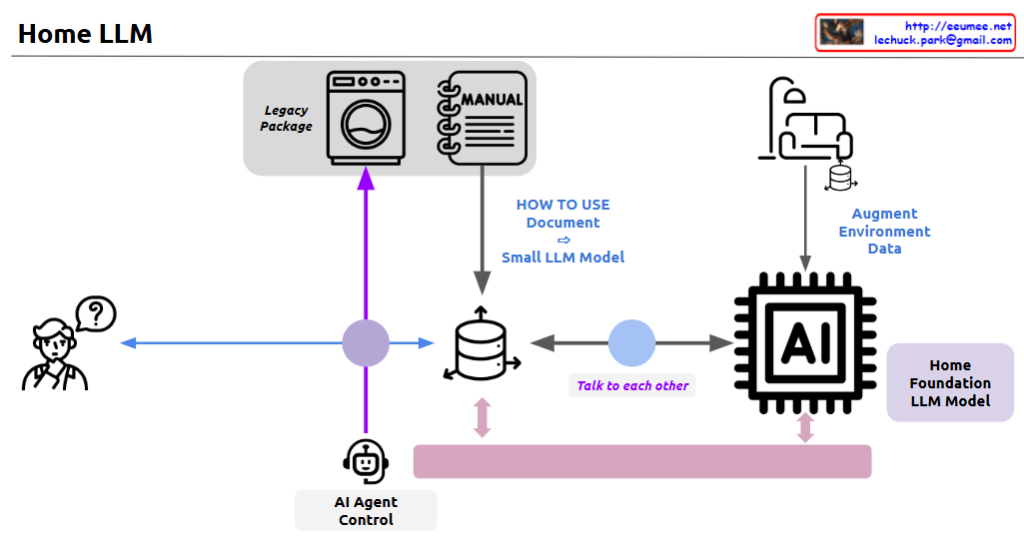
Home LLM

This image shows the architecture of a “Home LLM” system, illustrating an innovative change in how home appliances are used.

Key points:

  1. Evolution from Traditional Approach: While traditional electronics came as ‘product + paper manual’ packages, this new system replaces manuals with small LLM models.
  2. Home Foundation Model: Homes are equipped with a main LLM model (“Home Foundation LLM Model”) that learns from environmental data.
  3. Knowledge Exchange: Product-specific small LLM models and the home foundation model exchange data and learning outcomes with each other.
  4. User Interface: Users can easily interact through the LLM by asking questions and giving commands, making product usage much more intuitive and convenient.
  5. AI Agent Control: Additionally, AI agents automatically optimize the control of these products, increasing efficiency.

This system presents a smart home architecture that fundamentally improves the user experience of electronic products by integrating AI and LLM technologies in the home environment.

With Claude

Rule-Based vs LLM AI

Rule-Based AI vs. Machine Learning: Finding the Fastest Hiking Route

Rule-Based AI

  • A single expert hiker analyzes a map, considering terrain and conditions to select the optimal route.
  • This method is efficient and requires minimal energy (a small number of lunchboxes).

Machine Learning

  • A large number of hikers explore all possible paths without prior knowledge.
  • The fastest hiker’s route is chosen as the optimal path.
  • This approach requires many attempts, consuming significantly more energy (a vast number of lunchboxes).

πŸ‘‰ Comparison Summary

  • Rule-Based AI: Finds the best route through analysis β†’ Efficient, low energy consumption
  • Machine Learning: Finds the best route through trial and error β†’ Inefficient but discovers optimal paths, high energy consumption

with ChatGPT

Rule-base AI vs ML

The primary purpose of this image is to highlight the complementary nature of Rule-base AI and Machine Learning (ML), demonstrating the need to integrate these two approaches.

Rule-base AI (Top):

  • Emphasizes the importance of fundamental and ethical approaches
  • Designing strict rules based on human expertise and logical thinking
  • Providing core principles and ethical frameworks

Machine Learning AI (Bottom):

  • Highlighting scalability and innovation through data-driven learning
  • Ability to recognize complex patterns and adaptive learning
  • Potential for generating new insights and solutions

Hybrid Approach:

  • Combining the strengths of both approaches
  • Maintaining fundamental principles and ethical standards
  • Simultaneously achieving innovation and scalability through data-driven learning

The image illustrates the complementary nature of Rule-base AI and Machine Learning (ML). Rule-base AI represents precise, human-crafted logic with limited applicability, while ML offers flexibility and innovation through data-driven learning. The key message is that a hybrid approach combining the fundamental ethical principles of rule-based systems with the scalable, adaptive capabilities of machine learning can create more robust and intelligent AI solutions.

with Claude

Experience Selling

Experience Selling: Transforming Domain Expertise into Intellectual Capital

Paradigm Shift in Knowledge Economy

Core Value Proposition

  • Transforming specialized domain experience into structured digital data
  • Converting tacit knowledge into explicit, scalable intellectual assets

AI-Powered Knowledge Transformation

  • Digitalization of expert experiences
  • Large Language Model (LLM) training on domain-specific datasets
  • Creating replicable decision-making models from individual expertise

Key Message: In the AI era, experience is no longer a limited personal resource but a dynamic, expandable intellectual asset that can be transformed, shared, and monetized globally.