The Time is

From Claude with some prompting
This image explains the concept of time and its relation to gravity. Here’s a breakdown of the main points:

  1. Definition of Time:
    • It’s described as “The smallest unit of change” → “The smallest unit of time change * N” → “1 Second”.
  2. Gravity’s Influence:
    • The image states “Everything is affected by gravity.”
    • Gravity influences gear changes and signal changes, as shown by the icons.
  3. Relationship between Time and Gravity:
    • Time is affected by gravity.
    • The higher the gravity (lower place), the slower the changes, resulting in slower passage of time.
    • The lower the gravity (higher place), the faster the change, leading to faster passage of time.

This diagram simplifies one of the key concepts of Einstein’s General Theory of Relativity – how gravity affects the passage of time. It illustrates this complex idea in a straightforward, visual manner.

Everything is

From Claude with some prompting
This diagram titled “Everything is” illustrates the process of human perception and understanding:

  1. “Input” represents all information received through human senses, depicted by a group of people icons and various symbols.
  2. This input connects to “EVERYTHING”, suggesting that we perceive the world through our senses.
  3. The note “Only Meaning Very very small” indicates that the initial meaning of information at the input stage is limited.
  4. The “More & More” box represents the expansion of human understanding through two methods:
    • “Logics”: Human thought processes
    • “Auto Logics”: AI or automated thinking processes
  5. “More Micro” and “More Macro” arrows show that this expanded thinking develops into more microscopic and macroscopic perspectives.

In essence, this diagram portrays how humans receive information through their senses and process it using both human logical thinking and automated thinking (like AI). This continuous process expands our understanding of the world, allowing us to comprehend “EVERYTHING” from increasingly detailed (micro) and broad (macro) viewpoints. The diagram illustrates our journey towards a deeper and wider understanding of everything around us.

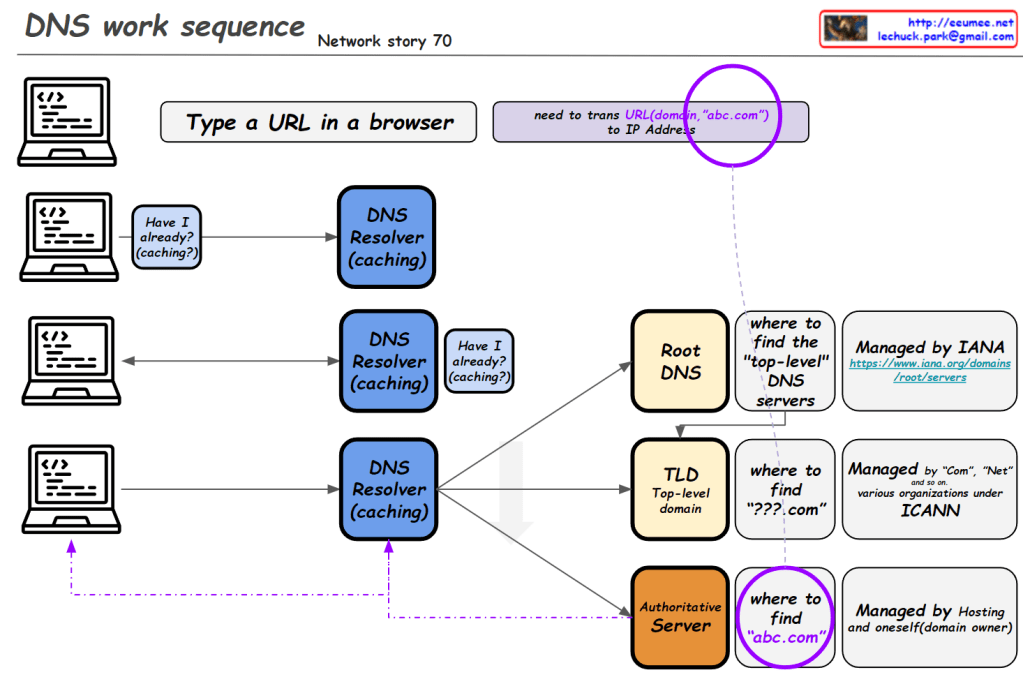
DNS work sequence

From Claude with some prompting
This image illustrates the DNS (Domain Name System) work sequence. Here’s a breakdown:

  1. It starts with typing a URL in a browser. For example, entering “abc.com” requires translation to an IP address.
  2. The DNS resolution process begins, involving multiple levels of DNS resolvers with caching capabilities.
  3. At each level, there’s a “Have I already? (caching?)” check. If the information is cached, it’s used immediately.
  4. If not found, it proceeds to the next level:
    • Root DNS: Provides information on top-level DNS servers (Managed by IANA)
    • TLD (Top-Level Domain): Gives information on domains like “.com” (Managed by various organizations under ICANN)
    • Authoritative Server: Provides actual domain information (e.g., abc.com, managed by hosting providers or domain owners)
  5. Through these stages, the system finds the necessary information to ultimately obtain the IP address of the entered domain.

This diagram effectively demonstrates the hierarchical structure of DNS lookup process and the caching mechanism at each stage.

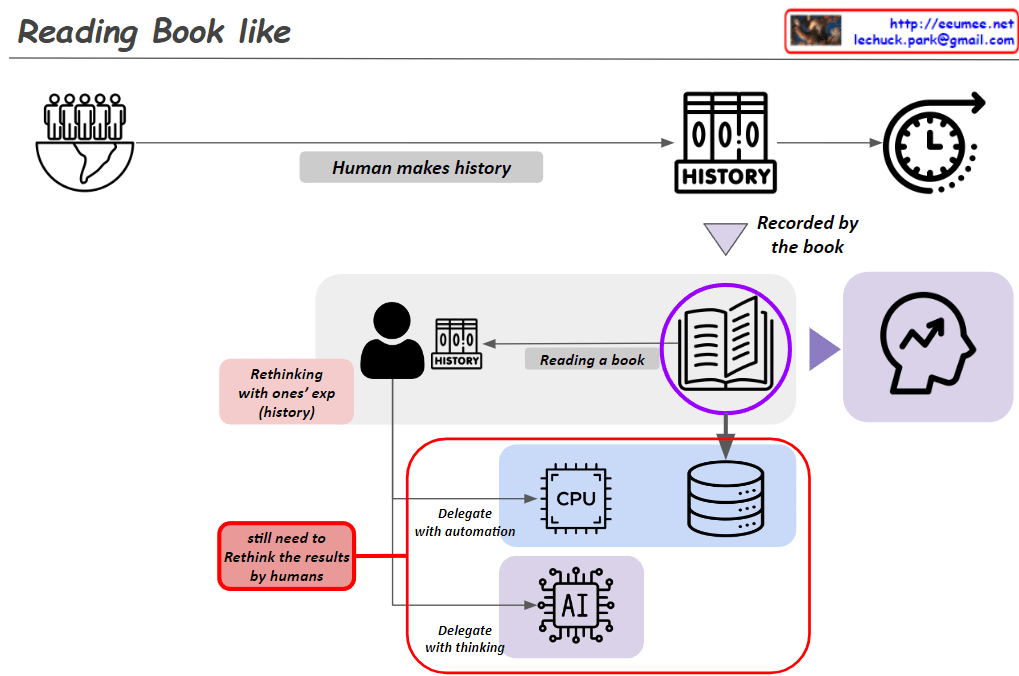
Reading book like

This diagram illustrates the process of learning history and technological advancement, highlighting the crucial role of humans:

  1. Creation and Recording of History:
    • Humans make history, which is recorded and transmitted through books.
  2. Knowledge Acquisition and Personal Growth:
    • Individuals learn history through books and reinterpret it by combining it with their own experiences.
  3. Technological Advancements and Utilization:
    • Automation of calculations through CPU
    • Delegation of some thinking processes to AI
  4. The Pivotal Role of Humans – Rethinking:
    • The key message is “still need to Rethink the results by humans”
    • This emphasizes that humans must critically evaluate and reinterpret the results obtained through technology
    • Through the process of rethinking, humans gain deeper understanding, new insights, and continue to develop
  5. Continuous Development Cycle:
    • Human rethinking generates new ideas and perspectives, which in turn become part of the history-making process

In conclusion, this diagram underscores that despite technological progress, human cognitive abilities, especially rethinking, are essential for individual and societal development. While humans use technology as a tool, the final interpretation and meaning-making remain uniquely human abilities, achieved through critical thinking and reinterpretation.