PUE 1 2 3

From Claude with some prompting
detailed explanation of the PUE levels :

  1. Level 1 (Basic Measurement):
  • Simple power meters are used to measure the total energy consumption of the entire data center.
  • Measurements are done periodically or manually, which is low-cost but has lower precision.
  • This level only provides visibility into the overall power usage of the data center.
  1. Level 2 (Intermediate Measurement):
  • Power consumption of individual IT equipment, cooling systems, and other subsystems is measured separately.
  • Automated software is used to collect more detailed data, providing moderate cost and mid-level precision.
  • This allows identifying the power usage breakdown across different subsystems.
  1. Level 3 (Advanced Measurement):
  • Real-time monitoring and in-depth data analysis provide deep insights, such as power usage patterns and predictive analytics.
  • Additional data points like power losses and environmental monitoring are collected.
  • The high-precision data enables advanced optimization of the data center’s energy efficiency.

The key differences between the levels are in terms of cost, precision, and the scope of data collected. Organizations can choose the appropriate PUE measurement level based on their operational goals and budget.

Getting digital “1” from real world

Bringing a digital “1” from the real world is far from simple.

  1. The need for complete control over “1”
    If a specific analog value is converted into a digital “1,” it must be clearly defined and controlled, as analog values are always subject to change. Determining the exact boundary of what qualifies as “1” is critical.
  2. Influence of external factors
    The analog world is full of external factors, such as temperature and humidity, which can affect digital values. Maintaining “1” consistently as desired in such an environment is a challenging task.
  3. Clear definition of “1”
    The value represented as “1” in digital form must have a clear definition from a human perspective. It should be universally understandable and explainable as “1.”
  4. Risks in AI environments
    In the realm of AI, where vast amounts of data are processed into complex outputs, even a single incorrect “1” can have significant and potentially dangerous consequences.

Ensuring and maintaining a digital “1” involves numerous challenges and complexities.

About the AI


The Evolution of Data and AI


1. Traditional Programs: Programs were designed to process data and generate new data.
2. Transition to AI: Traditional programs are being replaced by AI, particularly LLMs (Large Language Models).
• It’s like having an AI clone working alongside me for years, learning and handling tasks just like a human.
3. Only Data Remains: AI operates entirely based on data, making data the most critical resource.
4. Limits of Internet Data: The data available on the internet is finite, which means there’s a cap on how much AI can learn.
5. After AI Learning: Once all AI systems learn from the same dataset, there’s little difference in how they process information.
6. Winner Takes All: In LLM-driven services, the first to gain a competitive edge often dominates the market, leaving little room for competitors.


In summary, the evolution of data and AI introduces both new competitive dynamics and inherent limitations.

With ChatGPT

Workload trigger

From Claude with some prompting
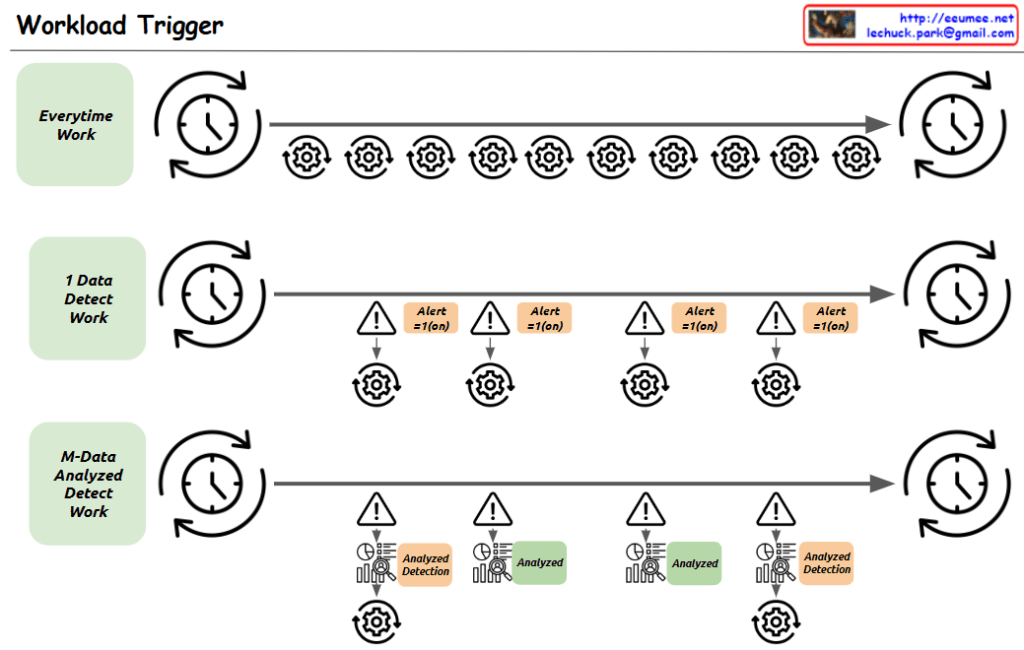
The image appears to be a diagram illustrating a “Workload Trigger” process. It shows three main stages of work:

  1. “Everytime Work”: This stage indicates work that is performed at a regular interval, represented by the repeating gear symbols.
  2. “1 Data Detect Work”: This stage shows data detection work that triggers alerts based on certain conditions, represented by the alert symbols.
  3. “M-Data Analyzed Detect Work”: This stage shows data analysis work that also triggers alerts based on the analysis results, represented by the analyzed detection symbols.

The overall flow of the diagram moves from left to right, with the work cycling through the three main stages. The timing of the work cycles is indicated by the clocks at the start and end of each stage.

The diagram seems to be illustrating some kind of automated monitoring or analysis workflow that triggers alerts based on the detection of certain data patterns or conditions.

log with the LLM

From Claude with some prompting
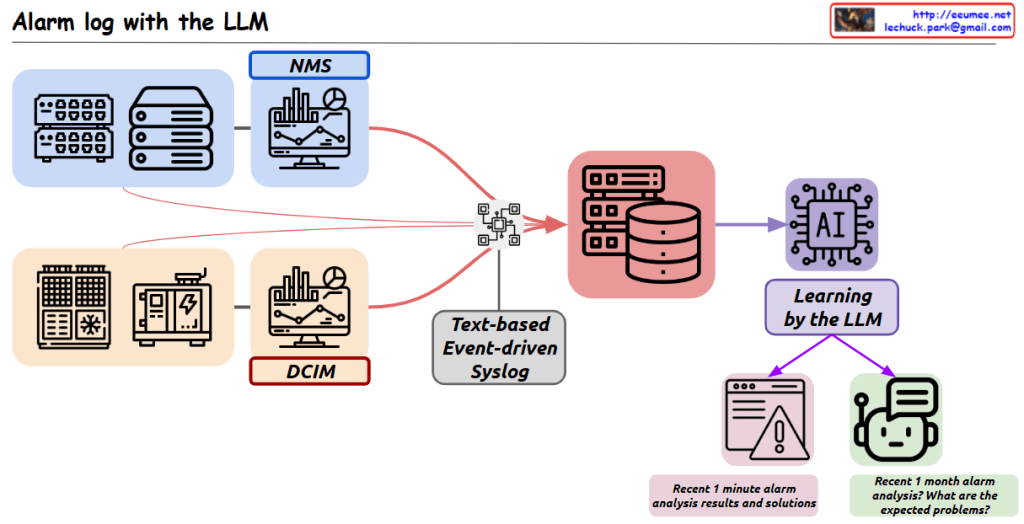
This image represents an “Alarm log with the LLM” system. The key components and functionality are as follows:

  1. NMS (Network Management System): A monitoring system that collects and displays alarm data.
  2. Text-based Event-driven Syslog: A system that logs events and alarm data in real-time text format. Syslog provides immediate data that is easily collected from existing environments.
  3. DCIM (Data Center Infrastructure Management): A system that manages the physical infrastructure of a data center, including alarms and monitoring.
  4. AI: An artificial intelligence component that utilizes a Large Language Model (LLM) for learning.
  5. 1-minute alarm analysis results and solutions: From a real-time monitoring perspective, this analyzes immediate alarm situations and provides solutions.
  6. 1-month alarm analysis: This long-term analysis of alarm data identifies anticipated problems. The analysis results can be used to provide a chatbot-based status query and response environment.

Overall, this system can provide powerful alarm management capabilities through real-time monitoring and predictive analysis.

Humans with numbers

From Claude with some prompting
This image depicts the progressive development of human capabilities and knowledge, showcasing how humans have strived to understand and explain the world through the use of numbers, mathematics, and computing technology.

  1. Human Groups: The image represents humans coming together in groups to explore and comprehend the world around them.
  2. Using Math: Humans have leveraged numbers and mathematical calculations in an effort to make sense of the world.
  3. Computing: Building upon their mathematical prowess, the advancement of computing technology has enhanced human analysis and understanding.
  4. High-Speed Infrastructure: The development of cutting-edge technological infrastructure has enabled further evolution of human activities.
  5. AI and Deep Learning: This series of technological advancements has led humans to a point where they may feel they have nearly reached the true essence of reality. However, the image suggests that the emergence of AI and deep learning technologies is now challenging this human-centric perspective, hinting that there may still be an infinite gap to traverse before fully grasping the fundamental nature of the world.

In essence, the image showcases the stepwise progression of human knowledge and capabilities, anchored in numbers, math, and computing, while also highlighting how these efforts are now being disrupted by the rise of advanced AI and deep learning, which may transcend the limitations of human understanding.