Digitalization of the data center

From DALL-E with some prompting
The image represents the digital transformation process in data center operations. The top section labeled ‘AI/DT Services’ showcases a variety of Artificial Intelligence and Digital Transformation services including predictive analytics, energy management, reliability, automation, and customer engagement. These services contribute to establishing service standards and ensure the services stay updated through continuous improvements.

The middle section, ‘Data Processing,’ covers the processes involved in data collection, transformation (ETL), and visualization. These processes are responsible for data control, verification through the network, and feeding into an analysis platform.

The bottom section, ‘DC Facility,’ illustrates the fundamental infrastructure of a data center, including power supply, cooling systems, security, CCTV, and fire detection, which are essential for the efficient operation of a data center.

All three sections are underpinned by a ‘Data-Driven Process’ and suggest a transition from legacy processes to modern, data-centric operations through ‘Digital Trans’ (presumably short for Digital Transformation).

Synchronization

From DALL-E with some prompting
this image illustrates the concept of ‘Synchronization’. Synchronization is a mechanism used to ensure that when multiple processes or threads share data, they all have a consistent view of that data. If each edit were made to shared data concurrently, it could lead to inconsistent data states. The image contrasts ‘Not Same State’ with ‘Same State’, suggesting that only one process at a time should be able to modify shared data to maintain consistency.

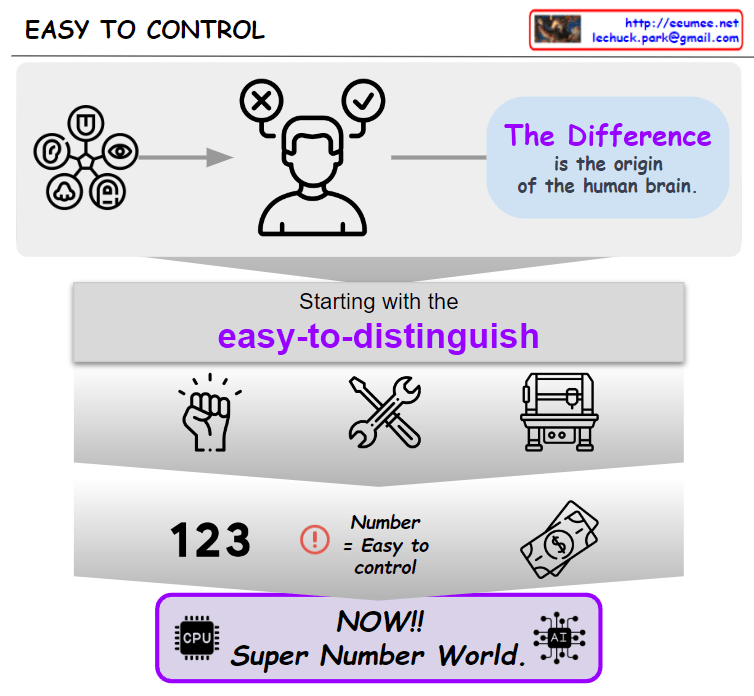
Human like “EASY TO CONTROL”

From DALL-E with some prompting
This image represents the connection between human discernment and numeric-based control systems. Humans possess the ability to detect and understand complex differences, which is crucial for the advancement of capital and business. Starting with simple and distinguishable elements, we have evolved to represent and control increasingly complex economic systems through numbers. The ‘Super Number World’ symbolically represents how we utilize technology, especially computing and artificial intelligence, to manage this complexity. Ultimately, the growth of capital and business is represented and understood through numbers, and controlling these numbers creates the most significant differences in the modern economy.

AI DC Operation

from DALL-E with some prompting
The image represents a diagram that outlines the transformation of data center operations through the integration of Artificial Intelligence (AI). The flow from left to right demonstrates the transition from traditional data center operations to a new paradigm facilitated by AI. The diagram begins with legacy operations characterized by machines, alarm systems, and the processes managed by experts.

The section titled ‘DC Growing’ highlights the expansion of data centers and the new challenges that arise, including hyperscale, increased complexity, and shifts in customer demographics from retail to major Cloud Service Providers (CSP).

In the subsequent ‘DT’ and ‘AI’ sections, the diagram showcases how Digital Transformation (DT) and AI are integrated into data center operations, enhancing service reliability, automation, energy optimization, and customer service. The ‘AI Accelerator’ section illustrates the role of AI in speeding up the operations of a data center, setting new benchmarks for AI-driven operations.

This diagram visually summarizes how data centers evolve with technological advancements and how AI and digital transformation technologies are revolutionizing traditional operational practices.

GPU techs

From DALL-E with some prompting
The image illustrates various aspects of GPU technology. Firstly, ‘Multi Input’ and ‘Direct Memory Access’ signify that GPUs efficiently receive data from multiple sources and optimize memory access. PCIe NVMe represents the hardware interface for fast data transfer.

Secondly, ‘Multi Computing’ and ‘Parallel Processing’ highlight the core capabilities of GPUs, which can process multiple operations simultaneously. ‘Nano Superconductivity no loss power’ suggests the use of nano-technology and superconductivity for efficient power transmission without energy loss.

Thirdly, the cooling system of the GPU is essential for managing heat and maintaining performance, indicating the importance of cooling technologies in high-performance computing to keep GPU temperatures stable.

Finally, ‘AI output’ shows that all these technologies are ultimately employed for processing data and outputting results for artificial intelligence applications.

This diagram provides an overview of the entire process of GPU technology, from data input through complex calculations and cooling systems, to the output for AI applications.