The time

with a claude’s help
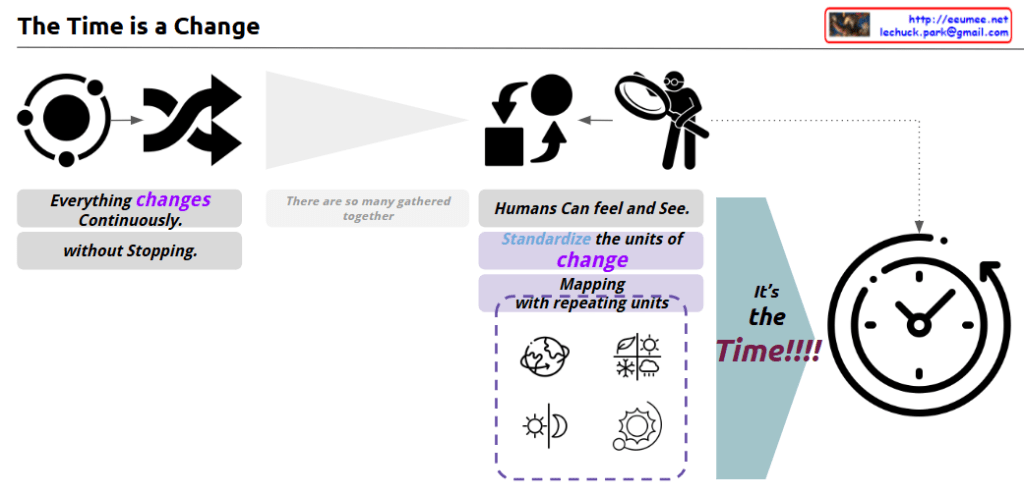
This image provides deep insights into the essence of time. The key points can be summarized as follows:

  1. Continuity of change: As shown in the image, everything is in a constant state of change. This phenomenon is observed even at the most fundamental atomic level.
  2. Observation and unitization: Humans observe these changes, identify recurring patterns, and define units of time accordingly. For example, units like year, 4 seasons, and day have been created based on the cycles of the Earth’s rotation and revolution.
  3. Humanization of the time concept: The defined time units have been concretized into forms that humans can easily understand and use. In other words, observing natural phenomena and interpreting them from a human-centric perspective is the essence of the time concept we know.
  4. Relationship between change and measurement: Time is a concept measured based on change. The time units we use routinely in daily life are essentially standardizations of natural cycles of change.

From a scientific perspective, this image explains the concept of time from multiple angles. The ceaseless change at the atomic level is a scientific fact, and the accumulation of these microscopic changes manifests as the macroscopic changes we perceive in nature. Humans have observed and measured these natural patterns of change to construct the concept of time.

However, the time units are not entirely objective. They can vary based on human physiological and cultural factors. Therefore, time can be viewed as a product of human interpretation and utilization of natural phenomena.

In summary, this image effectively illustrates the essence of the time concept from various perspectives. It shows how the changes in nature and human observation and measurement have given rise to the idea of time.

WHY I LOVE A COMPUTER.

Democracy and the constitution are like the fundamental principle of “1+1=10” in computer calculations. If these fundamentals are not respected, the results derived from immense computing power will ultimately be nothing more than illusions.

“1+1=10” 이어야 한다. 이 믿음이 사람들, 사회에서도 이루어지길 바란다.
물론 컴퓨터로 담아내지 못한, 또 담아낼 수도 없는 무언가 있다는 것은 잘알고 있다.
하지만, 알고 있는 것, 지켜야 하는 것, 지향해야 하는 것.. 그것은 확실히 지켜져야 한다.

정치라는 것의 아무런 관심도 없었고, 잘못된 정보로 인한 부끄러웠던 나의 과거가 존재한다. 하지만 1+1=10 이 아닌 현상을 너무 극명하게 느끼게 되면서.. 그 정치라는 것에 대해 관심을 가지게 되었다. 그리고 바랬다…누구에게나 공정한 “1+1=10” 세상이 되면 좋겠다고..
그리고 내가 그나마 알고 있는 컴퓨터 기술로 그 방향에 도움이 되면 좋겠다는 생각을 하게 된것 같다.

비트코인을 첨 알고 매력을 느꼈고. 지금은 WEB3 에 관심을 가질수 밖에 없는 이유이기도 하고.. 물론 사람의 욕심은 끝이 없고 무한할 것이다. 하지만 욕심은 문제가 아니다. 문제는 적어도 우리가 지켜온 “1+1=10” 이라는 지금까지 만들어온 기본인 Democracy 와 Constitution 은 지켜야 할 것 아닌가.. 그래야 발전을 꿈꾸고 그 위에서 사람의 욕심을 채워가야 하지 않을까 싶다.

number nice but limit

This concept emphasizes the balance between numerical analysis and human intuition. Numbers are efficient tools for decision-making but have limitations, as they cannot solve everything. It highlights the importance of adhering to principles and goals when using data. Areas beyond numerical solutions allow for creativity and human values to drive progress, advocating for an integrated approach to decision-making.

Evolutions

From Claude with some prompting
Summarize the key points from the image :

  1. Manually Control:
    • This stage involves direct human control of the system.
    • Human intervention and judgment are crucial at this stage.
  2. Data Driven:
    • This stage uses data analysis to control the system.
    • Data collection and analysis are the core elements.
  3. AI Control:
    • This stage leverages artificial intelligence technologies to control the system.
    • Technologies like machine learning and deep learning are utilized.
  4. Virtual:
    • This stage involves the implementation of systems in a virtual environment.
    • Simulation and digital twin technologies are employed.
  5. Massive Data:
    • This stage emphasizes the importance of collecting, processing, and utilizing vast amounts of data.
    • Technologies like big data and cloud computing are utilized.

Throughout this progression, there is a gradual shift towards automation and increased intelligence. The development of data and AI technologies plays a critical role, while the use of virtual environments and massive data further accelerates this technological evolution.

Getting digital “1” from real world

Bringing a digital “1” from the real world is far from simple.

  1. The need for complete control over “1”
    If a specific analog value is converted into a digital “1,” it must be clearly defined and controlled, as analog values are always subject to change. Determining the exact boundary of what qualifies as “1” is critical.
  2. Influence of external factors
    The analog world is full of external factors, such as temperature and humidity, which can affect digital values. Maintaining “1” consistently as desired in such an environment is a challenging task.
  3. Clear definition of “1”
    The value represented as “1” in digital form must have a clear definition from a human perspective. It should be universally understandable and explainable as “1.”
  4. Risks in AI environments
    In the realm of AI, where vast amounts of data are processed into complex outputs, even a single incorrect “1” can have significant and potentially dangerous consequences.

Ensuring and maintaining a digital “1” involves numerous challenges and complexities.