1. Traditional Programs: Programs were designed to process data and generate new data. 2. Transition to AI: Traditional programs are being replaced by AI, particularly LLMs (Large Language Models). • It’s like having an AI clone working alongside me for years, learning and handling tasks just like a human. 3. Only Data Remains: AI operates entirely based on data, making data the most critical resource. 4. Limits of Internet Data: The data available on the internet is finite, which means there’s a cap on how much AI can learn. 5. After AI Learning: Once all AI systems learn from the same dataset, there’s little difference in how they process information. 6. Winner Takes All: In LLM-driven services, the first to gain a competitive edge often dominates the market, leaving little room for competitors.
In summary, the evolution of data and AI introduces both new competitive dynamics and inherent limitations.
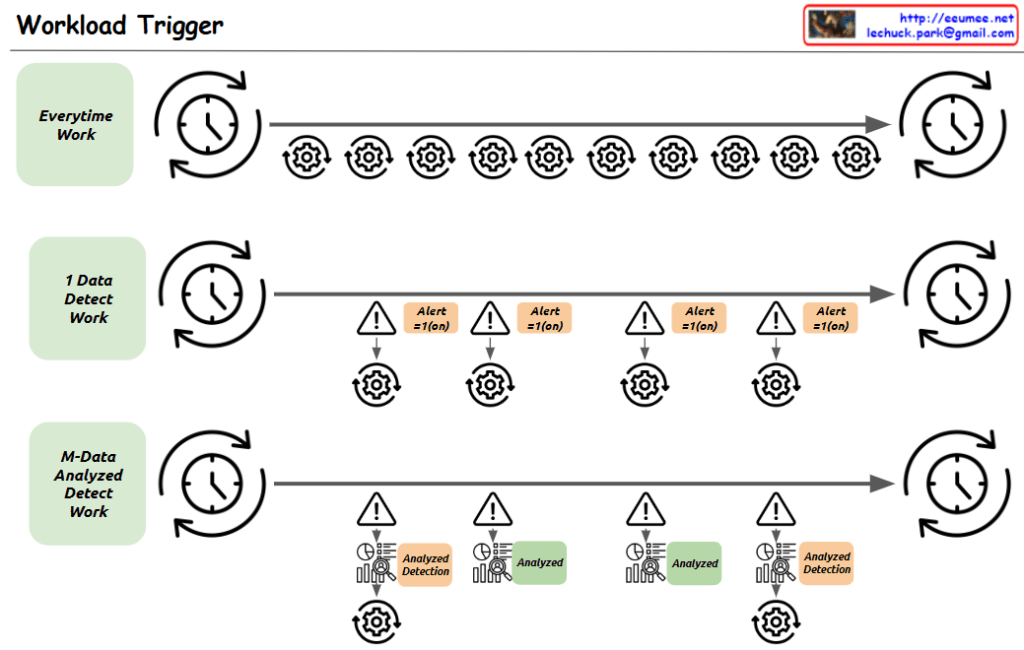
From Claude with some prompting The image appears to be a diagram illustrating a “Workload Trigger” process. It shows three main stages of work:
“Everytime Work”: This stage indicates work that is performed at a regular interval, represented by the repeating gear symbols.
“1 Data Detect Work”: This stage shows data detection work that triggers alerts based on certain conditions, represented by the alert symbols.
“M-Data Analyzed Detect Work”: This stage shows data analysis work that also triggers alerts based on the analysis results, represented by the analyzed detection symbols.
The overall flow of the diagram moves from left to right, with the work cycling through the three main stages. The timing of the work cycles is indicated by the clocks at the start and end of each stage.
The diagram seems to be illustrating some kind of automated monitoring or analysis workflow that triggers alerts based on the detection of certain data patterns or conditions.
From Claude with some prompting This image depicts the progressive development of human capabilities and knowledge, showcasing how humans have strived to understand and explain the world through the use of numbers, mathematics, and computing technology.
Human Groups: The image represents humans coming together in groups to explore and comprehend the world around them.
Using Math: Humans have leveraged numbers and mathematical calculations in an effort to make sense of the world.
Computing: Building upon their mathematical prowess, the advancement of computing technology has enhanced human analysis and understanding.
High-Speed Infrastructure: The development of cutting-edge technological infrastructure has enabled further evolution of human activities.
AI and Deep Learning: This series of technological advancements has led humans to a point where they may feel they have nearly reached the true essence of reality. However, the image suggests that the emergence of AI and deep learning technologies is now challenging this human-centric perspective, hinting that there may still be an infinite gap to traverse before fully grasping the fundamental nature of the world.
In essence, the image showcases the stepwise progression of human knowledge and capabilities, anchored in numbers, math, and computing, while also highlighting how these efforts are now being disrupted by the rise of advanced AI and deep learning, which may transcend the limitations of human understanding.
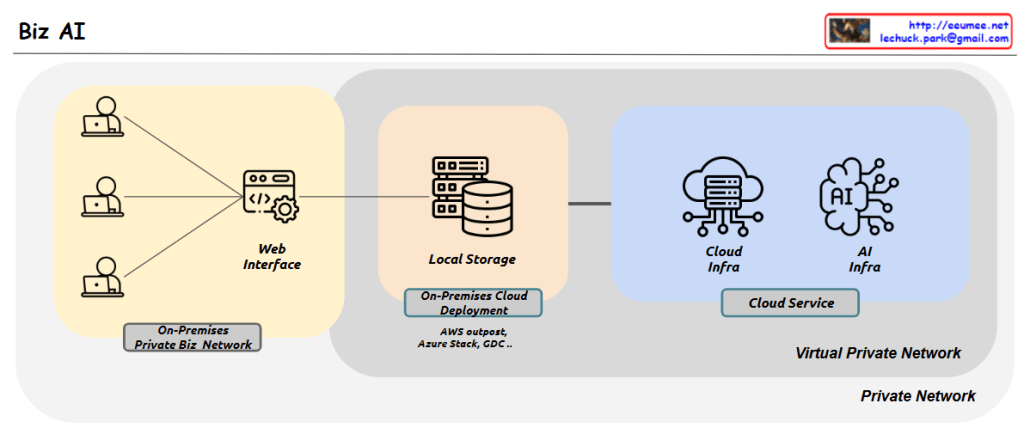
From Claude with some prompting the AI-based enterprise document analysis/conversation service architecture:
Architectural Components:
User Access Layer (On-Premises Private Biz Network)
User access through web interface
Secure access within corporate internal network environment
Data Management Layer (Local Storage)
On-Premises Cloud Deployment support
Hybrid cloud environment with AWS outpost, Azure Stack, GCP
Secure storage of corporate documents and data
Service Operation Layer (Cloud/AI Infra)
Enhanced security through Virtual Private Network
Cloud-based AI service integration
Document-based AI services like NotebookLM
Key Features and Benefits:
Security
Private Network-based operation
Minimized data leakage risk
Regulatory compliance facilitation
Scalability
Hybrid cloud architecture
Efficient resource management
Expandable to various AI services
Operational Efficiency
Centralized data management
Unified security policy implementation
Easy monitoring and management
Considerations and Improvements:
System Optimization
Balance between performance and cost
Implementation of caching system
Establishment of monitoring framework
Future Extensibility
Integration potential for various AI services
Multi-cloud strategy development
Resource adjustment based on usage patterns
Technical Considerations:
Performance Management
Network bandwidth and latency optimization
AI model inference response time management
Data synchronization between local and cloud storage
Security Measures
Data governance and sovereignty
Secure data transmission
Access control and authentication
Infrastructure Management
Resource scaling strategy
Service availability monitoring
Disaster recovery planning
This architecture provides a framework for implementing document-based AI services securely and efficiently in enterprise environments. It is particularly suitable for organizations where data security and regulatory compliance are critical priorities. The design allows for gradual optimization based on actual usage patterns and performance requirements while maintaining a balance between security and functionality.
This solution effectively combines the benefits of on-premises security with cloud-based AI capabilities, making it an ideal choice for enterprises looking to implement advanced document analysis and conversation services while maintaining strict data control and compliance requirements.









 Lechuck Park