Metric Analysis

With a Claude
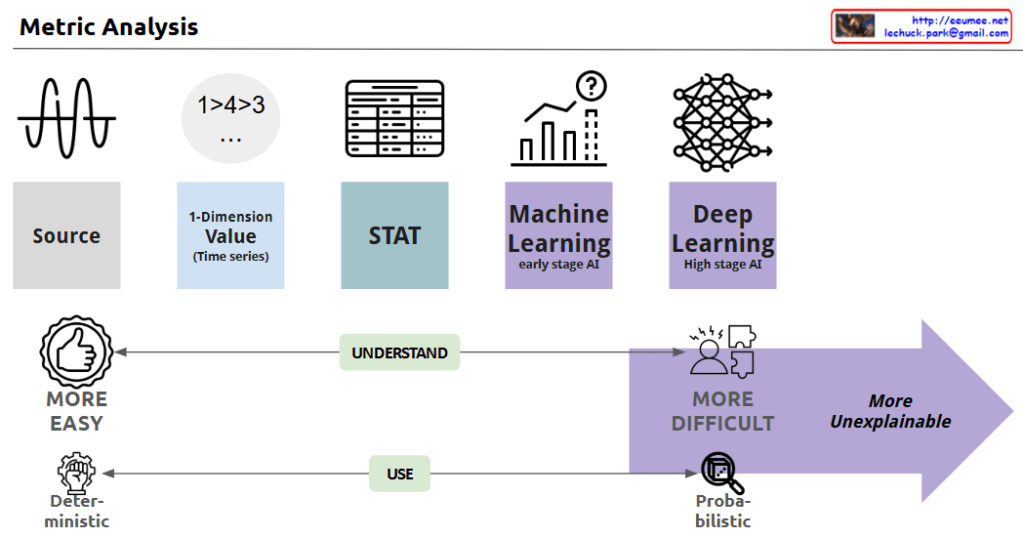
This image depicts the evolution of data analysis techniques, from simple time series analysis to increasingly sophisticated statistical methods, machine learning, and deep learning.

As the analysis approaches become more advanced, the process becomes less transparent and the results more difficult to explain. Simple techniques are more easily understood and allow for deterministic decision-making. But as the analysis moves towards statistics, machine learning, and AI, the computations become more opaque, leading to probabilistic rather than definitive conclusions. This trade-off between complexity and explainability is the key theme illustrated.

In summary, the progression shows how data analysis methods grow more powerful yet less interpretable, requiring a balance between the depth of insights and the ability to understand and reliably apply the results.

Basic Optimization

With a Claude
This Basic Optimization diagram demonstrates the principle of optimizing the most frequent tasks first:

  1. Current System Load Analysis:
  • Total Load: 54 X N (where N can extend to infinity)
  • Task Frequency Breakdown:
    • Red tasks: 23N (most frequent)
    • Yellow tasks: 13N
    • Blue tasks: 11N
    • Green tasks: 7N
  1. Optimization Strategy and Significance:
  • Priority: Optimize the most frequent task first (red tasks, 23N)
  • 0.4 efficiency improvement achieved on the highest frequency task
  • As N approaches infinity, the optimization effect grows exponentially
  • Calculation: 23 x 0.4 = 9.2 reduction in load per N
  1. Optimization Results:
  • Final Load: 40.2 X N (reduced from 54 X N)
  • Detailed calculation: (9.2 + 31) X N
    • 9.2: Load reduction from optimization
    • 31: Remaining task loads
  • Scale Effect Examples:
    • At N=100: 1,380 units reduced (5,400 → 4,020)
    • At N=1000: 13,800 units reduced (54,000 → 40,200)
    • At N=10000: 138,000 units reduced

The key insight here is that in a system where N can scale infinitely, optimizing the most frequent task (red) yields exponential benefits. This demonstrates the power of the “optimize the highest frequency first” principle – where focusing optimization efforts on the most common operations produces the greatest system-wide improvements. The larger N becomes, the more dramatic the optimization benefits become, making this a highly efficient approach to system optimization.

This strategy perfectly embodies the principle of “maximum impact with minimal effort” in system optimization, especially in scalable systems where N can grow indefinitely. 

Analog to Digital & Analysis

With Claude
Here’s the analysis of the image and key elements :

  1. Sampling Stage
  • Initial stage of converting analog signals to digital values
  • Converts analog waveforms from sensors into digital data (0110 1001 1010)
  • Critical first step that determines data quality
  • Foundation for all subsequent processing
  1. Resolution Stage
  • Determines data quality through Data density and Sampling rate
  • Direct impact on data precision and accuracy
  • Establishes the foundation for data quality in subsequent analysis
  • Controls the granularity of digital conversion
  1. How to Collect
  • Pooling: Collecting data at predetermined periodic intervals
  • Event: Data collection triggered by detected changes
  • Provides efficient data collection strategies based on specific needs
  • Enables flexible data gathering approaches
  1. Analysis Quality
  • NO error: Ensures error-free data processing
  • Precision: Maintains high accuracy in data analysis
  • Realtime: Guarantees real-time processing capability
  • Comprehensive quality control throughout the process

Key Importance in Data Collection/Analysis:

  1. Accuracy: Essential for reliable data-driven decision making. The quality of input data directly affects the validity of results and conclusions.
  2. Real-time Processing: Critical for immediate response and monitoring, enabling quick decisions and timely interventions when needed.
  3. Efficiency: Proper selection of collection methods ensures optimal resource utilization and cost-effective data management.
  4. Quality Control: Consistent quality maintenance throughout the entire process determines the reliability of analytical results.

These elements work together to enable reliable data-driven decision-making and analysis. The success of any data analysis system depends on the careful implementation and monitoring of each component, from initial sampling to final analysis. When properly integrated, these components create a robust framework for accurate, efficient, and reliable data processing and analysis.

Abstraction Progress with number

With Claude
this diagram shows the progression of data abstraction leading to machine learning:

  1. The process begins with atomic/molecular scientific symbols, representing raw data points.
  2. The first step shows ‘Correlation’ analysis, where relationships between multiple data points are mapped and connected.
  3. In the center, there’s a circular arrow system labeled ‘Make Changes’ and ‘Difference’, indicating the process of analyzing changes and differences in the data.
  4. This leads to ‘1-D Statistics’, where basic statistical measures are calculated, including:
    • Average
    • Median
    • Standard deviation
    • Z-score
    • IQR (Interquartile Range)
  5. The next stage incorporates ‘Multi-D Statistics’ and ‘Math Formulas’, representing more complex statistical analysis.
  6. Finally, everything culminates in ‘Machine Learning & Deep Learning’.

The diagram effectively illustrates the data science abstraction process, showing how it progresses from basic data points through increasingly complex analyses to ultimately reach machine learning and deep learning applications.

The small atomic symbols at the top and bottom of the diagram visually represent how multiple data points are processed and analyzed through this system. This shows the scalability of the process from individual data points to comprehensive machine learning systems.

The overall flow demonstrates how raw data is transformed through various statistical and mathematical processes to become useful input for advanced machine learning algorithms. CopyRet

Usage Evolutions : The Evolution of Human Tools and Knowledge Sharing

With a Claude’s Help
This diagram illustrates how humanity’s methods of sharing and expanding knowledge have evolved alongside the development of tools throughout history.

The Four Stages of Evolution

1. Experience-Based Era

  • Tool: Direct Human Experience
  • Characteristics: Knowledge sharing through face-to-face interactions based on personal experience
  • Limited scope of knowledge transfer and collaboration

2. Literature-Based Era

  • Tool: Books and Documents
  • Characteristics: Documentation of experiences and knowledge
  • Knowledge transfer possible across time and space

3. Internet-Based Era

  • Tool: Internet and Digital Platforms
  • Characteristics: Real-time information sharing and two-way communication
  • Formation of networks where multiple users simultaneously influence each other

4. AI-Based Era

  • Tool: Artificial Intelligence
  • Characteristics: Creation of new digital worlds through AI
  • Revolutionary expansion of knowledge creation, processing, and sharing

Key Characteristics of Evolution Process

  1. Increase in Data (More Data)
  • Exponential growth in the amount of information accumulated through each stage
  1. Enhanced Connectivity (More Connected)
  • Expansion of knowledge sharing networks
  • Dramatic increase in speed and scope of information transfer
  1. Increased Need for Verification (More Requires of Verification)
  • Growing demand for information reliability and accuracy
  • Heightened importance of data verification

This evolutionary process demonstrates more than just technological advancement; it shows fundamental changes in how humanity uses tools to expand and share knowledge. The emergence of new tools at each stage has enabled more effective and widespread knowledge sharing than before, becoming a key driving force in accelerating the development of human civilization.

This progression represents a continuous journey from individual experience-based learning to AI-enhanced global knowledge sharing, highlighting how each tool has revolutionized our ability to communicate, learn, and innovate as a species.

The evolution also underscores the increasing complexity and sophistication of our knowledge-sharing mechanisms, while emphasizing the growing importance of managing and verifying the ever-expanding volume of information available to us.

Definitions

With a Claude’s Help
this diagram that illustrates two approaches to definitions:

  1. Definitions By Number:
  • Input and output through function f(x) is precise and clear
  • 100% accuracy in results
  • No exceptions
  • Always yields consistent results regardless of context
  • Mathematical/numerical definitions are unambiguous
  1. Definitions By Text:
  • The concept being defined is connected to multiple contextual elements:
    • Historical background (History)
    • Linguistic expression (ABC)
    • Social/cultural context (represented by the global icon)
  • Characteristics and limitations:
    • Can only directly express a “Very Small” portion of the complete meaning
    • Often uses “Almost” in descriptions
    • Key Point: “Must be Shared”
      • Related background knowledge
      • Historical context
      • Social consensus
      • Cultural understanding
    • If these contextual elements are not properly shared, it becomes “Not 100% (Easy to break)”
      • Perfect communication of meaning becomes difficult
      • Possibility of misunderstanding or misinterpretation exists

The diagram ultimately explains:

  • While numerical definitions are objective and precise
  • Text-based definitions are inherently incomplete on their own
  • For proper understanding of text-based definitions, related contextual knowledge and background must be shared
  • This explains why the same words or sentences can be interpreted differently depending on cultural context and background knowledge

This concept is particularly important in understanding:

  • Why linguistic definitions can vary across cultures
  • The importance of shared context in communication
  • Why mathematical/numerical definitions remain consistent across different contexts
  • The inherent limitations of purely textual definitions without proper context

This diagram effectively shows why precise communication through text alone can be challenging without shared contextual understanding, while numerical definitions remain universally consistent.

High Computing Room Requires

With a Claude’s Help
Core Challenge:

  1. High Variability in GPU/HPC Computing Room
  • Dramatic fluctuations in computing loads
  • Significant variations in power consumption
  • Changing cooling requirements

Solution Approach:

  1. Establishing New Data Collection Systems
  • High Resolution Data: More granular, time-based data collection
  • New Types of Data Acquisition
  • Identification of previously overlooked data points
  1. New Correlation Analysis
  • Understanding interactions between computing/power/cooling
  • Discovering hidden patterns among variables
  • Deriving predictable correlations

Objectives:

  • Managing variability through AI-based analysis
  • Enhancing system stability
  • Improving overall facility operational efficiency

In essence, the diagram emphasizes that to address the high variability challenges in GPU/HPC environments, the key strategy is to collect more precise and new types of data, which enables the discovery of new correlations, ultimately leading to improved stability and efficiency.

This approach specifically targets the inherent variability of GPU/HPC computing rooms by focusing on data collection and analysis as the primary means to achieve better operational outcomes.