From DALL-E with some prompting The image explores how human decision-making has evolved from data analysis to probabilistic judgments. Initially, rules derived from data led to definitive decisions, but with the advent of AI, we have returned to probabilistic decision-making. The phrases at the top suggest that the real world may be inherently probabilistic and that humans still lack complete knowledge of the quantum realm.
From DALL-E with some prompting The image outlines the workflow and components of digital data services. It begins with data collection from various sources, which is then subjected to a verification process to ensure its integrity. The verified data is stored in a database and undergoes the ETL process (Extract, Transform, Load) to be formatted appropriately for analysis. This data is visualized to facilitate insightful analysis, which then feeds into an AI learning process. The outcomes of this analysis are applied in the service stage where established processes are confirmed and automation tools are implemented to deliver the final service. The AI model, refined by learning from the data, plays a critical role in enhancing the precision and efficiency of the service provided.
From DALL-E with some prompting The image illustrates the concept of digitization. It shows an analog signal being converted into a digital format, represented by a sequence of binary numbers. The process emphasizes the importance of accuracy and precision in digitization, noting that even small errors in digitizing the signal can lead to significant computing errors. Therefore, maintaining high accuracy and precision is marked as important to ensure the integrity of the huge computing tasks that rely on the digitized data.
From DALL-E with some prompting The image depicts the evolution of decision-making processes from manual to automated, facilitated by AI and Digital Transformation (DT). Initially, decisions were made by humans based on specific conditions (IF condition THEN action). This manual approach did not involve computing. With DT, the process becomes automated through computing, making it faster and more efficient. The transition to AI and Machine Learning (ML) marks a further evolution where decisions are not just automated but are also data-driven, increasing accuracy and the ability to adapt to complex situations. The visual suggests a shift from human-based decision-making to a more sophisticated, automated, and intelligent system of processing and action-taking, indicative of modern advancements in technology.
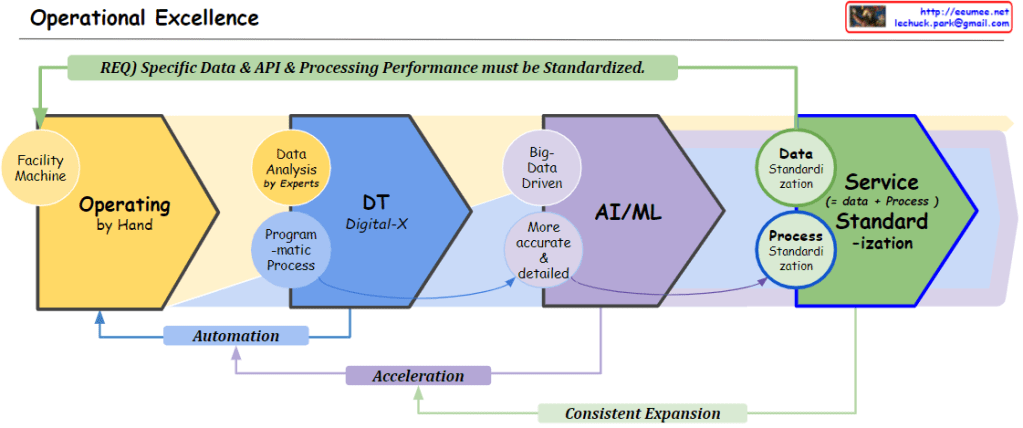
From DALL-E with some prompting The image delineates a progressive digital transformation process aimed at achieving operational efficiency. It comprises four main stages, each incorporating specific elements and influencing improvements in the preceding stages:
Manual Operation (Operating by Hand): This foundational stage involves the hands-on operation of facilities or machinery, focusing on the physical manipulation of equipment.
Digital Transformation (DT): Data derived from manual operations are analyzed by experts and digitized through programmatic processes. This stage fosters automation, enhancing the efficiency and optimization of processes.
AI/ML: The data processed through digital transformation are further analyzed with AI and machine learning technologies, driven by large-scale data to achieve more accurate and detailed insights. These analyses facilitate the acceleration and consistent expansion of processes and services.
Service Standardization: The final stage involves standardizing data and processes based on the insights from AI/ML analysis. Essential for delivering high-quality services, it necessitates a clear definition of necessary data, its integration, and performance parameters from facilities and machinery.
Each of these stages is interdependent, with the arrows at the bottom indicating a feedback loop to the previous stages. For instance, insights from AI/ML promote data standardization, which, in turn, contributes to the improvement of digital transformation and manual operations. This creates a cyclical mechanism where each phase reinforces the others, allowing for continuous enhancement of the overall system.
from DALL-E with some prompting The image illustrates a process of monitoring typically unchanging data to detect system malfunctions. The ‘Traffic / User(s)’ data reflects the relative amount of traffic between two connected users, which generally remains constant. The heat generated by the CPU, as well as electrical elements like voltage and current, are also considered unchanging data in a stable state. A fault detection sensor sends an alert when anomalies are detected in these data points. The ‘Detect it!!’ sensor shows no changes under normal conditions but identifies deviations when an event occurs, enabling a response to potential issues.
From DALL-E with some prompting The image contrasts the concept of maintaining the number “1” in the digital world versus the real world.
In the Digital World: The “1” represented in binary code is said to be very easy to maintain in the digital realm, implying that as long as there is electricity, the data “1” can be precisely preserved.
In the Real World: It questions the existence of a perfect “1,” showing values like 0.99999 and 1.00001 around the numerical representation of “1,” suggesting that maintaining an absolute “1” in the real world is challenging.
The phrases “Everything is Changed” and “Everything is Connected” at the bottom emphasize that in the real world, everything is subject to change and interconnected.
Overall, the image presents a philosophical inquiry into how the concept of “1” can be applied and interpreted differently between the digital and real worlds. While the digital world can uphold the accuracy and consistency of data, the real world embeds complexities and nuances within the concept of constancy.




 Lechuck Park