Optimization in the Real

From Claude with some prompting
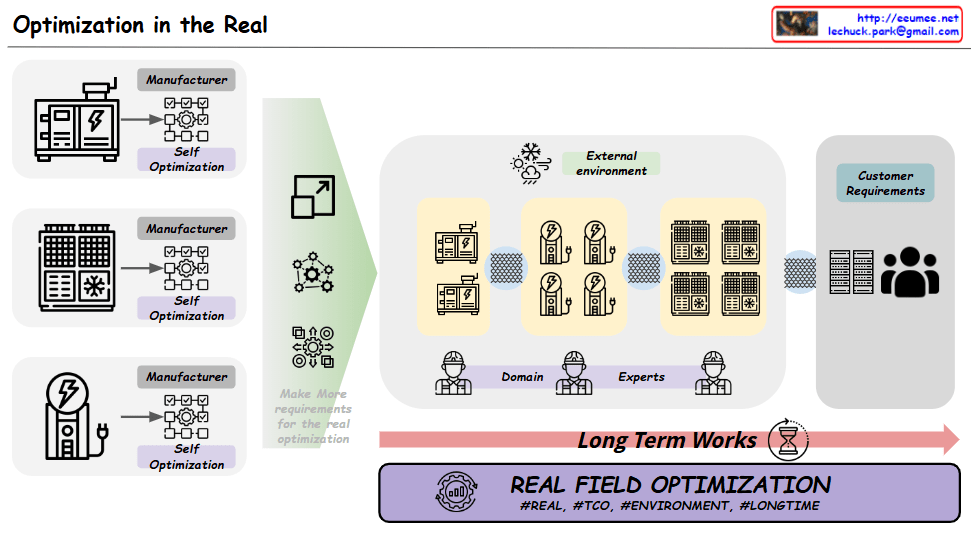
The Real Field Optimization diagram and its extended implications:

  1. Extended Scope of Optimization:
  • Begins with equipment Self-Optimization but extends far beyond
  • Increasing complexity in real operating environments:
    • Equipment/system interactions
    • Operational scale expansion
    • Service quality requirements
    • Various stakeholder requirements
  1. Real Operating Environment Considerations:
  • Domain Experts’ practical experience and knowledge
  • Customer requirements and feedback
  • External Environment impacts
  • Variables emerging from Long Term operations
  1. TCO (Total Cost of Ownership) Perspective:
  • Beyond initial installation/deployment costs
  • Operation/maintenance costs
  • Energy efficiency
  • Lifecycle cost optimization
  1. Data-Driven Optimization Necessity:
  • Collection and analysis of actual operational data
  • Understanding operational patterns
  • Predictive maintenance
  • Performance/efficiency monitoring
  • Data-driven decision making for continuous improvement
  1. Long-Term Perspective Importance:
  • Performance change management over time
  • Scalability considerations
  • Sustainable operation model establishment
  • Adaptability to changing requirements
  1. Real Field Integration:
  • Interaction between manufacturers, operators, and customers
  • Environmental factor considerations
  • Complex system interdependencies
  • Real-world constraint management

This comprehensive optimization approach goes beyond individual equipment efficiency, aiming for sustainable operation and value creation of the entire system. This can be achieved through continuous improvement activities based on real operational environment data. This represents the true meaning of “Real Field Optimization” with its hashtags #REAL, #TCO, #ENVIRONMENT, #LONGTIME.

The diagram effectively illustrates that while equipment-level optimization is fundamental, the real challenge and opportunity lie in optimizing the entire operational ecosystem over time, considering all stakeholders, environmental factors, and long-term sustainability. The implicit need for data-driven optimization in real operating environments becomes crucial for achieving these comprehensive optimization goals.

Motor Works

From Claude with some prompting

This image depicts the structure of a system for controlling the operation of a motor. The key elements are:

  1. Data Integrated Analysis System: This part collects and analyzes data related to the motor.
  2. Set a config: This section adjusts the settings of the motor system.
  3. Motor Actuator: This represents the actual component that operates the motor.
  4. Feedback loop: This shows the process where sensor data on the motor’s operating state is sent to the analysis system, which then uses the analysis results to adjust the actuator.
  5. “Tune to A = A” and “Too Big Diff A and A”: These indicate information related to tuning the motor system, where if the difference between the measured and target values is too large, adjustment is needed.

This system represents an automated control system that continuously monitors the motor’s performance and maintains optimal operating conditions. It adjusts the motor settings based on sensor data, and uses feedback to optimize the performance.

BAS + EPMS + @ = DCIM

From Claude with some prompting
This image illustrates the distinction between BAS (Building Automation System), EPMS (Energy Power Management System), and DCIM (Data Center Infrastructure Management), explaining their development and relationships.

  1. BAS (Building Automation System):
    • Focuses on general buildings
    • Emphasizes water management and HVAC (cooling) systems
    • Named “BAS” because water and air conditioning were crucial elements in building management
    • Primarily deals with low-power usage environments
    • Includes water control, cooling control, flow control, and pipe/plumbing management
  2. EPMS (Energy Power Management System):
    • Specialized for high-power usage environments
    • Concentrates on power generation, distribution, and control
    • Developed separately from BAS due to the unique complexities of high-power environments
  3. DCIM (Data Center Infrastructure Management):
    • Tailored for data center environments
    • Integrates functions of both BAS and EPMS
    • Manages power (EPMS) and cooling/environmental (BAS) aspects
    • Addresses additional requirements specific to data centers

The diagram clearly shows the background and characteristics of each system’s development:

  • BAS evolved from the need to manage water and air conditioning in general buildings
  • EPMS developed separately due to the specific requirements of high-power environments
  • DCIM integrates and expands on BAS and EPMS functionalities to meet the complex needs of data centers

The formula “BAS + EPMS + @ = DCIM” indicates that DCIM incorporates the functions of BAS and EPMS, while also including additional management capabilities (@) specific to data centers.

This structure effectively demonstrates how each system has specialized and evolved to suit particular environments and requirements, and how they are ultimately integrated in DCIM for comprehensive management of data center infrastructures.

Automatic Control System

From Claude with some prompting
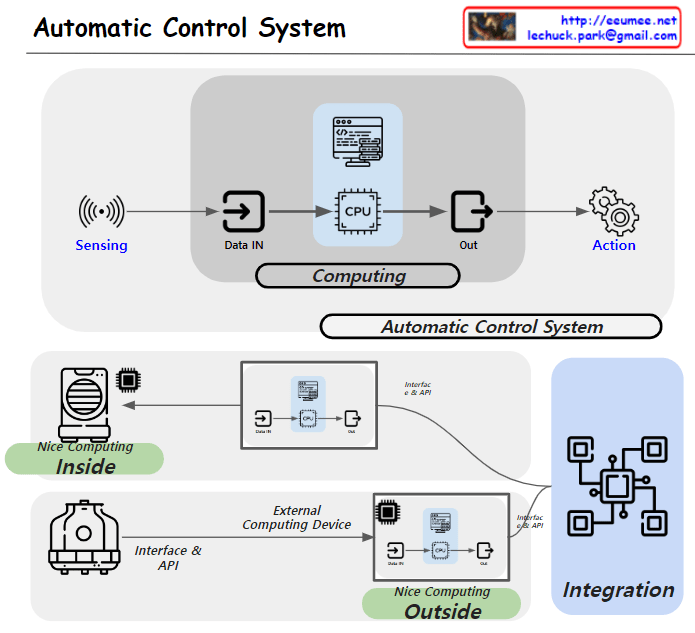
focusing on the importance of computing in automatic control systems and the distinction between devices with sufficient computing power and those without:

  1. Basic Structure of Automatic Control System:
    • The system operates in the sequence of Sensing -> Data IN -> CPU -> Out -> Action.
    • This entire process occurs within the ‘Computing’ phase, which is crucial for automatic control.
  2. Device Classification Based on Computing Capability:
    • ‘Nice Computing Inside’: Represents devices with sufficient computing power. These devices can process complex control logic independently.
    • ‘Nice Computing Outside’: Indicates devices with limited computing capabilities. These devices rely on external computing resources for automatic control.
  3. Utilization of External Computing Resources:
    • The ‘External Computing Device’ allows devices with limited computing power to perform advanced automatic control functions.
    • This is implemented through external computing devices such as PLCs (Programmable Logic Controllers) or DDCs (Direct Digital Controls).
  4. System Integration:
    • ‘Interface & API’ facilitates the connection and communication between various devices and external computing resources.
    • The ‘Integration’ section demonstrates how these diverse elements function as a unified automatic control system.
  5. Importance of Computing:
    • In automatic control systems, computing plays a crucial role in data processing, decision-making, and generating control commands.
    • By appropriately utilizing internal or external computing resources, various types of equipment can function as part of an efficient automatic control system.

This diagram effectively illustrates the flexibility and scalability of automatic control systems, explaining different approaches based on computing capabilities. The forthcoming explanation about PLC/DDC and other external computing devices will likely provide more concrete insights into the practical implementation of these systems.

SCADA & EPMS

From Perplexity with some prompting
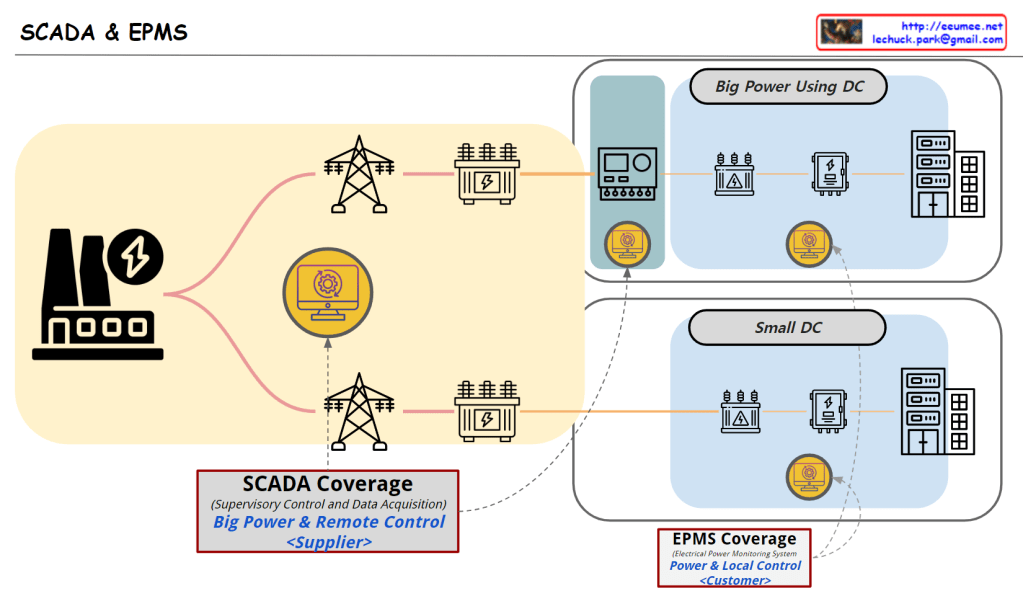
The image illustrates the roles and coverage of SCADA and EPMS systems in power management for data centers.

SCADA System

  • Target: Power Suppliers and Large Power Consumers (Big Power Using DC)
  • Role:
    • Power Suppliers: Remotely monitor and control infrastructure like power plants and substations to ensure the stability of large-scale power grids.
    • Large Data Centers: Manage complex power infrastructure and ensure stable power supply by utilizing some SCADA functionalities.
  • Coverage: Large power management and remote control

EPMS System

  • Target: Small Data Centers (Small DC)
  • Role:
    • Monitor and manage power usage within the data center to optimize energy efficiency.
    • Perform detailed local control of power management.
  • Coverage: Power monitoring and local control

Key Distinctions

  • SCADA focuses on large-scale power management and remote control, suitable for power suppliers and large consumers.
  • EPMS is used primarily in small data centers for optimizing energy consumption through local control.

In conclusion, large data centers benefit from using both SCADA and EPMS to effectively manage complex power infrastructures, while small data centers typically rely on EPMS for efficient energy management.

Standardization

From Claude + ChatGPT with some prompting
The image you provided shows a standardization process aimed at delivering high-quality data and consistent services. Here’s a breakdown of the structure based on the image:

Key Areas:

  1. [Data]
    • Facility: Represents physical systems or infrastructure.
    • Auto Control: Automatic controls used to manage the system.
  2. [Service]
    • Mgt. System: Management system that controls and monitors operations.
    • Process: Processes to maintain efficiency and quality.

Optimization Paths:

  1. Legacy Optimization:
    • a) Configure List-Up: Listing and organizing the configurations for the existing system.
    • b) Configure Optimization (Standardization): Optimizing and standardizing the existing system to improve performance.
    • Outcome: Enhances the existing system by improving its efficiency and consistency.
  2. New Setup:
    • a) Configure List-Up: Listing and organizing configurations for the new system.
    • b) Configure Optimization (Standardization): Optimizing and standardizing the configuration for the new system.
    • c) Configuration Requirement: Defining the specific requirements for setting up the new system.
    • d) Verification (on Installation): Verifying that the system operates correctly after installation.
    • Outcome: Builds a completely new system that provides high-quality data and consistent services.

Outcome:

The aim for both paths is to provide high-quality data and consistent service by standardizing either through optimizing legacy systems or creating entirely new setups.

This structured approach helps improve efficiency, consistency, and system performance.

Golden Circle For DC Operation

From perplexity with some prompting
The image explains the “Golden Circle for DC Operation,” focusing on optimizing data center operations.

WHY: Data Center Operation Optimization

  • Purpose: To optimize the operation of data centers.
  • Service Development: Through data-driven processes, including monitoring, automation, tool development, and customer-focused services.

HOW: Consistent Process & Data Management

  • Method: Ensures reliable data through consistent processes and management.
  • Standardization: Achieved through data lists, hardware/software protocols, and service/process views and flows.

WHAT: Integrated Digital Operation Platform

  • Objective: To build an integrated digital operation platform.
  • Platform: Operator-led development that involves analysis, AI integration, and service creation.

This structure emphasizes efficiency, standardization, and a data-centric approach to data center operations.