Von Neumann architecture / Neuromorphic computing

With Claude
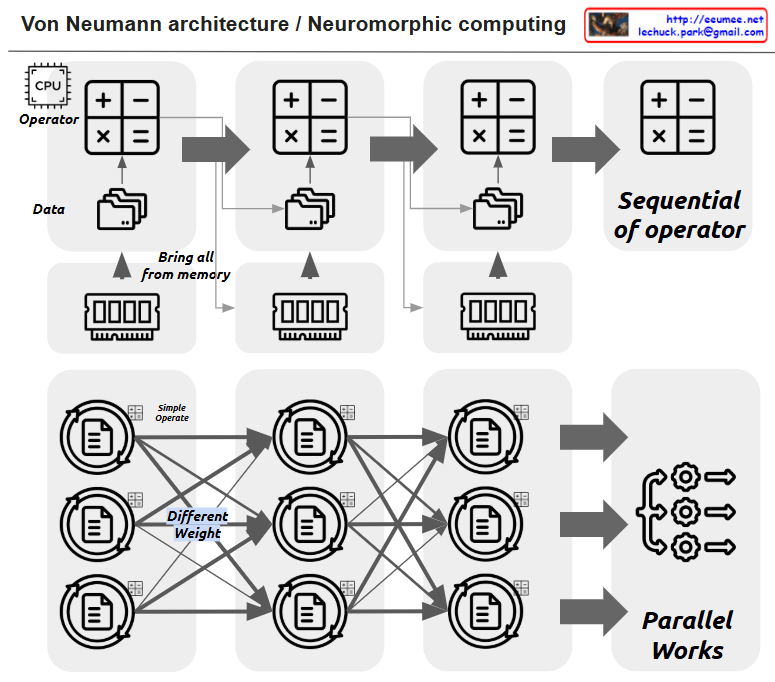
This image illustrates the comparison between Von Neumann architecture and Neuromorphic computing.

The upper section shows the traditional Von Neumann architecture:

  1. It has a CPU (Operator) that processes basic operations (+, -, ×, =) sequentially
  2. Data is brought from memory (“Bring all from memory”) and processed in sequence
  3. All operations are performed sequentially (“Sequential of operator”)

The lower section demonstrates Neuromorphic computing:

  1. It shows a neural network structure where multiple nodes are interconnected
  2. Each connection has different weights (“Different Weight”) and performs simple operations (“Simple Operate”)
  3. All operations are processed in parallel (“Parallel Works”)

Key differences between these architectures:

  • Von Neumann architecture: Sequential processing, centralized computation
  • Neuromorphic computing: Parallel processing, distributed computation, design inspired by the human brain’s structure

The main advantage of Neuromorphic computing is that it provides a more efficient architecture for artificial intelligence and machine learning tasks by mimicking the biological neural networks found in nature. This parallel processing approach can handle complex computational tasks more efficiently than traditional sequential processing in certain applications.

The image effectively contrasts how data flows and is processed in these two distinct computing paradigms – the linear, sequential nature of Von Neumann versus the parallel, interconnected nature of Neuromorphic computing.

Data Center Supply

With Claude
The supply system in data centers follows a unified control flow pattern of “Change → Distribute → Block”. This pattern is consistently applied across all core infrastructure elements (Traffic, Power, and Cooling). Let’s examine each stage and its applications:

1. Change Stage

  • Transforms incoming resources into forms suitable for the system
  • Traffic: Protocol/bandwidth conversion through routers
  • Power: Voltage/current conversion through transformers/UPS
  • Cooling: Temperature conversion through chillers/heat exchangers

2. Distribute Stage

  • Efficiently distributes converted resources where needed
  • Traffic: Network load distribution through switches and load balancers
  • Power: Power distribution through distribution boards and bus ducts
  • Cooling: Cooling air/water distribution through ducts/piping/dampers

3. Block Stage

  • Ensures system protection and security
  • Traffic: Security threat prevention through firewalls/IPS/IDS
  • Power: Overload protection through circuit breakers and fuses
  • Cooling: Backflow prevention through shutoff valves and dampers

Benefits of this unified approach:

  1. Ensures consistency in system design
  2. Increases operational management efficiency
  3. Enables quick problem identification
  4. Improves scalability and maintenance

Detailed breakdown by domain:

Traffic Management

  • Change: Router gateways (Protocol/Bandwidth)
  • Distribute: Switch/L2/L3, Load Balancer
  • Block: Firewall, IPS/IDS, ACL Switch

Power Management

  • Change: Transformer, UPS (Voltage/Current/AC-DC)
  • Distribute: Distribution boards/bus ducts
  • Block: Circuit breakers (MCCB/ACB), ELB, Fuses

Cooling Management

  • Change: Chillers/Heat exchangers (Water→Air)
  • Distribute: Ducts/Piping/Dampers
  • Block: Backflow prevention/isolation/fire dampers, shutoff valves

This structure enables systematic and efficient operation of complex data center infrastructure by managing the three critical supply elements (Traffic, Power, Cooling) within the same framework. Each component plays a specific role in ensuring the reliable and secure operation of the data center, while maintaining consistency across different systems.

One Value to Value(s)

With Claude
“A Framework for Value Analysis: From Single Value to Comprehensive Insights”

This diagram illustrates a sophisticated analytical framework that shows how a single value transforms through various analytical processes:

  1. Time Series Analysis Path:
    • A single value evolves over time
    • Changes occur through two mechanisms:
      • Self-generated changes (By oneself)
      • External influence-driven changes (By influence)
    • These changes are quantified through a mathematical function f(x)
    • Statistical measures (average, minimum, maximum, standard deviation) capture the characteristics of these changes
  2. Correlation Analysis Path:
    • The same value is analyzed for relationships with other relevant data
    • Weighted correlations indicate the strength and significance of relationships
    • These relationships are also expressed through a mathematical function f(x)
  3. Integration and Machine Learning Stage:
    • Both analyses (time series and correlation) feed into advanced analytics
    • Machine Learning and Deep Learning algorithms process this dual-perspective data
    • The final output produces either a single generalized value or multiple meaningful values

Core Purpose: The framework aims to take a single value and:

  • Track its temporal evolution within a network of influences
  • Analyze its statistical behavior through mathematical functions
  • Identify weighted correlational relationships with other variables
  • Ultimately synthesize these insights through ML/DL algorithms to generate either a unified understanding or multiple meaningful outputs

This systematic approach demonstrates how a single data point can be transformed into comprehensive insights by considering both its temporal dynamics and relational context, ultimately leveraging advanced analytics for meaningful interpretation.

The framework’s strength lies in its ability to combine temporal patterns, relational insights, and advanced analytics into a cohesive analytical approach, providing a more complete understanding of how values evolve and relate within a complex system.

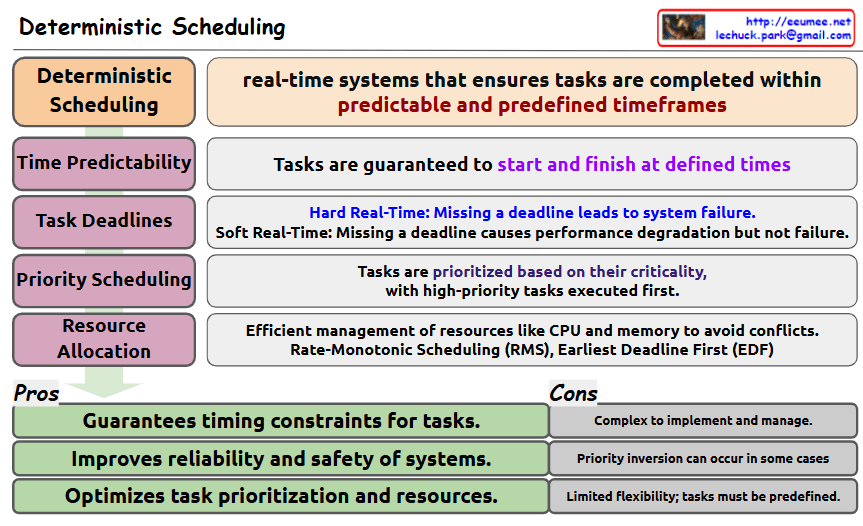
Deterministic Scheduling

With Claude
Definition: Deterministic Scheduling is a real-time systems approach that ensures tasks are completed within predictable and predefined timeframes.

Key Components:

  1. Time Predictability
  • Tasks are guaranteed to start and finish at defined times
  1. Task Deadlines
  • Hard Real-Time: Missing a deadline leads to system failure
  • Soft Real-Time: Missing a deadline causes performance degradation but not failure
  1. Priority Scheduling
  • Tasks are prioritized based on their criticality
  • High-priority tasks are executed first
  1. Resource Allocation
  • Efficient management of resources like CPU and memory to avoid conflicts
  • Uses Rate-Monotonic Scheduling (RMS) and Earliest Deadline First (EDF)

Advantages (Pros):

  • Guarantees timing constraints for tasks
  • Improves reliability and safety of systems
  • Optimizes task prioritization and resources

Disadvantages (Cons):

  • Complex to implement and manage
  • Priority inversion can occur in some cases
  • Limited flexibility; tasks must be predefined

The system is particularly important in real-time applications where timing and predictability are crucial for system operation. It provides a structured approach to managing tasks while ensuring they meet their specified time constraints and resource requirements.