Cooling(CRAH) Inside

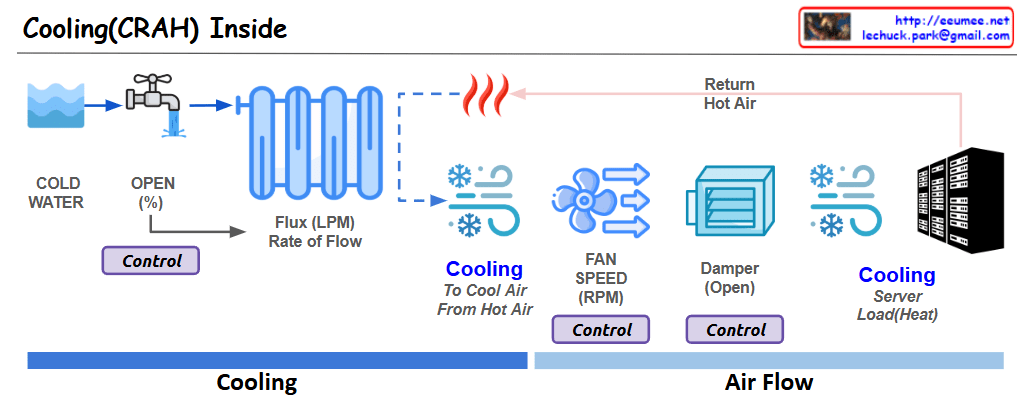
This image shows a diagram of the cooling system structure inside a CRAH (Computer Room Air Handler).

  1. Cooling Process Flow:
  • COLD WATER enters the system
  • Flow is controlled through an OPEN valve (%)
  • Water flows at a specified Flux rate (LPM)
  • Passes through a heat exchanger (coil)
  1. Air Circulation:
  • Return Hot Air from servers enters the system
  • Air is cooled through the heat exchanger
  • Air is circulated by fans (FAN SPEED in RPM)
  • Air volume is controlled by a Damper (Open)
  • Cooled air is supplied to the servers
  1. Key Control Elements:
  • Valve opening percentage (%)
  • Fan speed (RPM)
  • Damper position (Open)

This system illustrates the basic operating principles of a cooling system used in data centers or server rooms to effectively control server heat generation. The main purpose is to maintain appropriate temperatures by continuously removing heat (Load/Heat) generated by the servers.

The diagram efficiently shows the complete cycle from cold water intake to the cooling of hot server air and its recirculation, demonstrating how CRAH systems maintain optimal operating temperatures in data center environments.

With Claude

DLSS

DLSS is a graphics processing technology that consists of several key steps:

  1. Initial 3D Data
  • The process begins with 3D model/data input
  1. Rendering Process
  • Uses GPU to render 3D data into 2D screen output
  • Notes that higher resolution rendering requires more computing power
  1. Low Resolution Stage
  • Initially processes images at a lower resolution
  • This helps conserve computing resources
  1. DLSS Processing
  • Utilizes AI models and specialized hardware
  • Employs deep learning technology to enhance image quality
  • Combines lower computing requirements with AI processing
  1. Final Output
  • Upscales the low resolution image to appear high resolution
  • Delivers high-quality visual output that looks like native high resolution

The key advantage of DLSS is its ability to produce high-quality graphics while using less computing power. This technology is particularly valuable in applications requiring real-time rendering, such as gaming, where it can maintain visual quality while improving performance.

This innovative approach effectively balances the trade-off between visual quality and computational resources, making high-quality graphics more accessible on a wider range of hardware.

With Claude
With AI

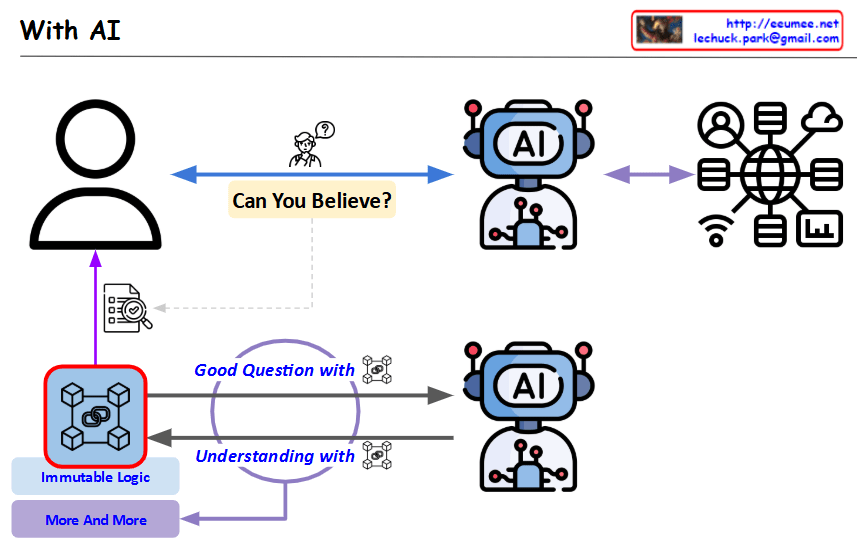
This diagram illustrates the effective collaboration method with AI:

Key Components:

  1. Upper Section: User-AI-Network Connection
  • “Can You Believe?” emphasizes the need to verify and not blindly trust the outputs of AI that has learned from the internet and vast amounts of data
  • While AI has access to extensive networks/data, verification of this information’s reliability is essential
  1. Lower Section: Logical Foundation and Development
  • “Immutable Logic” forms the foundation
  • Through this logical foundation, “Good Questions” and “Understanding” with AI occur in a cyclical process
  • “More And More” represents continuous development through this process

Core Message:

  • When utilizing AI, the most crucial element is the user’s own solid logical foundation
  • Verify and evaluate AI outputs based on this immutable logic
  • Continuously develop one’s own logic and knowledge through verified information and understanding
  • While AI is a powerful tool, its outputs must be logically verified by the user

This presents an approach not of simply using AI, but of critically evaluating AI outputs through one’s logical foundation and growing together through this process.

The diagram emphasizes that successful interaction with AI requires:

  • Having your own robust logical framework
  • Critical evaluation of AI-provided information
  • Using verified insights to enhance your own understanding
  • Maintaining a balanced approach where AI serves as a tool for growth rather than an unquestioned authority

This creates a virtuous cycle where both the user’s logical foundation and their ability to effectively utilize AI continuously improve.

With Claude
Uretprobe

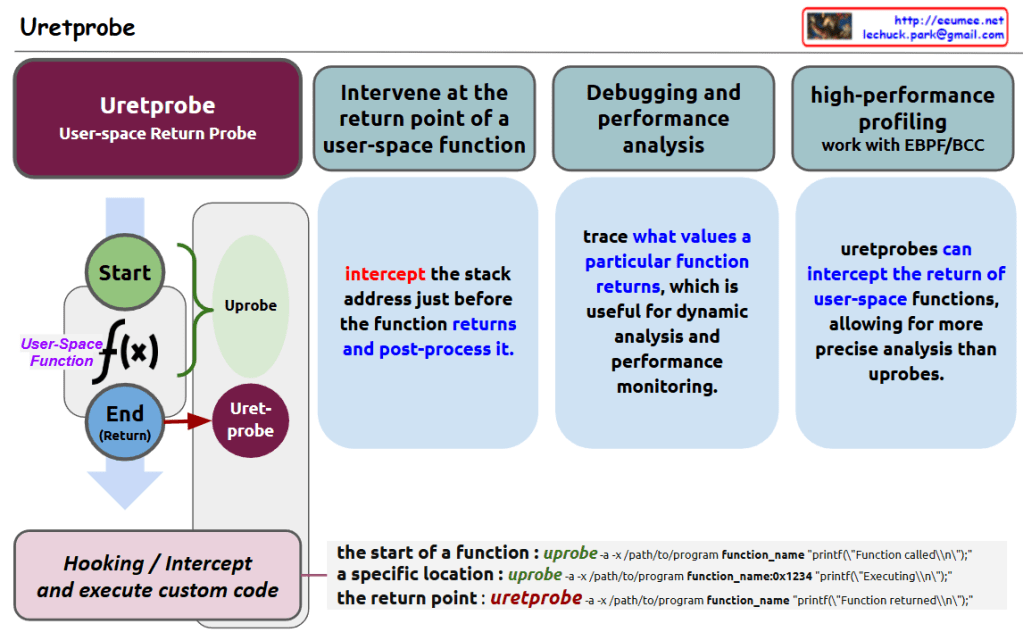
Here’s a summary of Uretprobe, a Linux kernel tracing/debugging tool:

  1. Overview:
  • Uretprobe is a user-space return probe tool designed to monitor function returns in user space
  • It can track the execution flow from function start to end/return points
  1. Key Features:
  • Ability to intervene at the return point of user-space functions
  • Intercepts the stack address just before function returns and enables post-processing
  • Supports debugging and performance analysis capabilities
  • Can trace specific function return values for dynamic analysis and performance monitoring
  1. Advantages:
  • Provides more precise analysis compared to uprobes
  • Can be integrated with eBPF/BCC for high-performance profiling

The main benefit of Uretprobe lies in its ability to intercept user-space operations and perform additional code analysis, enabling deeper insights into program behavior and performance characteristics.

Similar tracing/debugging mechanisms include:

  • Kprobes (Kernel Probes)
  • Kretprobes (Kernel Return Probes)
  • DTrace
  • SystemTap
  • Ftrace
  • Perf
  • LTTng (Linux Trace Toolkit Next Generation)
  • BPF (Berkeley Packet Filter) based tools
  • Dynamic Probes (DynProbes)
  • USDT (User Statically-Defined Tracing)

These tools form part of the Linux observability and performance analysis ecosystem, each offering unique capabilities for system and application monitoring.

Human, Data,AI

The Key stages in human development:

  1. The Start (Humans)
  • Beginning of human civilization and knowledge accumulation
  • Formation of foundational civilizations
  • Human intellectual capacity and creativity as key drivers
  • The foundation for all future developments
  1. The History Log (Data)
  • Systematic storage and management of accumulated knowledge
  • Digitalization of information leading to quantitative and qualitative growth
  • Acceleration of knowledge sharing and dissemination
  • Bridge between human intelligence and artificial intelligence
  1. The Logic Calculation (AI)
  • Logical computation and processing based on accumulated data
  • New dimensions of data utilization through AI technology
  • Automated decision-making and problem-solving through machine learning and deep learning
  • Represents the current frontier of human technological achievement

What’s particularly noteworthy is the exponential growth curve shown in the graph. This exponential pattern indicates that each stage builds upon the achievements of the previous one, leading to accelerated development. The progression from human intellectual activity through data accumulation and management, ultimately leading to AI-driven innovation, shows a dramatic increase in the pace of advancement.

This developmental process is significant because:

  • Each stage is interconnected rather than independent
  • Previous stages form the foundation for subsequent developments
  • The rate of progress increases exponentially over time
  • Each phase represents a fundamental shift in how we process and utilize information

This timeline effectively illustrates how human civilization has evolved from basic knowledge creation to data management, and finally to AI-powered computation, with each stage marking a significant leap in our technological and intellectual capabilities.

With Claude