Road to AI

This image shows a flowchart titled “Road to AI” that illustrates the step-by-step process of AI development.

Main Stages:

  1. Digitization – Starting from a globe icon, data is converted into digital format (binary code)
  2. Central Processing Area – Data is processed through network structures, where two key processes occur in parallel:
    • Verification – Confirming data accuracy
    • Tuning – Improving the model through “Higher Resolution” and “More Relative Data”
  3. AI System – Finally implemented as an AI robot

Development Phases (Right Side):

  • “Easy First, Everybody Know” – Starting with simple tasks that everyone can understand
  • “Again & Again” – Iterative improvement process
  • “More Difficult & Auto Decision” – Advanced stage with complex and automated decision-making

This diagram visually represents how AI development progresses from simple data digitization, through continuous verification and tuning processes, and gradually evolves into sophisticated AI systems capable of complex automated decision-making. The process emphasizes the iterative nature of AI development, moving from basic, universally understood concepts to increasingly complex autonomous systems.

With Claude

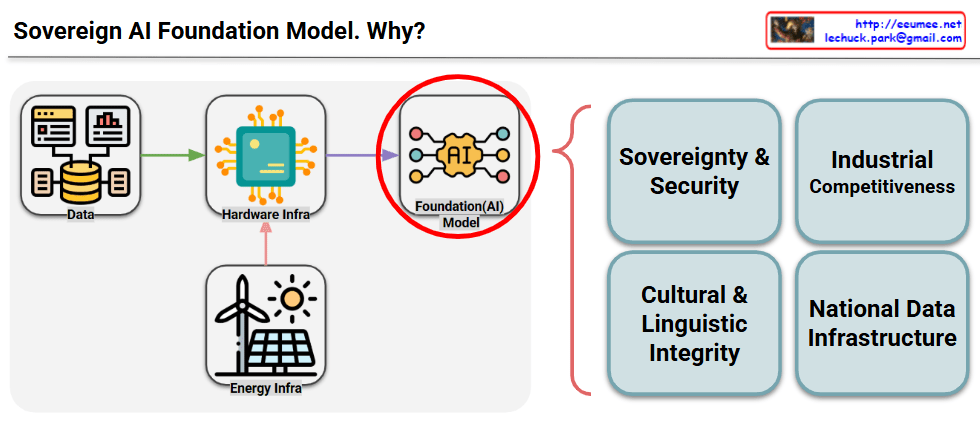
Sovereign AI Foundation Model

This diagram illustrates the concept of “Sovereign AI Foundation Model” and explains why it’s necessary.

Structure Analysis

Left Side (Infrastructure Elements):

  • Data
  • Hardware Infrastructure (Hardware Infra)
  • Energy Infrastructure (Energy Infra)

These three elements are connected to the central Foundation AI Model.

Why Sovereign AI is Needed (Four boxes on the right)

  1. Sovereignty & Security
    • Securing national AI technology independence
    • Data security and technological autonomy
    • Digital Sovereignty, National Security, Avoid Tech-Colonization, Data Jurisdiction, On-Premise Control.
  2. Industrial Competitiveness
    • Strengthening AI-based competitiveness of national industries
    • Gaining advantages in technological hegemony competition
    • Ecosystem Enabler, Beyond ‘Black Box’, Deep Customization, Innovation Platform, Future Industries.
  3. Cultural & Linguistic Integrity
    • Developing AI models specialized for national language and culture
    • Preserving cultural values and linguistic characteristics
    • Cultural Context, Linguistic Nuance, Mitigate Bias, Preserve Identity, Social Cohesion.
  4. National Data Infrastructure
    • Systematic data management at the national level
    • Securing data sovereignty
    • Data Standardization, Break Data Silos, High-Quality Structured Data, AI-Ready Infrastructure, Efficiency & Scalability.

Key Message

This diagram systematically presents why each nation should build independent AI foundation models based on their own data, hardware, and energy infrastructure, rather than relying on foreign companies’ AI models. It emphasizes the necessity from the perspectives of technological sovereignty, competitiveness, cultural identity, and data independence.

The diagram essentially argues that nations need to develop their own AI capabilities to maintain control over their digital future and protect their national interests in an increasingly AI-driven world.

WIth Claude

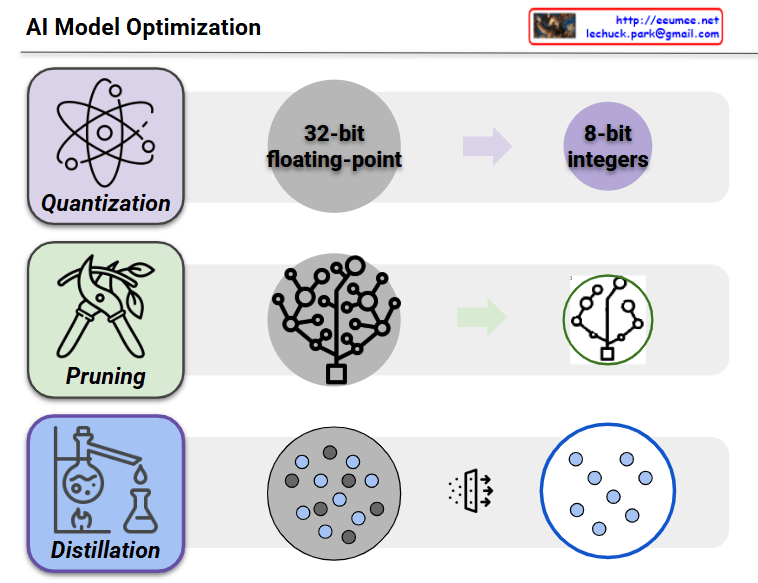
AI Model Optimization

This image shows a diagram illustrating three major AI model optimization techniques.

1. Quantization

  • The process of converting 32-bit floating-point numbers to 8-bit integers
  • A technique that dramatically reduces model size while maintaining performance
  • Significantly decreases memory usage and computational complexity

2. Pruning

  • The process of removing less important connections or neurons from neural networks
  • Transforms complex network structures into simpler, more efficient forms
  • Reduces model size and computation while preserving core functionality

3. Distillation

  • A technique that transfers knowledge from a large model (teacher model) to a smaller model (student model)
  • Reproduces the performance of complex models in lighter, more efficient models
  • Greatly improves efficiency during deployment and execution

All three techniques are essential methods for optimizing AI models to be more efficiently used in real-world environments. They are particularly crucial technologies when deploying AI models in mobile devices or edge computing environments.

With Claude

DC Changes

This image shows a diagram that matches 3 Environmental Changes in data centers with 3 Operational Response Changes.

Environmental Changes → Operational Response Changes

1. Hyper Scale

Environmental Change: Large-scale/Complexity

  • Systems becoming bigger and more complex
  • Increased management complexity

→ Operational Response: DevOps + Big Data/AI Prediction

  • Development-Operations integration through DevOps
  • Intelligent operations through big data analytics and AI prediction

2. New DC (New Data Center)

Environmental Change: New/Edge and various types of data centers

  • Proliferation of new edge data centers
  • Distributed infrastructure environment

→ Operational Response: Integrated Operations

  • Multi-center integrated management
  • Standardized operational processes
  • Role-based operational framework

3. AI DC (AI Data Center)

Environmental Change: GPU Large-scale Computing/Massive Power Requirements

  • GPU-intensive high-performance computing
  • Enormous power consumption

→ Operational Response: Digital Twin – Real-time Data View

  • Digital replication of actual configurations
  • High-quality data-based monitoring
  • Real-time predictive analytics including temperature prediction

This diagram systematically demonstrates that as data center environments undergo physical changes, operational approaches must also become more intelligent and integrated in response.

with Claude

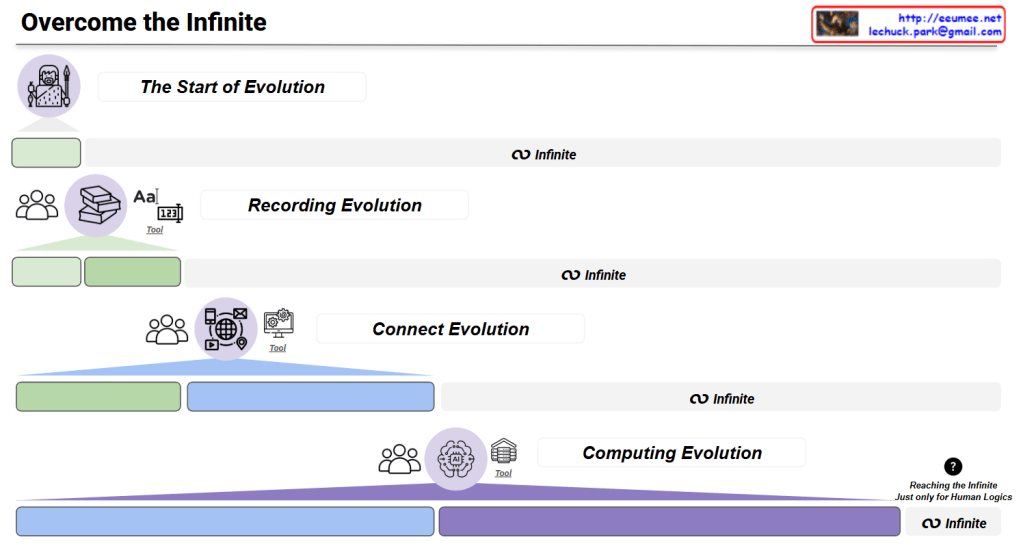
Overcome the Infinite

Overcome the Infinite – Game Interface Analysis

Overview

This image presents a philosophical game interface titled “Overcome the Infinite” that chronicles the evolutionary journey of human civilization through four revolutionary stages of innovation.

Game Structure

Stage 1: The Start of Evolution

  • Icon: Primitive human figure
  • Description: The beginning of human civilization and consciousness

Stage 2: Recording Evolution

  • Icon: Books and writing materials
  • Innovation: The revolution of knowledge storage through numbers, letters, and books
  • Significance: Transition from oral tradition to written documentation, enabling permanent knowledge preservation

Stage 3: Connect Evolution

  • Icon: Network/internet symbols with people
  • Innovation: The revolution of global connectivity through computers and the internet
  • Significance: Worldwide information sharing and communication breakthrough

Stage 4: Computing Evolution

  • Icon: AI/computing symbols with data centers
  • Innovation: The revolution of computational processing through data centers and artificial intelligence
  • Significance: The dawn of the AI era and advanced computational capabilities

Progress Indicators

  • Green and blue progress bars show advancement through each evolutionary stage
  • Each stage maintains the “∞ Infinite” symbol, suggesting unlimited potential at every level

Philosophical Message

“Reaching the Infinite Just only for Human Logics” (Bottom right)

This critical message embodies the game’s central philosophical question:

  • Can humanity truly overcome or reach the infinite through these innovations?
  • Even if we approach the infinite, it remains constrained within the boundaries of human perception and logic
  • Represents both technological optimism and humble acknowledgment of human limitations

Theme

The interface presents a contemplative journey through human technological evolution, questioning whether our innovations truly bring us closer to transcending infinite boundaries, or merely expand the scope of our human-limited understanding.

With Claude