Priority

From DALL-E
The image is a visual representation of task prioritization and management. It comprises various elements that communicate the challenges and strategies of handling multiple tasks effectively:

  1. Multi-Tasking NOT EASY: This indicates that juggling multiple tasks is challenging, and one task could be affected by another, implying the potential for decreased efficiency or interference.
  2. So. The Focusing is required.: It emphasizes the need for focus, suggesting that concentrating on specific tasks is essential for successful completion.
  3. First! Need to find out Which is more priority.: This statement highlights the importance of determining which task has the highest priority to address it appropriately.
  4. Managing with Data.: It suggests that data management is a crucial part of prioritizing and executing tasks.

On the right side, there is a list numbered 1 to 5, indicating a ranked list of tasks:

  • Number 1 is circled, with an arrow pointing to it and the phrases “DO IT” and “Do it Now!!”, stressing the urgency of tackling the most important task immediately.
  • Number 5 has a question mark next to it, and the phrase “Keep it for the future more details.”, suggesting that the lowest priority task may be deferred until more information is available or it becomes more relevant.

The bottom right corner has an “X” symbol with the text “without interruption”, indicating the importance of completing the top priority task without distractions or interruptions. The overall message of the image is to prioritize tasks, focus on the most critical one, manage tasks based on data, and execute them without disruption for effective productivity.
Read-copy update

From DALL-E with some prompting
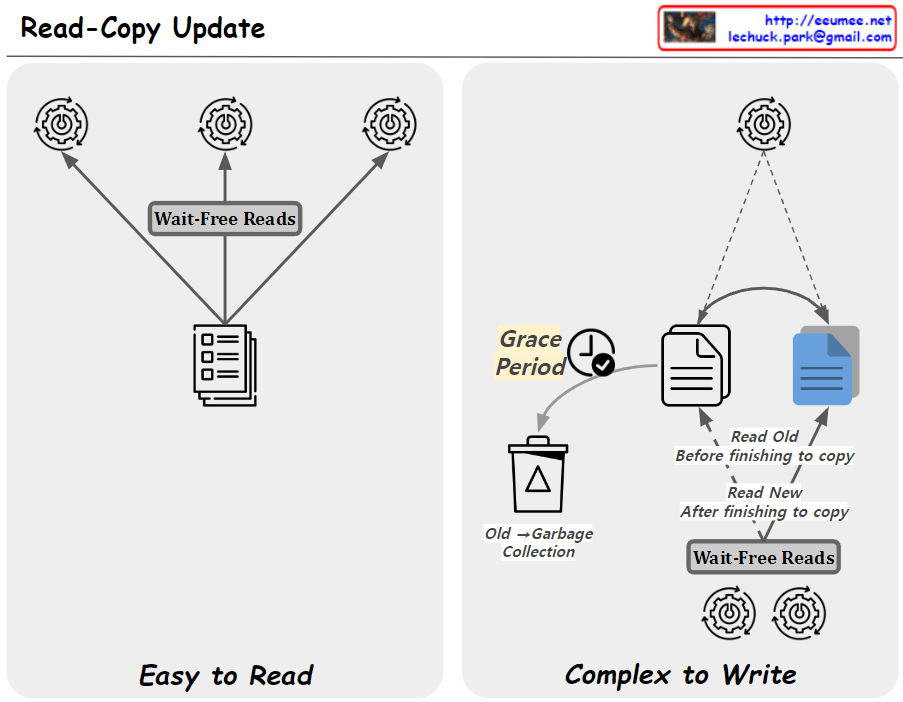
The image explains the “Read-Copy Update” mechanism, illustrating the process of reading and writing data in concurrent programming divided into two parts.

The left section, accompanied by the phrase “Easy to Read,” shows arrows from three gear icons pointing towards a document icon. This represents the “Wait-Free Reads” process, indicating that multiple threads can read data simultaneously without waiting.

The right section, labeled “Complex to Write,” demonstrates that the writing process is more complicated. During the “Grace Period,” the old data can still be read, but after copying is finished, the new data is read. During this period, the old data is subject to “Old → Garbage Collection,” meaning it will be discarded through garbage collection. This mechanism ensures that data reads are not blocked while the data is being updated.

The Read-Copy Update is a strategy used in systems handling concurrency to maintain data consistency while optimizing the performance of read operations. Although the process of writing data is complex, the mechanism is designed to allow reads to be simple and fast.

Road to “the new”

From DALL-E with some prompting

The image visually explains the process of creating new ideas and innovations. Each stage is as follows:

Experience: The icon represents human experiences.
Digitization: The process of converting experiences into digital data.
Data: The digitized information.
AI/ML (Artificial Intelligence/Machine Learning): Technologies that analyze and learn from the data.
Accelerator: Represents the acceleration of the analysis and learning process through AI/ML.
Analysis: The process of analyzing data to extract useful insights.
Idea: The emergence of new ideas from data analysis. The phrase “Easy to Get” indicates that this process has become more accessible.
New: Two text icons depicting the implementation of new ideas into innovative products or services.


The image illustrates the flow of digitizing experiences into data, using AI/ML to analyze and accelerate this data, easily obtaining new ideas, and transforming them into new innovations.

Unknown conditions

From DALL-E with some prompting
The image conveys that the response to external conditions and the infinite number of conditions that humans cannot precisely analyze is becoming possible through Artificial Intelligence (AI), especially deep learning. The top part represents the traditional programming approach, where predefined actions are executed given known conditions, as indicated by the “if (conditions) then (actions)” code snippet and the “100% analyzed” phrase, highlighting the need for conditions to be fully analyzed. In contrast, the bottom part illustrates how AI, even with unknown conditions, can learn from data and autonomously determine appropriate actions. Data-driven AI actions suggest the capability to recognize complex patterns and make autonomous decisions, demonstrating the potential of deep learning technologies to go beyond human analysis in various contexts.

Video/Matrix processing

From DALL-E with some prompting
The image highlights the system configuration for graphics-intensive tasks like video processing, emphasizing the use of a dedicated PCIe route instead of the CPU’s general bus for data transmission. This enables the GPU to quickly process image and matrix data in parallel. The direct access provided by the PCIe interface offers a data transfer speed range from 250MB to 1GB/s and more, significantly accelerating machine learning (ML) data processing. This setup provides an optimized pathway not only for rapid video processing but also for data-intensive tasks such as ML.

Traceroute works 2

From DALL-E with some prompting
The image provides a detailed explanation of the ‘traceroute’ network diagnostic tool and how it functions, along with potential error messages and their meanings. The ‘traceroute’ command can work with not only ICMP but also TCP/UDP protocols, allowing it to trace the path data packets take through a network to reach the destination. Specifically, the command ‘traceroute -T -p 80 [destination]’ is used to trace the route to the destination over TCP port 80.

The diagram displays several routers (labeled 1, 2, 3, 4) that the traceroute may encounter on its path. Accompanying these are four cases, each illustrating a different error scenario that might occur during the trace:

  • Case1: A TCP block might occur, potentially due to a firewall or Access Control List (ACL), indicated by ICMP Type 3, Code 2 (Protocol Unreachable) or Code 10 (Communication with Destination Host is Administratively Prohibited).
  • Case2: A block on TCP Port 80 might be encountered, also possibly because of a firewall or ACL.
  • Case3: A general TCP block, which might be caused by iptables or similar tools, indicated by ICMP Type 3, Code 2 (Protocol Unreachable) or Code 13 (Communication Administratively Prohibited).
  • Case4: A block on TCP Port 80 or a service not being open on the destination, which can result in messages such as “Port Unreachable” or “Connection Refused”.

Each case provides the relevant ICMP message type and code that might be returned if such a situation occurs, which is crucial for network administrators or IT professionals in diagnosing and resolving network connectivity issues.

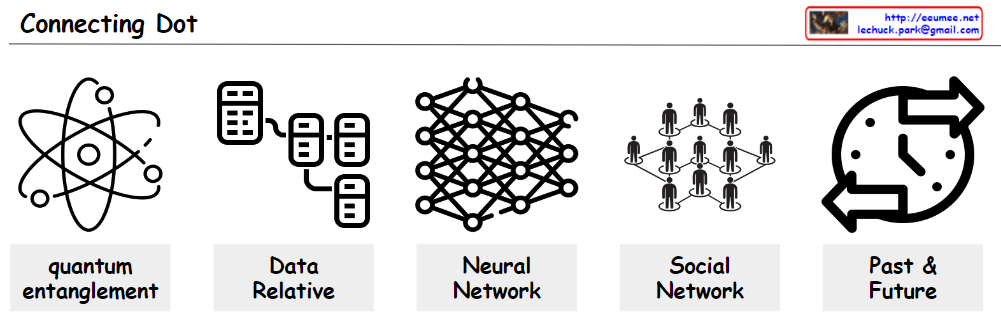
Connecting Dot

From DALL-E with some prompting
The image demonstrates how various distinct concepts are interconnected, emphasizing that all items are linked. ‘Quantum entanglement’ depicts particles whose states are interconnected regardless of physical distance, while ‘Data Relative’ represents the interactions between data. ‘Neural Network’ illustrates an AI model that learns complex data patterns, and ‘Social Network’ symbolizes the web of human relationships. Lastly, ‘Past & Future’ symbolizes the continuous changes occurring over time. All these concepts are interlinked, suggesting that new insights and innovations can arise from understanding these connections.