Overall IP Network

From DALL-E with some prompting
The image is a diagram explaining the overall structure and data flow of an IP network.

Overall IP network: The entire structure of an IP network
Ethernet In the LAN: Ethernet used within the Local Area Network (LAN)
Identification in the internet: Identifying devices on the internet
OSPF short path with IP addresses: Open Shortest Path First (OSPF) routing protocol finds the shortest path using IP addresses
Addressing/Routing to the peer: Assigning addresses and routing to peer devices
BGP to get/share IP (other & me): Border Gateway Protocol (BGP) is used for obtaining and sharing IP addresses between others and oneself
Service Connection: Establishing a service connection
IP address ↔ Domain address: The relationship between IP addresses and domain addresses
DNS Easy to keep an internet address by Domain name: Domain Name System (DNS) makes it easy to maintain an internet address by using domain names
On TCP/UDP: Operating on TCP (Transmission Control Protocol) and UDP (User Datagram Protocol)
The diagram illustrates how data moves within a network. For instance, when a user accesses web services using the HTTP protocol, the DNS translates domain names into IP addresses, and then a service connection is established using the IP address over TCP/UDP protocols. Routing protocols such as OSPF and BGP are used to find the optimal path for data transmission through internal networks and the wider internet, respectively.

Unexplainable

From DALL-E with some prompting
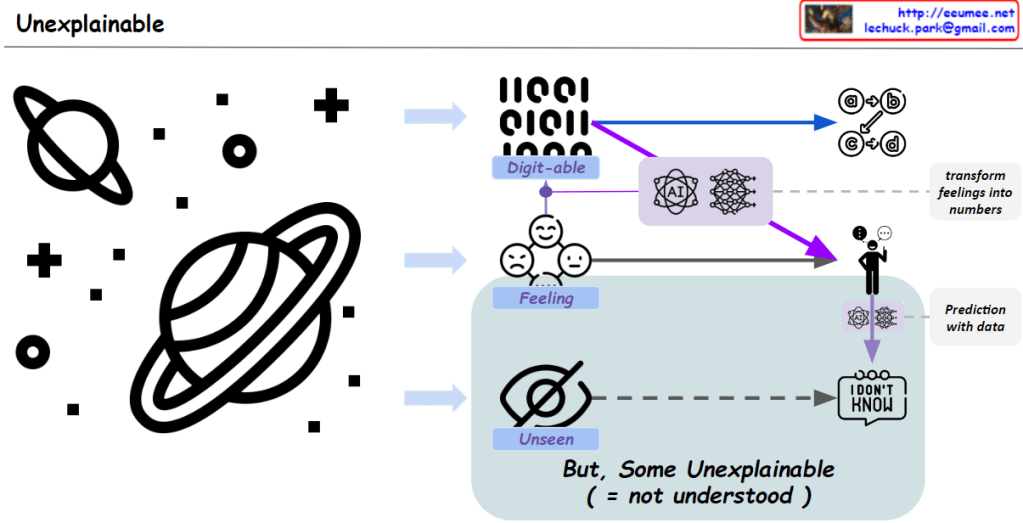
The image intends to explain two critical perspectives of AI/ML. First, it illustrates that while traditionally digitalized data was defined by rules, AI/ML enables us to judge human ‘feelings’ as data based on a more extensive dataset. Second, AI/ML allows for the prediction of the future using data; however, some parts of these significant advancements remain unexplainable and difficult for humans to comprehend fully. This interpretation suggests that while AI aims to quantify and use non-visible elements like emotions for predictions through data standardization and optimized processing, there are aspects that cannot be fully articulated or understood.

Data Standardization

From DALL-E with some prompting
The image emphasizes the importance of data quality in the digital transformation of large-scale operations. By securing “Data Quality” through data standardization, optimized operations based on verified data enable reliable decision-making, monitoring, and optimization. AI-enhanced analysis and optimization accelerate business transformation, drive data-led innovation, and achieve sustainable operation and customer satisfaction.

  1. Data Standardization: Emphasizes the importance of “Data Quality,” indicating that high-quality, standardized data is foundational.
  2. Operation based on verified data/system: Shows the use of verified data to ensure reliable decision-making, monitoring, and optimization, leading to sustainable operations, business intelligence, and customer satisfaction.
  3. Accelerating (AI) digital business transformation: Describes how optimized and customized processing, along with an AI data analysis platform, can accelerate digital transformation. This leads to work automation, user customization, resource optimization, data-driven innovation, AI predictions and analytics, and expanding standardization.

The overall message suggests that standardizing data quality is crucial for building AI systems that can drive digital transformation and improve business operations and customer satisfaction.

On-device AI

From DALL-E with some prompting
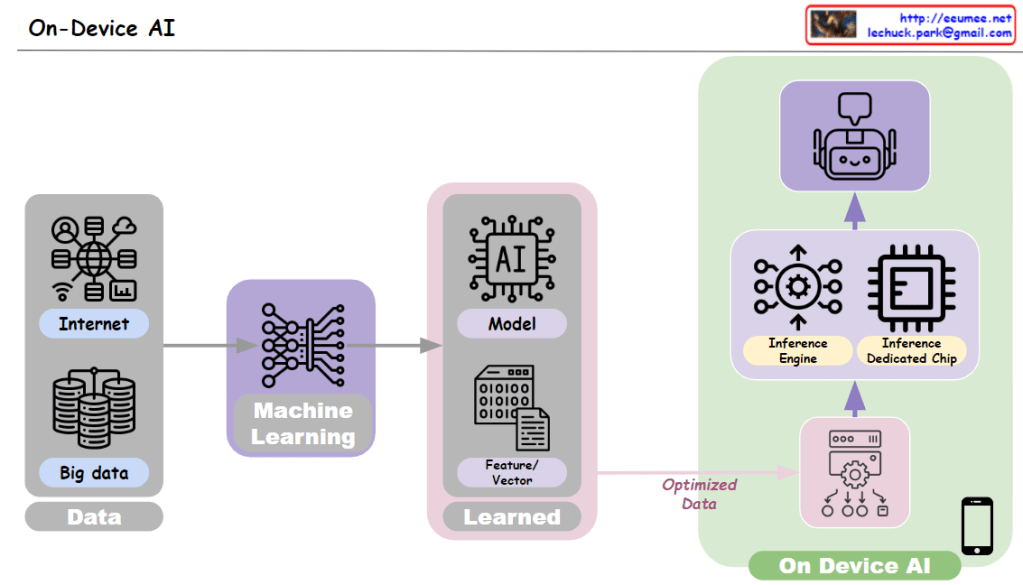
The image is a diagram explaining the concept of “On-Device AI,” which describes the process of operating artificial intelligence within a device. The stages are as follows:

Data: It begins with the collection of data from large databases and the internet, represented by a “Big data” icon and various icons representing different internet services.

Machine Learning: The collected data is used to train models through the machine learning process, depicted by a neural network icon.

Model: The trained model is represented by an AI model icon, including learned features or vectors, indicated by the term “Learned.”

Optimized Data: The trained model is transformed into optimized data for use in on-device AI.

On Device AI: The on-device AI operates using an inference engine and a dedicated inference chip, supporting AI functionalities on the end-user’s device, such as a smartphone, as illustrated by a device icon.

The image represents the flow from data collection, through model training and optimization, to the execution of AI within a device. This process allows AI to function independently within a personal device rather than on cloud servers, providing benefits such as reduced response times and enhanced privacy protection

The time is

From DALL-E with some prompting
The image conveys that innovation is more than just seeking new things; it is achieved through numerous changes performed within a given absolute time. The upper section shows three change attempts within a limited timeframe, suggesting that evolution occurs through these trials and failures. The lower section emphasizes the capability to undertake nine changes in the same time period, highlighting faster and more substantial evolution. It underlines the idea that digital transformation enables more rapid and extensive changes than those made by humans, which is a crucial element in driving innovation and evolution.

DT for new biz

From DALL-E with some prompting
The image is a diagram that illustrates the process of digital transformation for discovering new business opportunities through the digitization of data center operations. The stages included are as follows:

  1. Digitization: The initial step of converting data into digital form.
  2. Digitalization: The process of enhancing operational know-how and creating new value through the experience and analysis with AI, as indicated by the phrases “Exp & Analysis with AI” and “Selling EXP and more!!”.
  3. Digital Transformation: The stage where insights and ideas gained from digitalization are actualized into new business changes.

At the bottom of the diagram, the phrase “All New for DC By Digital(data)” is accompanied by four boxes labeled Design, Deployment, Operating, and Customer. This indicates that all components of business operations are undergoing new changes based on digital data. The “NEW” marker emphasizes the new business opportunities that arise through digital transformation.

The diagram visually explains how transforming existing data into a digital format and using technologies like AI for analysis can improve operational knowledge and, as a result, generate and implement new business ideas. It specifically highlights that digital transformation in data center operations can provide opportunities for uncovering new business ventures.

ARP/RARP

From DALL-E with some prompting
The image focuses on the primary uses and applications of ARP and RARP protocols in a network. ARP (Address Resolution Protocol) is utilized to translate IP addresses into MAC addresses to ensure packets are delivered to the correct destination. This information is stored in the ARP table, facilitating packet forwarding across the Ethernet network. On the other hand, RARP (Reverse Address Resolution Protocol) has largely been superseded by DHCP (Dynamic Host Configuration Protocol). DHCP is commonly used to dynamically assign IP addresses to devices on a network and to automatically configure network setting information.