DC Data Collecting Performance Factors

From Claude with some prompting
This image conceptually illustrates various factors that can affect the performance of DC data collection. The main components include the facility generating the data, the facility network, PLC/DDC converters, an integration network, and the final collection/analysis system.

Factors that can impact data collection performance include the data generation rate, CPU performance, bandwidth limitations of the network medium, network topology, protocols used (such as TCP/IP and SNMP), input/output processing performance, and program logic.

The diagram systematically outlines the overall flow of the DC data collection process and the performance considerations at each stage. It covers elements like the facility, network infrastructure, data conversion, integration, and final collection/analysis.

By mapping out these components and potential bottlenecks, the image can aid in the design and optimization of data collection systems. It provides a comprehensive overview of the elements that need to be accounted for to ensure efficient data gathering performance.


Memory Control Unit

From Claude with some prompting
The image explains the memory management and access approaches in computing systems. Fundamentally, for any memory management approach, whether hardware or software, there needs to be a defined unit of operation.

At the hardware level, the physical Memory Access Unit is determined by the CPU’s bit width (32-bit or 64-bit).

At the software/operating system level, the Paging Unit, typically 4KB, is used for virtual memory management through the paging mechanism.

Building upon these foundational units, additional memory management techniques are employed to handle memory regions of varying sizes:

  • Smaller units: Byte-addressable memory, bit operations, etc.
  • Larger units: SLAB allocation, Buddy System, etc.

Essentially, the existence of well-defined units at the hardware and logical/software layers is a prerequisite that enables comprehensive and scalable memory management. These units serve as the basis for memory control mechanisms across different levels of abstraction and size requirements in computing systems.

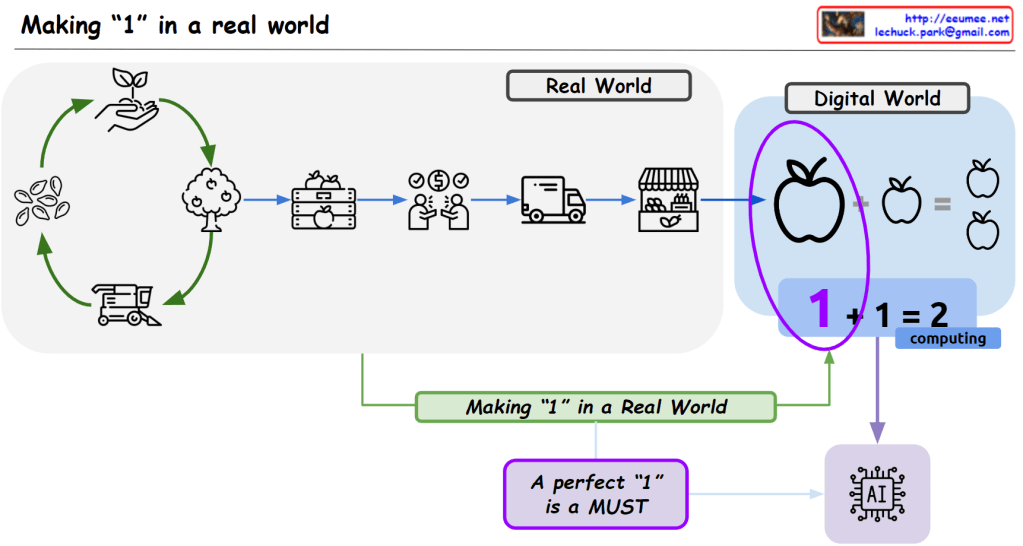
MaKING “1”

From Claude with some prompting
This image emphasizes the crucial importance of obtaining high-quality data from the real world for the advancement of the digital world, particularly artificial intelligence (AI).

The real-world section depicts the complex series of steps required to produce a “perfect 1,” or a product of excellent quality (e.g., an apple), including growing trees, harvesting, transportation, and selling.

In contrast, the digital world represents this intricate process through a simple mathematical computation (1 + 1 = 2). However, the image conveys that securing flawless data from the real world is an extremely important and arduous process for AI to develop and improve.

In essence, the image highlights that the complex process of extracting high-quality data from the physical realm is essential for enhancing AI performance. It serves as a reminder that this crucial aspect should not be overlooked or underestimated.

The overall message is that for AI to advance in the digital world, obtaining pristine data from the real world through an intricate series of steps is an indispensable and challenging requirement that must be prioritized.

MSS

From Claude with some prompting
This image explains the concept of Maximum Segment Size (MSS) in computer networking. MSS refers to the maximum size of the data payload that can be transmitted in a single TCP segment. The main points illustrated are:

  1. The TCP header and IP header each have a fixed size of 20 bytes.
  2. MSS is defined as the maximum size of the TCP payload within a single packet.
  3. MSS is used for TCP communication to control congestion and prevent large TCP packets at the application level.
  4. This is contrasted with the Maximum Transmission Unit (MTU) which limits packet size at the physical layer, such as in Ethernet switches.
  5. The image depicts a concept called “One Time Transfer Data Size” with 1 MTU packet being sent, followed by acknowledgment (3 DUP ACK), and then a timeout period.

The overall purpose of MSS is to manage and optimize data transmission by limiting the segment size, thereby facilitating better congestion control and efficient network performance.

AI vs Human

From Claude with some prompting
Sure, here’s an explanation of the image in English, with a detailed description of the graph’s contents:

This image contrasts the capabilities of rule-based human logic and data-driven AI. The graph shows two curves:

  1. The blue curve represents rule-based human logic, which is stated to be “Always 100%” accurate. However, the curve flattens out, indicating that as data volume increases, human logic reaches its limits and analysis stagnates.
  2. The purple curve represents data-driven AI output, which starts at 0% accuracy but increases “dramatically based on more data” as computing power increases. The curve asymptotically approaches but never quite reaches 100%, with values like 99.99%, 99.999% mentioned.

The key points made are:

  • Rule-based human logic is 100% accurate but limited in its ability to process excessive data volumes.
  • Data-driven AI has lower initial accuracy but can approach near-perfect accuracy (99.99%+) by analyzing vast amounts of data powered by immense computing capabilities.
  • As more data and computing power become available, the effectiveness of data-driven AI surpasses the limits of human logic analysis.

So the image suggests that while human logic is perfect within its constraints, the future lies with data-driven AI systems that can harness massive data and computing resources to deliver extremely high accuracy, potentially exceeding human capabilities.