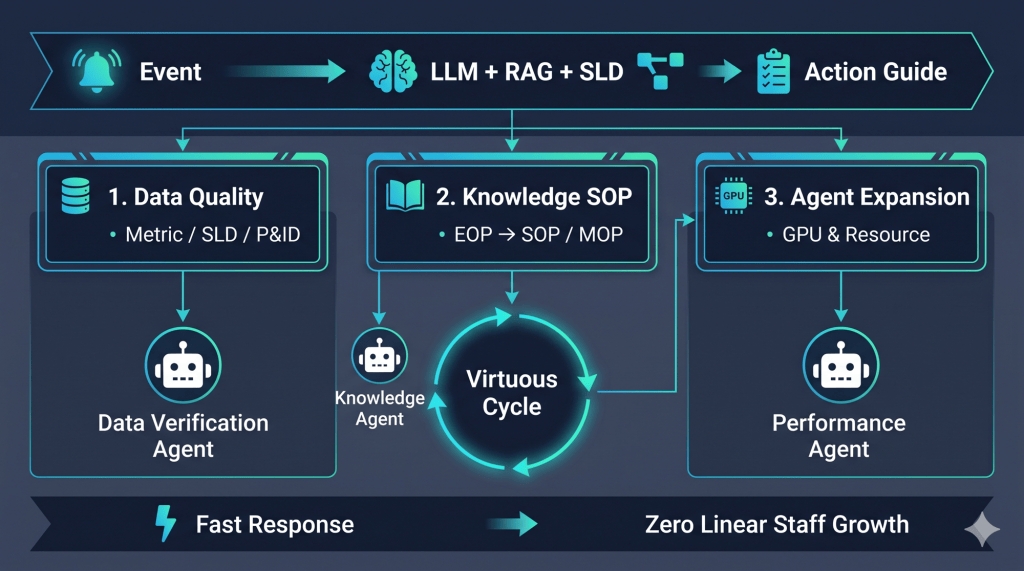
This image is a structured architectural infographic that outlines a complete AI-driven incident response system, its core development challenges, and its ultimate operational impact. Set against a dark navy background with glowing cyan and teal highlights, the diagram is organized into three horizontal tiers that guide the viewer from top to bottom.
- Top Tier (The Incident Response Pipeline): A horizontal banner at the top illustrates the primary workflow. It begins on the left with a glowing bell icon labeled “Event”, representing an incoming system alert. An arrow points to the central processing unit, featuring a brain icon and a schematic diagram labeled “LLM + RAG + SLD”. This shows that the AI combines a Large Language Model, Retrieval-Augmented Generation, and Single Line Diagrams to analyze the issue. A final arrow leads to a clipboard icon labeled “Action Guide”, indicating the immediate generation of troubleshooting instructions.
- Middle Tier (The Three Core Pillars and Specialized Agents): Branching down from the top pipeline are three distinct columns, each representing a foundational requirement paired with a dedicated AI robot icon below it:
- Column 1 (Left): A box with a database icon is titled “1. Data Quality” and lists “Metric / SLD / P&ID” as key inputs. An arrow points down to a robot icon labeled “Data Verification Agent”, showing that an AI agent is responsible for monitoring and validating the accuracy of design-stage data.
- Column 2 (Center): A box with a book icon is titled “2. Knowledge SOP” and notes the progression “EOP → SOP / MOP” (expanding from Emergency Operating Procedures to Standard and Maintenance Operating Procedures). Directly beneath it, a smaller robot icon labeled “Knowledge Agent” works alongside a glowing circular arrow loop titled “Virtuous Cycle”. This loop connects upward into the third column, visually emphasizing that as agents strengthen the data and knowledge foundations, those improved foundations directly fuel the further expansion of the agents.
- Column 3 (Right): A box with a microchip icon is titled “3. Agent Expansion” and highlights “GPU & Resource”. Below it sits a robot icon labeled “Performance Agent”, which calculates the optimal hardware and model standards required to scale the system across all operations.
- Bottom Tier (The Ultimate Business Impact): At the very bottom, a dark ribbon banner summarizes the final outcome of this architecture. On the left, a lightning bolt icon is paired with “Fast Response”, which points via an arrow to “Zero Linear Staff Growth” on the right. This highlights that the system drastically compresses incident response times while allowing new data centers to be operated without a proportional increase in human staff.
This architectural infographic illustrates how an AI incident response system processes alerts using LLMs, RAG, and system diagrams to automatically generate action guides. To make this system faster and more reliable, it relies on three foundational pillars—Data Quality, Knowledge Standardization, and Agent Expansion—each managed by its own specialized AI Agent (Data Verification, Knowledge, and Performance Agents). Together, they form a virtuous cycle that continuously strengthens operational foundations, ultimately achieving rapid incident resolution and enabling scalable facility management without needing proportional increases in staffing.
#AIAgent #IncidentResponse #AIOps #SystemArchitecture #LLM #RAG #DataQuality #ProcessAutomation #VirtuousCycle #ScalableOperations #ITInfrastructure #TechInfographic
With Gemini


