Framework Overview
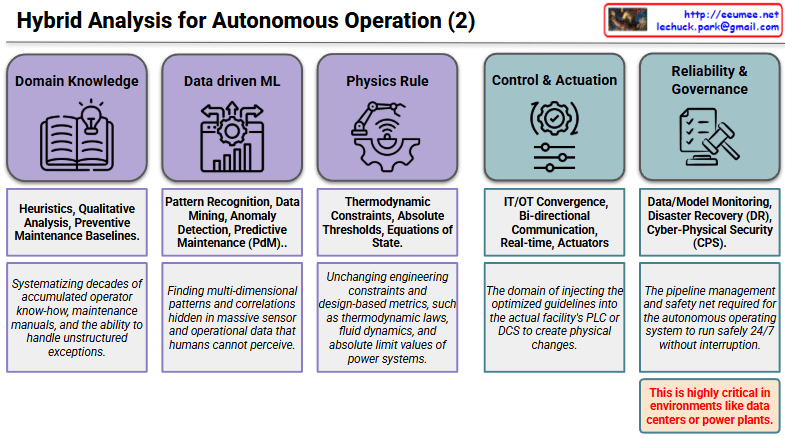
The image illustrates a “Hybrid Analysis” framework designed to achieve true Autonomous Operation. It outlines five core pillars required to build a reliable, self-driving system for high-stakes environments like AI data centers or power plants. The architecture combines three analytical foundations (purple) with two execution and safety layers (teal).
1. The Analytical Foundation (The Hybrid Triad)
This section forms the “brain” of the autonomous system, blending human expertise, artificial intelligence, and absolute scientific laws.
- Domain Knowledge (Human Experience):
- Core: Systematized heuristics, decades of operator know-how, and maintenance manuals.
- Role: Provides qualitative analysis, establishes preventive maintenance baselines, and handles unstructured exceptions that algorithms might miss.
- Data-driven ML (Artificial Intelligence):
- Core: Pattern recognition, anomaly detection, and Predictive Maintenance (PdM).
- Role: Analyzes massive volumes of multi-dimensional sensor and operational data to find hidden correlations and risks that are imperceptible to human operators.
- Physics Rule (Engineering Guardrails):
- Core: Thermodynamic constraints, equations of state, fluid dynamics, and absolute power limits.
- Role: Acts as the ultimate boundary. It ensures that the operational commands generated by ML models are physically possible and safe, preventing the AI from violating unchanging engineering laws.
2. Execution and Safety Nets
This section translates the insights from the analytical triad into real-world, physical changes while guaranteeing system stability.
- Control & Actuation (The Hands):
- Core: IT/OT (Information Technology / Operational Technology) convergence and real-time bi-directional communication.
- Role: The domain of injecting the optimized setpoints and guidelines directly into the facility’s PLC (Programmable Logic Controller) or DCS (Distributed Control System) to drive physical actuators.
- Reliability & Governance (The Shield):
- Core: Data/Model monitoring, Disaster Recovery (DR), and Cyber-Physical Security (CPS).
- Role: The overarching safety net and pipeline management required to ensure the autonomous operating system runs securely and continuously, 24/7, without interruption.
💡 Key Takeaway
As emphasized by the red text at the bottom, this multi-layered approach is highly critical in environments like data centers or power plants. Relying solely on data-driven ML is too risky for high-density infrastructure; true autonomous stability is only achieved when AI is anchored by human domain expertise and strict physical laws.
#AutonomousOperations #AIOps #HybridAnalysis #PredictiveMaintenance #ITOTConvergence #CyberPhysicalSystems #MissionCritical #TechVisualization #EngineeringInfographic
With Gemini

 Lechuck Park