Hybrid Analysis for Autonomous Operation (1)
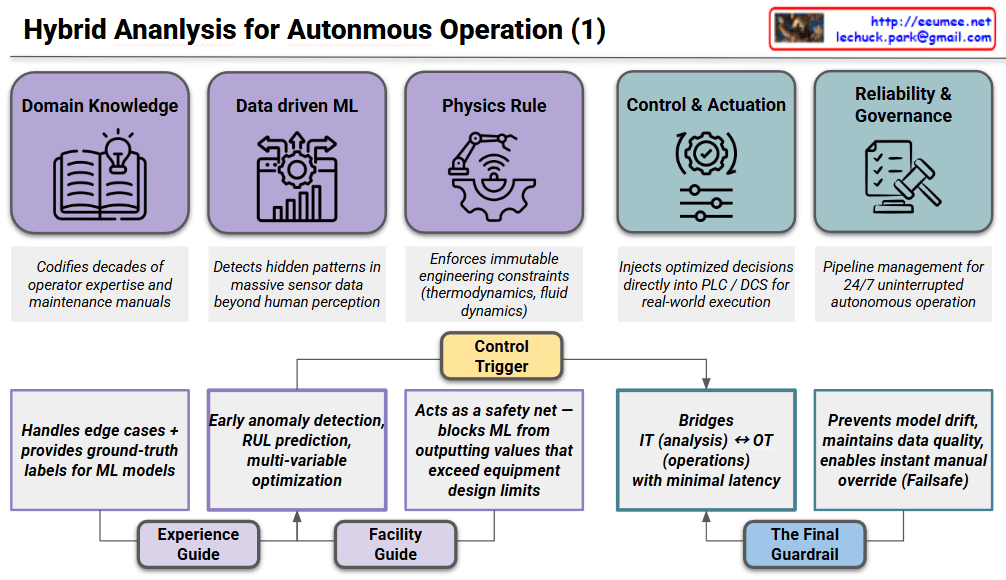
This framework illustrates a holistic approach to autonomous systems, integrating human expertise, physical laws, and AI to ensure safe and efficient real-world execution.
1. Five Core Modules (Top Layer)
- Domain Knowledge: Codifies decades of operator expertise and maintenance manuals into digital logic.
- Data-driven ML: Detects hidden patterns in massive sensor data that go beyond human perception.
- Physics Rule: Enforces immutable engineering constraints (such as thermodynamics or fluid dynamics) to ground the AI in reality.
- Control & Actuation: Injects optimized decisions directly into PLC / DCS (Distributed Control Systems) for real-world execution.
- Reliability & Governance: Manages the entire pipeline to ensure 24/7 uninterrupted autonomous operation.
2. Integrated Value Drivers (Bottom Layer)
These modules work in synergy to create three essential “Guides” for the system:
- Experience Guide: Combines domain expertise with ML to handle edge cases and provide high-quality ground-truth labels for model training.
- Facility Guide: Acts as a safety net by combining ML predictions with physical rules. It predicts Remaining Useful Life (RUL) while blocking outputs that exceed equipment design limits.
- The Final Guardrail: Bridges the gap between IT (Analysis) and OT (Operations). It prevents model drift and ensures an instant manual override (Failsafe) is always available.
3. Key Takeaways
The architecture centers on a “Control Trigger” that converts digital insights into physical action. By anchoring machine learning with physical laws and human experience, the system achieves a level of reliability required for mission-critical environments like data centers or industrial plants.
#AutonomousOperations #IndustrialAI #MachineLearning #SmartFactory #DataCenterManagement #PredictiveMaintenance #ControlSystems #OTSecurity #AIOps #HybridAI
With Gemini

 Lechuck Park