Operation with AI

From Claude with some prompting
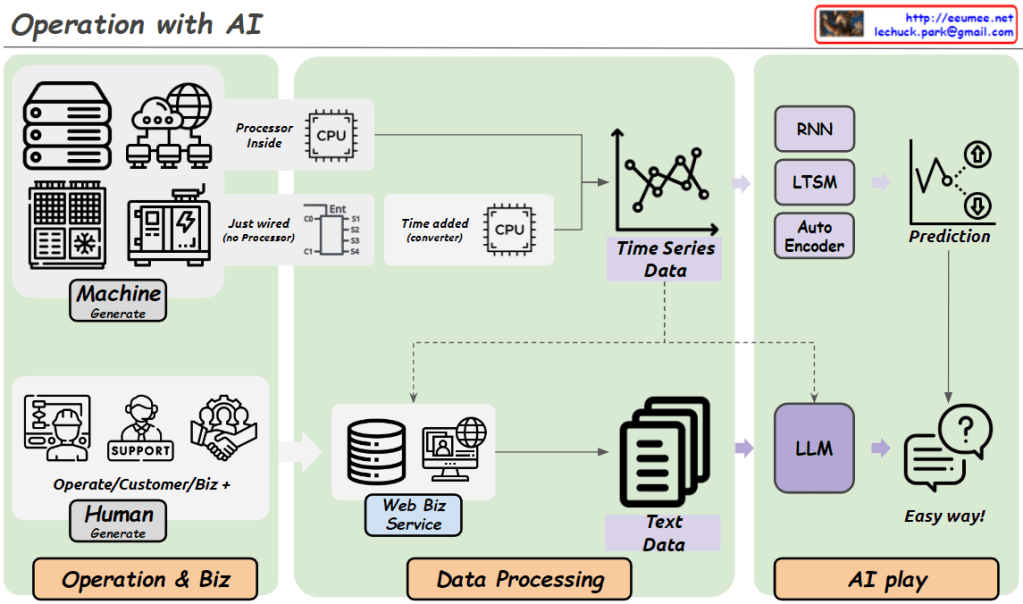
This diagram illustrates an integrated approach to modern operational management. The system is divided into three main components: data generation, data processing, and AI application.

The Operation & Biz section shows two primary data sources. First, there’s metric data automatically generated by machines such as servers and network equipment. Second, there’s textual data created by human operators and customer service representatives, primarily through web portals.

These collected data streams then move to the central Data Processing stage. Here, metric data is processed through CPUs and converted into time series data, while textual data is structured via web business services.

Finally, in the AI play stage, different AI models are applied based on data types. For time series data, models like RNN, LSTM, and Auto Encoder are used for predictive analytics. Textual data is processed through a Large Language Model (LLM) to extract insights.

This integrated system effectively utilizes data from various sources to improve operational efficiency, support data-driven decision-making, and enable advanced analysis and prediction through AI. Ultimately, it facilitates easy and effective management even in complex operational environments.

The image emphasizes how different types of data – machine-generated metrics and human-generated text – are processed and analyzed using appropriate AI techniques, all from the perspective of operational management.

TSDB flow for alerts

From Claude with some prompting
This image illustrates the flow and process of a Time Series Database (TSDB) system. The main components are:

Time Series Data: This is the input data stream containing time-stamped values from various sources or metrics.

Counting: It performs change detection on the incoming time series data to capture relevant events or anomalies.

Delta Value: The difference or change observed in the current value compared to a previous reference point, denoted as NOW() – previous value.

Time-series summary Value: Various summary statistics like MAX, MIN, and other aggregations are computed over the time window.

Threshold Checking: The delta values and other aggregations are evaluated against predefined thresholds for anomaly detection.

Alert: If any threshold conditions are violated, an alert is triggered to notify the monitoring system or personnel.

The process also considers correlations with other metrics for improved anomaly detection context. Additionally, AI-based techniques can derive new metrics from the existing data for enhanced monitoring capabilities.

In summary, this flow diagram represents the core functionality of a time series database focused on capturing, analyzing, and alerting on anomalies or deviations from expected patterns in real-time data streams.